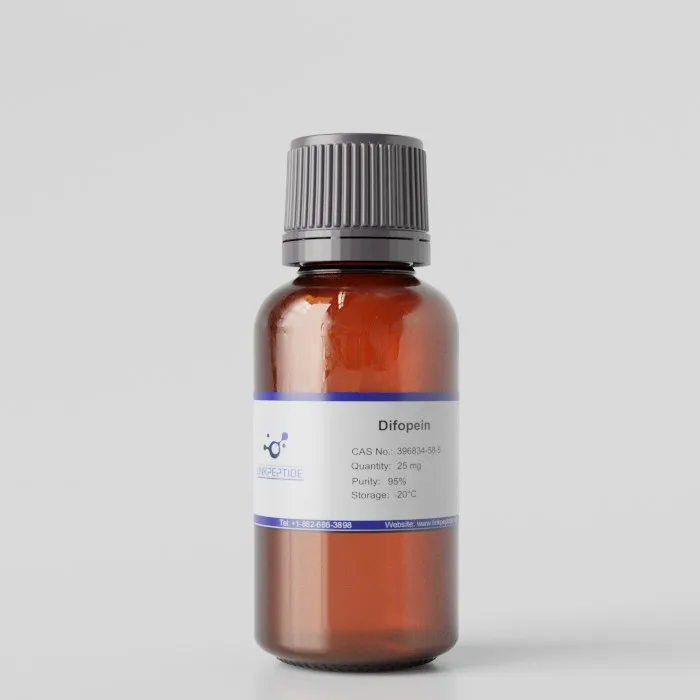
Product Name: Difopein
CAS No: 396834-58-5
Purity: 95%
Molar Mass: 6387.2
Chemical Formula: C273H424N76O89S6
Storage: Store at -20??
Sequence: SADGAPHCVPRDLSWLDLEANMCLPGAAGLDSADGAPHCVPRDLSWLDLEANMCLPGAAGLE
Target: 14.3.3 proteins
Application: Difopein is a synthetic peptide inhibitor that targets dimerization of the 14-3-3 protein, a key regulator of many cellular processes, including signal transduction, apoptosis, and cell cycle control. By preventing 14-3-3 dimers from interacting with their binding partners, Difopein disrupts 14-3-3-mediated signaling pathways. This peptide is extensively used in pharmaceutical and biochemical research to investigate the role of 14-3-3 in various diseases, such as cancer, neurodegenerative disorders, and metabolic diseases. Difopein's ability to modulate 14-3-3 functions makes it a crucial tool for studying cellular regulatory mechanisms and developing therapeutic strategies.
Current Research:
Difopein, a dimeric peptide inhibitor, has emerged as a pivotal tool in molecular biology for elucidating the functions of 14-3-3 proteins. By competitively binding to the ligand-binding grooves of 14-3-3 dimers, difopein effectively disrupts their interactions with target proteins, thereby modulating various cellular processes.
Recent studies have leveraged difopein to investigate the role of 14-3-3 proteins in apoptosis, particularly within glioma cells. Overexpression of difopein in these cells has been shown to inhibit proliferation and induce apoptosis, highlighting the potential of 14-3-3
In neuropharmacology, difopein has been instrumental in exploring the synaptic localization of N-methyl-D-aspartate receptors (NMDARs). Expression of difopein in primary cortical and hippocampal neurons resulted in a decreased number of synaptic puncta containing NMDAR subunits, suggesting that 14-3-3 proteins facilitate the synaptic presence of these receptors.
Further research has utilized difopein to examine the regulation of ion channels by 14-3-3 proteins. For instance, suppression of endogenous 14-3-3 function with difopein in human cell lines led to an upregulation of Eag1 potassium channel protein levels, implicating 14-3-3 proteins in the proteostasis of Eag1 through mechanisms involving cullin 7-mediated degradation.
Additionally, difopein has been employed to study the regulation of the human cardiac sodium channel Na_v1.5. However, findings indicate that 14-3-3 proteins may not significantly influence Na_v1.5 function, as overexpression of difopein did not affect current density, gating kinetics, or channel expression, suggesting a dispensable role for 14-3-3 in this context.
In summary, difopein serves as a critical molecular tool for dissecting the diverse roles of 14-3-3 proteins across various biological systems. Its application has provided valuable insights into cellular processes such as apoptosis, synaptic receptor localization, and ion channel regulation, thereby advancing our understanding of 14-3-3-mediated mechanisms and their potential as therapeutic targets.
Get a Quote
 LinkPeptide