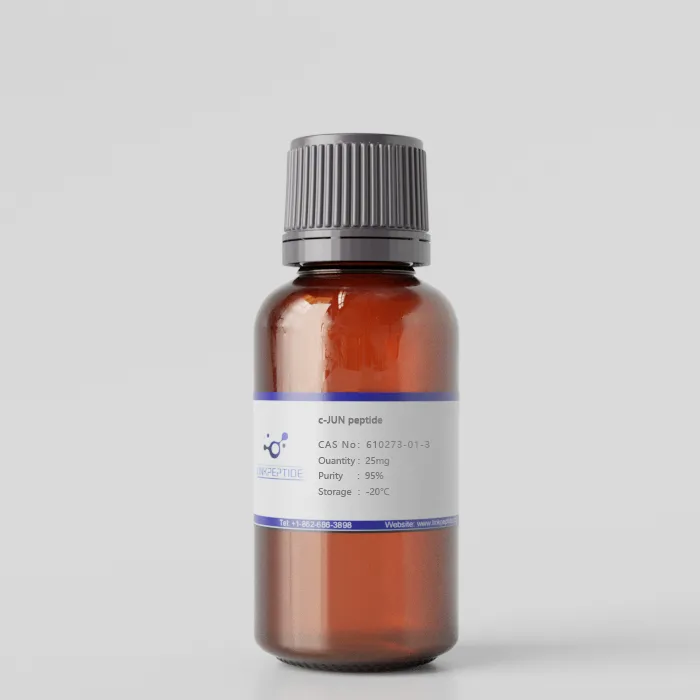
Product Name:c-JUN peptide
Synonyms:AP-1, AP1, c-Jun, AP 1, c Jun, cJun
CAS No:610273-01-3
Purity:95%
Molar Mass:2745.3
Chemical Formula:C121H210N36O34S
Storage:Store at -20 degrees Celsius
Sequence:ILKQSMTLNLADPVGSLKPHLRAKN
Application:
c-JUN Peptide is a synthetic peptide derived from the c-JUN protein, a key component of the Activator Protein-1 (AP-1) transcription factor complex. c-JUN is involved in regulating gene expression in response to various stimuli, including stress, cytokines, growth factors, and bacterial and viral infections. This peptide is often used in research to study the binding interactions between c-JUN and DNA or other proteins, as well as to investigate the role of c-JUN in cellular processes such as proliferation, differentiation, and apoptosis. The c-JUN peptide is particularly valuable in exploring the mechanisms of gene regulation and the signaling pathways involved in cancer development, neurodegenerative diseases, and other conditions where AP-1 activity is implicated. By utilizing this peptide, researchers can gain insights into the modulation of c-JUN activity and its potential as a therapeutic target.
Current Research:
The c-JUN peptide (CAS: 610273-01-3) is a synthetic, cell-permeable peptide comprising residues 33 to 57 of the δ domain of human c-Jun. This peptide functions as an inhibitor of the c-JUN–c-Jun N-terminal kinase (JNK) interaction, effectively disrupting their complex formation. By inhibiting this interaction, the c-JUN peptide prevents serum-induced phosphorylation of c-Jun, leading to the upregulation of p21^Cip1/Waf1 and modulation of inflammatory gene expression. Notably, it has been shown to specifically induce apoptosis in HeLa tumor cells.
Biological Activity
The c-JUN peptide disrupts the c-JUN–JNK complex, inhibiting the phosphorylation of c-Jun, a critical transcription factor involved in cellular proliferation, differentiation, and apoptosis. This inhibition results in the upregulation of p21^Cip1/Waf1, a cyclin-dependent kinase inhibitor that plays a pivotal role in cell cycle regulation. Additionally, the peptide modulates the expression of specific inflammatory genes, highlighting its potential in regulating inflammatory responses.
Applications in Research
Due to its ability to modulate key signaling pathways, the c-JUN peptide is extensively utilized in research to:
Investigate the role of c-Jun and JNK interactions in various cellular processes.
Explore mechanisms underlying apoptosis, particularly in cancer cell lines such as HeLa cells.
Study the regulation of inflammatory gene expression and potential therapeutic targets for inflammatory diseases.
Handling and Storage
For optimal stability, the c-JUN peptide should be stored at -20°C. It is soluble in water up to 1 mg/mL, facilitating its use in various experimental setups.
Conclusion
The c-JUN peptide serves as a valuable tool in molecular biology and biomedical research, offering insights into the modulation of apoptosis, cell cycle regulation, and inflammatory responses through the inhibition of c-JUN–JNK interactions.
Reference:
Get a Quote
 LinkPeptide