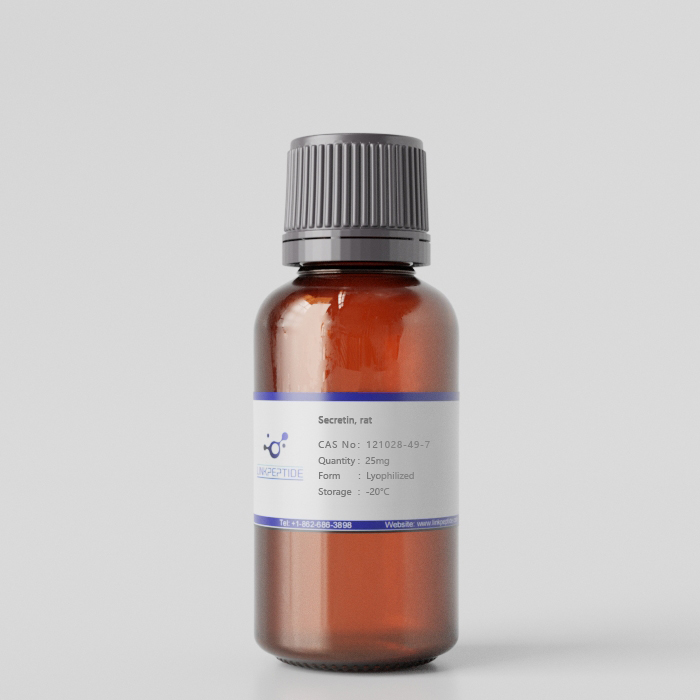
Product Name: Secretin, rat
Sequence One Letter Code: HSDGTFTSELSRLQDSARLQRLLQGLV-NH2
Sequence Three Letter Code: H-His-Ser-Asp-Gly-Thr-Phe-Thr-Ser-Glu-Leu-Ser-Arg-Leu-Gln-Asp-Ser-Ala-Arg-Leu-Gln-Arg-Leu-Leu-Gln-Gly-Leu-Val-NH2
Cas No: 121028-49-7
Chemical Formula:C129H216N42O42
Molecular Weight: 3027.6
Purity: 95%
Form: Lyophilized
Storage Conditions: - 20 °C
Research Area: Endocrinology Disease Research
SMILES: C[C@H]([C@@H](C(=O)N[C@@H](CC1=CC=CC=C1)C(=O)N[C@@H]([C@@H](C)O)C(=O)N[C@@H](CO)C(=O)N[C@@H](CCC(=O)O)C(=O)N[C@@H](CC(C)C)C(=O)N[C@@H](CO)C(=O)N[C@@H](CCCNC(=N)N)C(=O)N[C@@H](CC(C)C)C(=O)N[C@@H](CCC(=O)N)C(=O)N[C@@H](CC(=O)O)C(=O)N[C@@H](CO)C(=O)N[C@@H](C)C(=O)N[C@@H](CCCNC(=N)N)C(=O)N[C@@H](CC(C)C)C(=O)N[C@@H](CCC(=O)N)C(=O)N[C@@H](CCCNC(=N)N)C(=O)N[C@@H](CC(C)C)C(=O)N[C@@H](CC(C)C)C(=O)N[C@@H](CCC(=O)N)C(=O)NCC(=O)N[C@@H](CC(C)C)C(=O)N[C@@H](C(C)C)C(=O)N)NC(=O)CNC(=O)[C@H](CC(=O)O)NC(=O)[C@H](CO)NC(=O)[C@H](CC2=CNC=N2)N)O
IUPAC: (4S)-5-[[(2S)-1-[[(2S)-1-[[(2S)-1-[[(2S)-1-[[(2S)-5-amino-1-[[(2S)-1-[[(2S)-1-[[(2S)-1-[[(2S)-1-[[(2S)-1-[[(2S)-5-amino-1-[[(2S)-1-[[(2S)-1-[[(2S)-1-[[(2S)-5-amino-1-[[2-[[(2S)-1-[[(2S)-1-amino-3-methyl-1-oxobutan-2-yl]amino]-4-methyl-1-oxopentan-2-yl]amino]-2-oxoethyl]amino]-1,5-dioxopentan-2-yl]amino]-4-methyl-1-oxopentan-2-yl]amino]-4-methyl-1-oxopentan-2-yl]amino]-5-carbamimidamido-1-oxopentan-2-yl]amino]-1,5-dioxopentan-2-yl]amino]-4-methyl-1-oxopentan-2-yl]amino]-5-carbamimidamido-1-oxopentan-2-yl]amino]-1-oxopropan-2-yl]amino]-3-hydroxy-1-oxopropan-2-yl]amino]-3-carboxy-1-oxopropan-2-yl]amino]-1,5-dioxopentan-2-yl]amino]-4-methyl-1-oxopentan-2-yl]amino]-5-carbamimidamido-1-oxopentan-2-yl]amino]-3-hydroxy-1-oxopropan-2-yl]amino]-4-methyl-1-oxopentan-2-yl]amino]-4-[[(2S)-2-[[(2S,3R)-2-[[(2S)-2-[[(2S,3R)-2-[[2-[[(2S)-2-[[(2S)-2-[[(2S)-2-amino-3-(1H-imidazol-4-yl)propanoyl]amino]-3-hydroxypropanoyl]amino]-3-carboxypropanoyl]amino]acetyl]amino]-3-hydroxybutanoyl]amino]-3-phenylpropanoyl]amino]-3-hydroxybutanoyl]amino]-3-hydroxypropanoyl]amino]-5-oxopentanoic acid
INCHIKEY: LKHWQEXKRMDFFJ-NEMWHCQRSA-N
INCHI:
InChI=1S/C129H216N42O42/c1-58(2)40-78(119(206)170-99(64(13)14)102(134)189)149-94(181)51-145-105(192)74(29-33-91(131)178)153-113(200)81(43-61(7)8)161-116(203)82(44-62(9)10)159-108(195)72(27-22-38-143-128(137)138)151-110(197)75(30-34-92(132)179)154-114(201)79(41-59(3)4)157-107(194)71(26-21-37-142-127(135)136)150-103(190)65(15)148-121(208)87(53-172)166-118(205)86(49-98(187)188)163-111(198)76(31-35-93(133)180)155-115(202)80(42-60(5)6)158-109(196)73(28-23-39-144-129(139)140)152-122(209)89(55-174)167-117(204)83(45-63(11)12)160-112(199)77(32-36-96(183)184)156-123(210)90(56-175)168-126(213)101(67(17)177)171-120(207)84(46-68-24-19-18-20-25-68)164-125(212)100(66(16)176)169-95(182)52-146-106(193)85(48-97(185)186)162-124(211)88(54-173)165-104(191)70(130)47-69-50-141-57-147-69/h18-20,24-25,50,57-67,70-90,99-101,172-177H,21-23,26-49,51-56,130H2,1-17H3,(H2,131,178)(H2,132,179)(H2,133,180)(H2,134,189)(H,141,147)(H,145,192)(H,146,193)(H,148,208)(H,149,181)(H,150,190)(H,151,197)(H,152,209)(H,153,200)(H,154,201)(H,155,202)(H,156,210)(H,157,194)(H,158,196)(H,159,195)(H,160,199)(H,161,203)(H,162,211)(H,163,198)(H,164,212)(H,165,191)(H,166,205)(H,167,204)(H,168,213)(H,169,182)(H,170,206)(H,171,207)(H,183,184)(H,185,186)(H,187,188)(H4,135,136,142)(H4,137,138,143)(H4,139,140,144)/t65-,66+,67+,70-,71-,72-,73-,74-,75-,76-,77-,78-,79-,80-,81-,82-,83-,84-,85-,86-,87-,88-,89-,90-,99-,100-,101-/m0/s1
Source / Species: rat
Conjugation: Unconjugated
Code Nacres: NA.26
Application: Secretin, rat is a synthetic 27-residue peptide hormone that reproduces the endogenous rat secretin sequence, differing from the porcine form by a Gln¹⁴ substitution. Secretin is a key regulator of digestive physiology, stimulating pancreatic ductal bicarbonate secretion and modulating biliary output in response to luminal acidity. In addition to suppressing gastric acid production, secretin influences gastric motility, renal electrolyte handling, and central nervous system signaling. Because of its species-specific sequence, rat secretin is particularly suited for rodent in vivo and ex vivo experimental models. The peptide is widely employed to study secretin receptor activation, GPCR-mediated cAMP signaling, and gastrointestinal hormone cross-talk. It also supports investigations into neuroendocrine regulation and gut–brain axis communication, providing a precise tool for mechanistic studies of digestive and systemic hormone signaling.
Current Research: Secretin, Rat (27 aa) Secretin, Rat is a synthetic 27–amino acid peptide corresponding to the endogenous rat secretin sequence, differing from the porcine form by a Gln¹⁴ substitution. As a member of the secretin/glucagon family of class B G protein–coupled receptor (GPCR) ligands, secretin plays a central role in coordinating digestive physiology, electrolyte transport, and neuroendocrine signaling. The rat-specific sequence ensures accurate pharmacological activity in rodent experimental systems, where even single-residue differences can influence receptor binding affinity and signaling efficacy. Secretin is released from S cells in the duodenal mucosa in response to luminal acidification. Upon binding to the Secretin Receptor (SCTR), a G_s-coupled GPCR expressed in pancreatic ductal epithelial cells, hepatocytes, gastric mucosa, and select central nervous system regions, it stimulates adenylyl cyclase and elevates intracellular cAMP. This activates PKA-dependent pathways that regulate chloride and bicarbonate transport, particularly through CFTR channels and Cl⁻/HCO₃⁻ exchangers. The resulting bicarbonate-rich secretion neutralizes gastric acid entering the small intestine, providing optimal pH conditions for digestive enzyme activity. Beyond its classical exocrine pancreatic role, rat secretin suppresses gastric acid secretion and modulates gastric motility. These effects involve both direct endocrine signaling and indirect neural pathways, integrating digestive timing and feedback mechanisms. Current research continues to explore secretin’s interaction with other gastrointestinal hormones, including cholecystokinin (CCK), gastrin, and GLP-1, highlighting complex hormonal cross-talk within the enteroendocrine system. Recent studies have also expanded the physiological scope of secretin signaling into the gut–brain axis. SCTR expression in brain regions associated with appetite regulation and stress responses has prompted investigations into central secretin signaling, neuronal cAMP activation, and vagal reflex modulation. Rodent models are particularly valuable for dissecting these neuroendocrine pathways, making rat secretin an essential reagent for mechanistic studies. In experimental settings, Rat Secretin is widely used in: cAMP accumulation assays Pancreatic duct secretion and ion transport studies Gastrointestinal motility models Rodent in vivo endocrine physiology Neuroendocrine and behavioral research Because species-specific ligand–receptor interactions can influence pharmacodynamics, the rat sequence ensures reliable activation in rodent tissues and cell lines. The peptide supports investigations into digestive regulation, CFTR-associated pathophysiology, pancreatitis models, and systemic fluid homeostasis. Overall, Secretin, Rat serves as a precise tool for examining SCTR-mediated GPCR signaling, epithelial transport regulation, and neuroendocrine communication in rodent systems. Its defined primary structure and biological fidelity make it a foundational reagent in gastrointestinal and metabolic research.
Get a Quote
 LinkPeptide