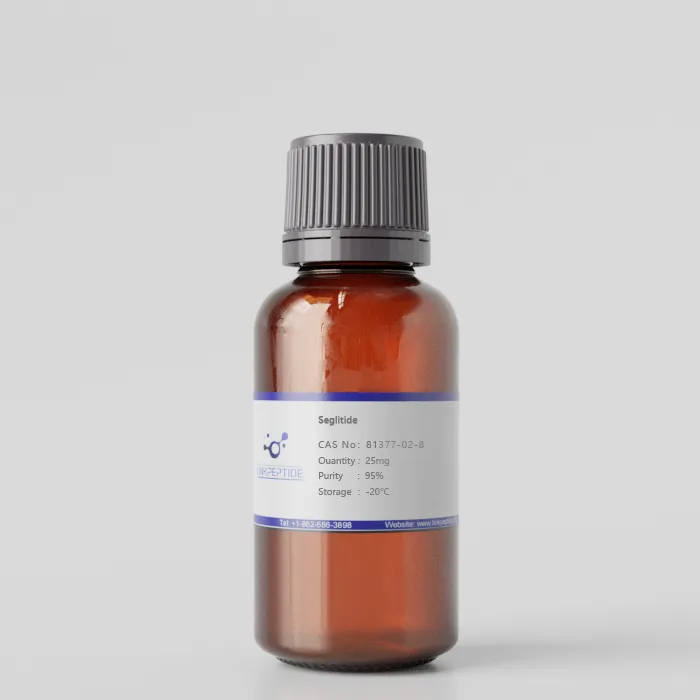
Product Name:Seglitide
Synonyms:MK 678
CAS No:81377-02-8
Purity:95%
Molar Mass:809
Chemical Formula:C44H56N8O7
Storage:Store at -20 degrees Celsius
Sequence:AYWKVF
Application:
Seglitide is a potent somatostatin analog known for its inhibitory effects on the secretion of various hormones, including growth hormone and insulin. This synthetic peptide is valuable in research focused on neuroendocrine regulation, particularly in studying the role of somatostatin receptors in controlling endocrine and exocrine functions. Seglitide is also utilized in investigations related to gastrointestinal disorders and neuroendocrine tumors. With its high receptor affinity and prolonged action, Seglitide provides reliable and reproducible results, making it an essential tool for researchers exploring the therapeutic potential of somatostatin analogs in both clinical and experimental settings.
Current Research:
Seglitide, also known as MK-678, is a synthetic cyclic hexapeptide analog of somatostatin-14, designed to mimic the inhibitory effects of the natural hormone somatostatin. It functions primarily as a potent agonist of the somatostatin receptor subtype 2 (SSTR2), with high affinity, and exhibits varying degrees of activity across other somatostatin receptor subtypes.
Chemical Structure and Properties
The molecular structure of seglitide is characterized by a cyclic configuration, contributing to its stability and receptor-binding affinity. Its molecular formula is C₃₈H₄₉N₉O₉S₂, with a molecular weight of approximately 843.98 g/mol. The cyclic nature of seglitide enhances its resistance to enzymatic degradation, prolonging its biological activity.
Pharmacological Profile
As an SSTR2 agonist, seglitide effectively inhibits the release of several hormones, including growth hormone and glucagon. This inhibition is mediated through the activation of SSTR2, leading to downstream signaling events that suppress hormone secretion. Additionally, seglitide has demonstrated antihypertensive effects, further indicating its potential therapeutic applications.
Clinical Research and Applications
Seglitide has been investigated for its potential in treating conditions such as acromegaly, where excessive growth hormone secretion is a primary concern. By mimicking somatostatin, seglitide can reduce growth hormone levels, thereby alleviating symptoms associated with this disorder. Moreover, its ability to inhibit glucagon release suggests potential utility in managing hyperglycemia in diabetic patients.
In the context of neurodegenerative diseases, seglitide has been explored for its effects on Alzheimer's disease. Preliminary studies have assessed its impact on cognitive function and neuroprotection, although further research is necessary to establish its efficacy in this domain.
Current Status and Availability
Despite its promising pharmacological profile, seglitide's development has encountered challenges, leading to its withdrawal from commercial sale by certain suppliers. The reasons for this discontinuation are not explicitly detailed but may involve strategic business decisions or regulatory considerations.
Conclusion
Seglitide represents a significant advancement in the development of somatostatin analogs, offering potent and selective activation of SSTR2. Its ability to modulate hormone secretion positions it as a potential therapeutic agent for conditions like acromegaly and hyperglycemia. However, the current limitations in its availability underscore the need for continued research and development to fully realize its clinical potential.
Reference:
Get a Quote
 LinkPeptide