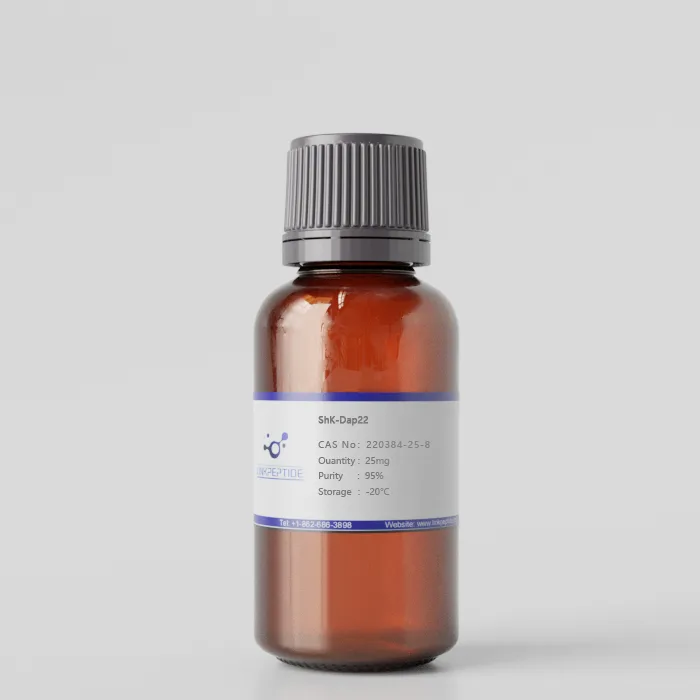
Product Name:ShK-Dap22
CAS No:220384-25-8
Purity:95%
Molar Mass:4012.7
Chemical Formula:C166H268N54O48S7
Storage:Store at -20 degrees Celsius
Sequence:RSCIDTIPKSRCTAFQCKHSMXYRLSFCRKTCGTC
Target:KV1.3 channel blocker
Application:
ShK-Dap22 is a synthetic analog of the ShK toxin, originally derived from the sea anemone Stichodactyla helianthus. In this analog, the 22nd amino acid, lysine, is replaced with diaminopropionic acid (Dap), enhancing its specificity and stability. ShK-Dap22 selectively blocks the Kv1.3 potassium channels, which are crucial in the activation of effector memory T cells. This makes it a valuable tool in immunological research, particularly in the study of autoimmune diseases like multiple sclerosis and rheumatoid arthritis. It is also explored for its potential therapeutic applications in targeting immune system dysregulation.
Current Research:
ShK-Dap22 is a synthetic analog of ShK, a peptide toxin derived from the sea anemone Stichodactyla helianthus. This analog is engineered to selectively inhibit the voltage-gated potassium channel Kv1.3, which plays a crucial role in the activation and proliferation of T lymphocytes. By targeting Kv1.3, ShK-Dap22 exhibits potent immunosuppressive properties, making it a valuable tool in immunological research and a potential therapeutic candidate for autoimmune diseases.
Structural Modification and Selectivity
In ShK-Dap22, the lysine residue at position 22 of the native ShK peptide is replaced with diaminopropionic acid (Dap), a positively charged non-natural amino acid. This substitution enhances the peptide's selectivity for Kv1.3 channels over other closely related potassium channels. Specifically, ShK-Dap22 exhibits an IC?? of approximately 23 pM for Kv1.3, while its affinity for Kv1.1, Kv1.4, and Kv1.6 channels is significantly lower, with IC?? values of 1.8 nM, 37 nM, and 10 nM, respectively.
Immunosuppressive Activity
At subnanomolar concentrations, ShK-Dap22 effectively suppresses anti-CD3-induced proliferation of human T lymphocytes in vitro, as measured by [3H]thymidine incorporation. This indicates its potential to modulate immune responses by inhibiting T cell activation.
Reduced Toxicity Profile
In rodent models, ShK-Dap22 demonstrates a favorable toxicity profile. The median paralytic dose following intravenous administration is approximately 200 mg/kg body weight, suggesting lower toxicity compared to the native ShK peptide.
Structural Insights
Nuclear Magnetic Resonance (NMR) studies reveal that the overall solution structure of ShK-Dap22 closely resembles that of the native ShK toxin. However, subtle differences are observed in the residues involved in potassium channel binding, which may contribute to its enhanced selectivity for Kv1.3.
Potential Therapeutic Applications
Due to its high selectivity and potency in blocking Kv1.3 channels, ShK-Dap22 holds promise as an immunosuppressive agent for preventing transplant rejection and treating autoimmune diseases. By specifically targeting Kv1.3 channels, it may offer therapeutic benefits with reduced side effects compared to broader immunosuppressive therapies.
Conclusion
ShK-Dap22 represents a significant advancement in the development of selective Kv1.3 channel inhibitors. Its unique structural modification confers enhanced selectivity and potency, positioning it as a valuable tool in immunological research and a promising candidate for therapeutic intervention in immune-related disorders.
Reference:
Get a Quote
 LinkPeptide