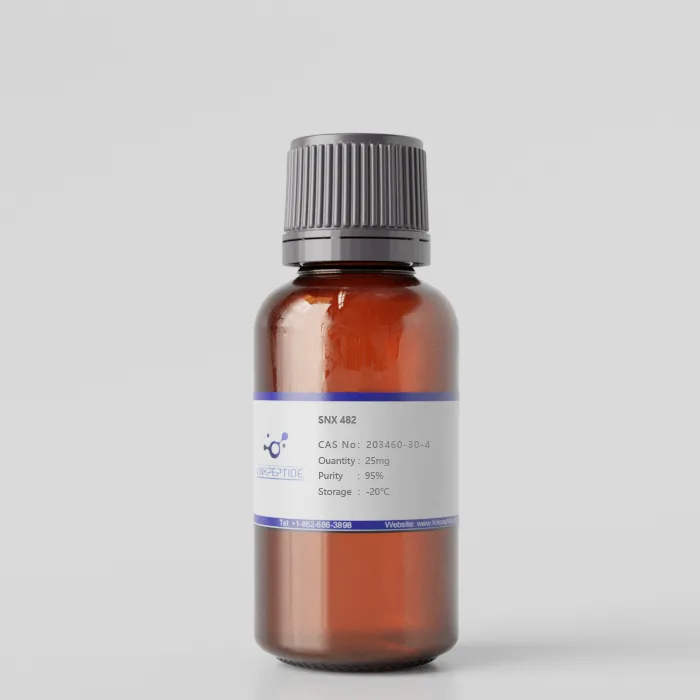
Product Name:SNX 482
CAS No:203460-30-4
Purity:95%
Molar Mass:4495.01
Chemical Formula:C192H274N52O60S7
Storage:Store at -20 degrees Celsius
Sequence:GVDKAGCRYMFGGCSVNDDCCPRLGCHSLFSYCAWDLTFSD
Target:voltage-dependent R-type CaV2.3 calcium channel blocker
Application:
SNX 482 is a peptide toxin derived from the venom of the tarantula Hysterocrates gigas. It is a highly selective blocker of Cav2.3 (R-type voltage-gated calcium channels). SNX 482 is widely used in research to study calcium channel physiology, particularly in the context of neuronal signaling, synaptic transmission, and pain pathways. By inhibiting Cav2.3 channels, SNX 482 helps elucidate the role of R-type calcium currents in processes like neurotransmitter release and long-term potentiation (LTP). It is especially valuable in neuroscience research for understanding its implications in pain management, epilepsy, and other neurological disorders.
Current Research:
SNX-482, identified by CAS number 203460-30-4, is a 41-amino acid peptide toxin originally isolated from the venom of the African tarantula Hysterocrates gigas. It functions as a potent and selective blocker of R-type (Cav2.3) voltage-gated calcium channels, with an IC?? of approximately 30 nM. This specificity has made SNX-482 a valuable tool in neurophysiological research, particularly in studies investigating the role of Cav2.3 channels in neuronal signaling and pain pathways.
Mechanism of Action
SNX-482 inhibits Cav2.3 channels in a voltage-dependent manner, binding to specific sites on the channel to prevent calcium ion influx during neuronal depolarization. This blockade can modulate neurotransmitter release and neuronal excitability, thereby influencing various physiological processes. At higher concentrations, SNX-482 has also been reported to affect other calcium channel subtypes, such as P/Q-type channels, and to inhibit A-type potassium currents, indicating a broader spectrum of activity under certain conditions.
Applications in Research
The selective inhibition of Cav2.3 channels by SNX-482 has facilitated its use in exploring the physiological and pathological roles of these channels. For instance, studies utilizing SNX-482 have demonstrated its ability to reduce dorsal horn neuronal responses in models of chronic neuropathic pain, suggesting that Cav2.3 channels contribute to pain transmission pathways. Additionally, SNX-482 has been employed to investigate the involvement of R-type calcium channels in synaptic plasticity and neurotransmitter release, enhancing our understanding of neuronal communication mechanisms.
Considerations
While SNX-482 is a valuable research tool, its effects on other ion channels at elevated concentrations necessitate careful experimental design and interpretation. Researchers should account for potential off-target interactions to accurately attribute observed physiological effects to Cav2.3 channel inhibition.
Reference:
Get a Quote
 LinkPeptide

![[Nphe1]Nociceptin(1-13)NH2](https://www.linkpeptide.com/wp-content/uploads/2024/10/Nphe1Nociceptin1-13NH2-jpg-3.webp "[Nphe1]Nociceptin(1-13)NH2")