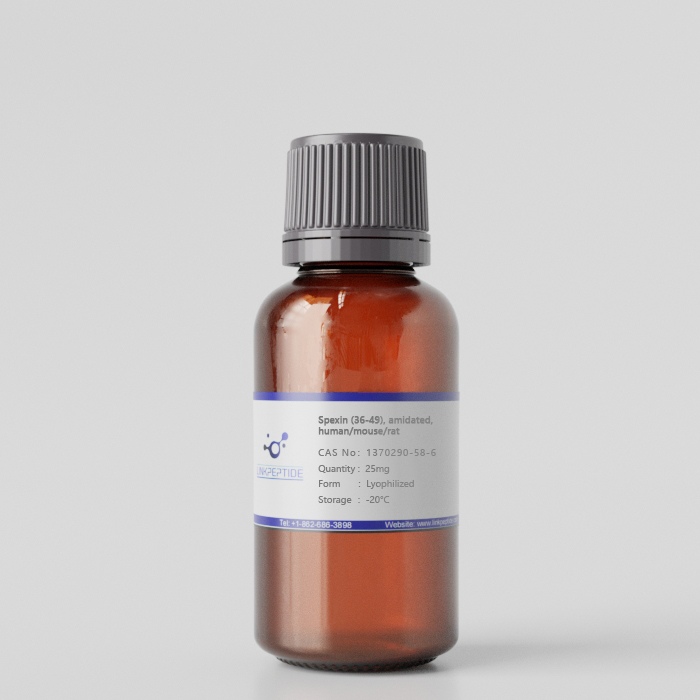
Product Name: Spexin (36-49), amidated, human/mouse/rat
Sequence One Letter Code: NWTPQAMLYLKGAQ-NH2
Sequence Three Letter Code: Asn-Trp-Thr-Pro-Gln-Ala-Met-Leu-Tyr-Leu-Lys-Gly-Ala-Gln-NH2
Cas No: 1370290-58-6
Chemical Formula:C74H114N20O19S
Molecular Weight: 1620
Purity: 95%
Form: Lyophilized
Storage Conditions: - 20 °C
Research Area: Diabetes and Metabolic Syndrome
SMILES: C[C@H]([C@@H](C(=O)N1CCC[C@H]1C(=O)N[C@@H](CCC(=O)N)C(=O)N[C@@H](C)C(=O)N[C@@H](CCSC)C(=O)N[C@@H](CC(C)C)C(=O)N[C@@H](CC2=CC=C(C=C2)O)C(=O)N[C@@H](CC(C)C)C(=O)N[C@@H](CCCCN)C(=O)NCC(=O)N[C@@H](C)C(=O)N[C@@H](CCC(=O)N)C(=O)N)NC(=O)[C@H](CC3=CNC4=CC=CC=C43)NC(=O)[C@H](CC(=O)N)N)O
IUPAC: (2S)-2-[[(2S)-2-[[2-[[(2S)-6-amino-2-[[(2S)-2-[[(2S)-2-[[(2S)-2-[[(2S)-2-[[(2S)-2-[[(2S)-5-amino-2-[[(2S)-1-[(2S,3R)-2-[[(2S)-2-[[(2S)-2,4-diamino-4-oxobutanoyl]amino]-3-(1H-indol-3-yl)propanoyl]amino]-3-hydroxybutanoyl]pyrrolidine-2-carbonyl]amino]-5-oxopentanoyl]amino]propanoyl]amino]-4-methylsulfanylbutanoyl]amino]-4-methylpentanoyl]amino]-3-(4-hydroxyphenyl)propanoyl]amino]-4-methylpentanoyl]amino]hexanoyl]amino]acetyl]amino]propanoyl]amino]pentanediamide
INCHIKEY: ZZDZBDJTNIOJMF-TWMPYRTRSA-N
INCHI:
InChI=1S/C74H114N20O19S/c1-37(2)30-52(69(108)87-49(16-11-12-27-75)66(105)82-36-60(100)83-39(5)63(102)85-48(62(80)101)22-24-57(77)97)91-71(110)54(32-42-18-20-44(96)21-19-42)92-70(109)53(31-38(3)4)90-68(107)51(26-29-114-8)86-64(103)40(6)84-67(106)50(23-25-58(78)98)88-73(112)56-17-13-28-94(56)74(113)61(41(7)95)93-72(111)55(89-65(104)46(76)34-59(79)99)33-43-35-81-47-15-10-9-14-45(43)47/h9-10,14-15,18-21,35,37-41,46,48-56,61,81,95-96H,11-13,16-17,22-34,36,75-76H2,1-8H3,(H2,77,97)(H2,78,98)(H2,79,99)(H2,80,101)(H,82,105)(H,83,100)(H,84,106)(H,85,102)(H,86,103)(H,87,108)(H,88,112)(H,89,104)(H,90,107)(H,91,110)(H,92,109)(H,93,111)/t39-,40-,41+,46-,48-,49-,50-,51-,52-,53-,54-,55-,56-,61-/m0/s1
Source / Species: Human, mouse, rat
Conjugation: Unconjugated
Code Nacres: NA.26
Application: Spexin (36–49), amidated is a synthetic peptide corresponding to residues 36–49 of the proNPQ precursor and is highly conserved across mammalian species. The peptide undergoes C-terminal amidation following proteolytic processing at the GRR motif, a modification required for biological activity. Spexin functions as a neuroendocrine regulator involved in arterial blood pressure control, fluid balance, nociceptive modulation, and energy homeostasis. Experimental studies demonstrate its ability to reduce long-chain fatty acid uptake in adipocytes and promote weight reduction in rodent models. This peptide is of significant interest for investigations into metabolic regulation, obesity, type 2 diabetes, and neuroendocrine signaling pathways linking energy balance and cardiovascular function.
Current Research: Spexin (36–49), amidated is a synthetic peptide corresponding to residues 36–49 of the proNPQ precursor protein and represents the biologically active, mature form of spexin following proteolytic processing. The precursor undergoes cleavage at conserved dibasic motifs, including the GRR processing site, and subsequent C-terminal amidation—a post-translational modification essential for full receptor activation and physiological function. The amidated C-terminus enhances receptor affinity and stabilizes the peptide’s bioactive conformation, consistent with many regulatory neuropeptides. Spexin is highly conserved across vertebrate species, underscoring its functional importance in systemic homeostasis. It is widely expressed in central and peripheral tissues, including hypothalamic nuclei, adipose tissue, liver, gastrointestinal tract, and cardiovascular tissues. Functionally, spexin acts as a neuroendocrine modulator linking metabolic status with autonomic and endocrine signaling pathways. At the receptor level, spexin primarily signals through galanin receptor subtypes GALR2 and GALR3, members of the G protein–coupled receptor (GPCR) family. Through these receptors, spexin modulates intracellular signaling cascades involving phospholipase C activation, calcium mobilization, MAPK pathways, and cAMP regulation, depending on receptor subtype and cellular context. Its receptor selectivity distinguishes it from galanin itself and supports distinct physiological roles within the galaninergic signaling network. In metabolic research, spexin has gained significant attention for its regulatory effects on lipid handling and energy balance. Experimental studies demonstrate that spexin reduces long-chain fatty acid uptake in adipocytes, likely through modulation of fatty acid transport proteins and lipid metabolism pathways. In rodent models, exogenous spexin administration is associated with reduced body weight gain, decreased adiposity, and improved metabolic profiles. These findings position spexin as a negative regulator of adipogenesis and lipid accumulation. Beyond adipose tissue, spexin influences glucose metabolism and insulin sensitivity. Emerging evidence suggests correlations between circulating spexin levels and metabolic disorders, including obesity and type 2 diabetes mellitus (T2DM). Clinical observations indicate that spexin concentrations may be reduced in individuals with metabolic syndrome, suggesting a potential compensatory or protective role in metabolic regulation. Ongoing studies are investigating whether spexin analogs or receptor-targeted strategies could represent therapeutic avenues for metabolic disease. Spexin also participates in cardiovascular regulation. It has been implicated in arterial blood pressure control and fluid balance, potentially through central autonomic circuits and peripheral vascular effects. Its integration into neuroendocrine networks suggests cross-talk between metabolic and cardiovascular systems, reinforcing the concept that energy homeostasis and vascular function are tightly interconnected. In the central nervous system, spexin contributes to nociceptive modulation and stress-related signaling. Its expression in hypothalamic and limbic regions indicates involvement in appetite regulation, stress responsiveness, and neuroendocrine feedback loops. Experimental data support a role in appetite suppression and feeding behavior regulation, further linking spexin to energy balance control. From a research applications perspective, Spexin (36–49), amidated is widely used in in vitro receptor activation assays, adipocyte metabolism studies, and animal models evaluating metabolic and cardiovascular endpoints. Investigators commonly assess downstream signaling events such as ERK phosphorylation, intracellular calcium flux, and gene expression changes related to lipid metabolism. In vivo, parameters including body weight, food intake, insulin sensitivity, lipid profiles, and blood pressure are measured to characterize physiological responses. Overall, Spexin (36–49), amidated represents a biologically active neuroendocrine peptide with multifaceted roles in metabolic regulation, cardiovascular control, and energy homeostasis. Its conserved structure, receptor specificity, and documented metabolic effects make it a valuable tool for investigating the molecular mechanisms underlying obesity, type 2 diabetes, and neuroendocrine integration of metabolic and cardiovascular function.
Get a Quote
 LinkPeptide