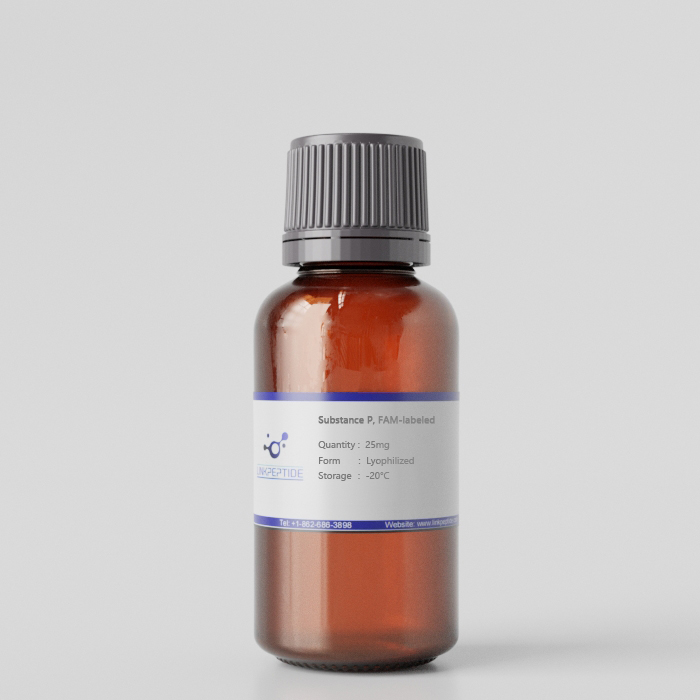
Product Name: Substance P, FAM-labeled
Sequence One Letter Code: FAM-RPKPQQFFGLM-NH2
Sequence Three Letter Code: FAM-Arg-Pro-Lys-Pro-Gln-Gln-Phe-Phe-Gly-Leu-Met-NH2
Chemical Formula:C84H108N18O19S
Molecular Weight: 1706
Purity: 95%
Form: Lyophilized
Storage Conditions: - 20 °C Protected from light
Research Area: Neurological Disease Research
Source / Species: guinea pig
Conjugation: Conjugated
Conjugation Type: Fluorescent dyes
Code Nacres: NA.26
Application: 5-FAM–Labeled Substance P Peptide is a fluorescent derivative of Substance P, a tachykinin neuropeptide that functions as both a neurotransmitter and neuromodulator in the nervous system. Substance P is released from sensory nerve endings and plays a central role in pain transmission, neurogenic inflammation, and immune regulation through activation of neurokinin receptors. The peptide is labeled with 5-carboxyfluorescein (FAM), enabling sensitive fluorescence detection with excitation/emission maxima of 494/521 nm. This fluorescent probe is widely used in receptor binding assays, cellular internalization studies, and imaging experiments to investigate neurokinin receptor signaling. It supports research in pain biology, inflammatory signaling pathways, neuroimmune communication, and neuropeptide receptor pharmacology.
Current Research: Substance P is a well-known neuropeptide belonging to the tachykinin family, widely recognized for its role in neurotransmission, pain perception, and neurogenic inflammation. It acts as both a neurotransmitter and neuromodulator, particularly within sensory neurons of the peripheral and central nervous systems. To facilitate the investigation of Substance P signaling in cellular and molecular systems, fluorescent derivatives such as the 5-FAM–labeled Substance P peptide are widely used in experimental research. By incorporating a fluorescent tag, this probe enables sensitive detection and visualization of peptide–receptor interactions and intracellular trafficking. Biological Role of Substance P Substance P is released primarily from sensory nerve endings, particularly in response to tissue injury, inflammatory stimuli, or nociceptive signals. After release, the peptide binds to neurokinin receptors, especially the neurokinin-1 receptor (NK1R), a G protein–coupled receptor expressed in neurons, immune cells, endothelial cells, and other tissues. Activation of NK1 receptors by Substance P initiates signaling pathways that regulate several physiological and pathological processes, including: Transmission of pain signals in the central and peripheral nervous systems Neurogenic inflammation, involving vasodilation and plasma extravasation Immune cell activation and cytokine release Regulation of smooth muscle contraction and vascular responses Because of its broad biological effects, Substance P signaling has been extensively studied in areas such as pain biology, inflammatory diseases, and neuroimmune communication. Design of the 5-FAM–Labeled Substance P Peptide The fluorescent probe is derived from the native Substance P peptide sequence but incorporates a 5-carboxyfluorescein (5-FAM) fluorophore. This dye is commonly used in biochemical and cell-based assays because it provides strong fluorescence and high detection sensitivity. The fluorophore exhibits excitation and emission maxima around 494 nm and 521 nm, making it compatible with standard fluorescence microscopes, plate readers, and flow cytometry systems. Attachment of the FAM label allows researchers to monitor the peptide’s interaction with cells and receptors in real time. Importantly, the fluorescent modification typically preserves the peptide’s ability to interact with neurokinin receptors, allowing it to function as a biologically relevant probe for receptor binding studies. Monitoring Neurokinin Receptor Binding One of the primary applications of the FAM-labeled Substance P peptide is the study of neurokinin receptor binding dynamics. Because the fluorescent label allows direct visualization of peptide binding, researchers can quantify interactions between Substance P and NK receptors in vitro. In receptor binding assays, the fluorescent peptide can be used to: Measure binding affinity to neurokinin receptors Evaluate competitive displacement by receptor antagonists Analyze receptor distribution on the surface of living cells These experiments help clarify the pharmacological properties of neurokinin receptors and the molecular mechanisms underlying neuropeptide signaling. Studying Peptide Internalization and Cellular Trafficking After binding to NK1 receptors, Substance P often triggers receptor internalization, a process in which ligand–receptor complexes are taken into the cell through endocytosis. Fluorescent labeling allows researchers to track this internalization process in real time. Using fluorescence microscopy or flow cytometry, investigators can observe: Cellular uptake of the peptide–receptor complex Intracellular trafficking pathways Receptor recycling or degradation These studies provide insight into how neurokinin receptor signaling is regulated after ligand binding. Applications in Imaging and Cell-Based Assays Because of its strong fluorescence signal, the 5-FAM–labeled Substance P peptide is suitable for multiple experimental techniques used in neurobiology and pharmacology research. Common applications include: Fluorescence microscopy to visualize peptide binding and internalization in living cells Flow cytometry to quantify receptor expression and peptide uptake High-throughput screening assays for identifying neurokinin receptor modulators These approaches allow researchers to analyze neuropeptide signaling in a wide range of biological models. Relevance to Pain and Inflammation Research Substance P signaling is closely linked to pain transmission and inflammatory responses, making neurokinin receptors important therapeutic targets. Fluorescent probes such as the FAM-labeled peptide enable researchers to investigate how receptor activation contributes to nociceptive signaling, immune responses, and inflammatory processes. Such studies help identify compounds that modulate neurokinin receptor activity and improve understanding of signaling pathways involved in chronic pain and inflammatory diseases. A Versatile Tool for Neuropeptide Research The 5-FAM–labeled Substance P peptide combines the biological activity of a key tachykinin neuropeptide with the analytical advantages of fluorescence detection. This design allows researchers to monitor peptide–receptor interactions, visualize cellular uptake, and analyze signaling pathways with high sensitivity. Through applications in receptor binding assays, cellular imaging experiments, and neuropeptide pharmacology studies, this fluorescent probe continues to support research exploring pain signaling, neurogenic inflammation, and neuroimmune communication.
Get a Quote
 LinkPeptide