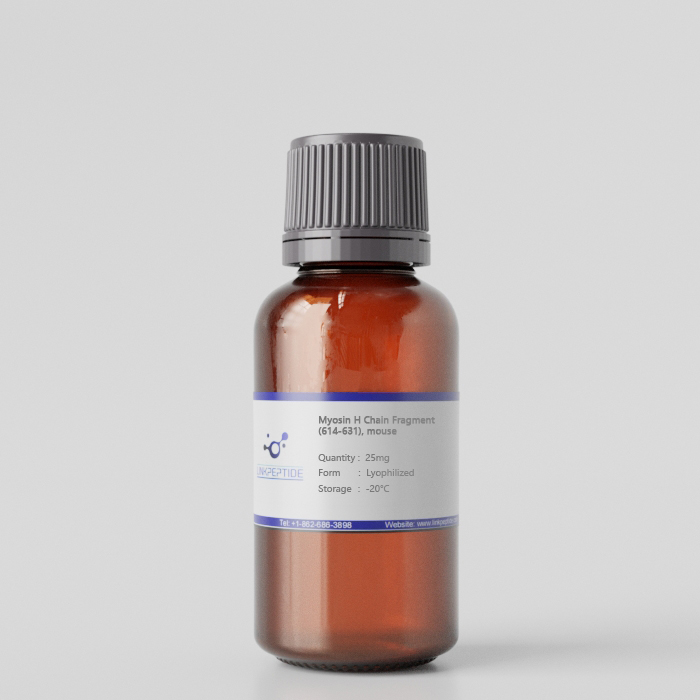
Product Name: Syk Kinase Peptide Substrate
Sequence One Letter Code: KEDPDYEWPSAK-NH2
Sequence Three Letter Code: H-Lys-Glu-Asp-Pro-Asp-Tyr-Glu-Trp-Pro-Ser-Ala-Lys-NH2
Chemical Formula:C66H94N16O22
Molecular Weight: 1463.6
Purity: 95%
Form: Lyophilized
Storage Conditions: - 20 °C
Research Area: peptide substrate
Conjugation: Unconjugated
Code Nacres: NA.26
Application: Syk Kinase Peptide Substrate is a synthetic peptide designed for use as a phosphorylation substrate of spleen tyrosine kinase (Syk), a non-receptor tyrosine kinase central to immune receptor signaling. Syk mediates downstream signaling of the B cell receptor, Fc receptors, and various immunoreceptors involved in innate and adaptive immunity. This peptide is widely used in in vitro kinase assays to quantify Syk catalytic activity, determine enzyme kinetics, and evaluate inhibitor potency. It supports mechanistic studies of immune signaling cascades and drug discovery efforts targeting inflammatory and autoimmune diseases driven by aberrant Syk activation.
Current Research: Spleen tyrosine kinase (Syk) is a cytoplasmic non-receptor tyrosine kinase that plays a pivotal role in immune receptor–mediated signal transduction. It functions downstream of immunoreceptor tyrosine-based activation motif (ITAM)-containing receptors, including the B cell receptor (BCR), Fcγ and Fcε receptors, and various innate immune receptors expressed on myeloid cells. Upon receptor engagement, Src family kinases phosphorylate ITAM motifs, creating docking sites for Syk recruitment. Activated Syk subsequently phosphorylates downstream substrates, initiating signaling cascades that regulate proliferation, differentiation, cytokine production, and effector responses. The Syk Kinase Peptide Substrate is a synthetic peptide engineered to serve as a specific phosphorylation target for Syk in biochemical assays. This peptide contains a tyrosine residue embedded within a sequence context optimized for Syk recognition and catalytic efficiency. By providing a defined and reproducible substrate, it enables direct measurement of Syk kinase activity in vitro. In typical kinase assays, recombinant Syk is incubated with the peptide substrate in the presence of ATP, allowing phosphorylation of the target tyrosine residue. Phosphorylation can then be quantified using radiometric detection, phospho-specific antibodies, fluorescence-based assays, or mass spectrometry, depending on the assay format. The use of a synthetic peptide substrate offers several experimental advantages. Unlike full-length protein substrates, short peptides reduce structural complexity and eliminate confounding effects arising from protein folding or secondary interaction domains. This allows precise determination of catalytic parameters such as Km for ATP and substrate, kcat, and overall catalytic efficiency (kcat/Km). These kinetic measurements are essential for understanding enzyme mechanism and comparing wild-type and mutant forms of Syk. Syk kinase assays employing defined peptide substrates are widely used in drug discovery programs targeting inflammatory and autoimmune diseases. Aberrant Syk activation has been implicated in rheumatoid arthritis, systemic lupus erythematosus, allergic inflammation, and certain B cell malignancies. Small-molecule Syk inhibitors are evaluated for their potency by measuring their ability to reduce peptide phosphorylation in vitro. Determination of IC50 and Ki values provides quantitative metrics for inhibitor comparison and optimization. Because the assay directly measures catalytic activity, it supports early-stage screening and structure–activity relationship (SAR) studies. Beyond inhibitor screening, the Syk Kinase Peptide Substrate facilitates mechanistic investigations of immune receptor signaling. By analyzing how adaptor proteins, phosphorylation status, or regulatory domains influence catalytic efficiency, researchers can dissect activation mechanisms at a biochemical level. For example, studies comparing full-length Syk with truncated constructs or SH2 domain mutants can clarify how intramolecular interactions regulate kinase activation and substrate engagement. The substrate is also useful for assessing kinase selectivity. In panels evaluating off-target effects, the same peptide-based format can be adapted for related tyrosine kinases to determine specificity profiles of candidate inhibitors. This is particularly important given the structural similarities among cytoplasmic tyrosine kinases involved in immune signaling pathways. In translational research, quantitative Syk activity assays support biomarker development and pathway analysis. Measuring Syk catalytic function under varying experimental conditions—such as exposure to inflammatory stimuli or pharmacological modulators—provides insight into pathway regulation and therapeutic responsiveness. Overall, the Syk Kinase Peptide Substrate is a defined synthetic reagent designed to enable accurate measurement of Syk-mediated tyrosine phosphorylation. Its application in kinetic analysis, inhibitor evaluation, and mechanistic signaling studies makes it an essential tool in immunology research and drug discovery efforts. By providing a controlled and quantitative assay system, this peptide supports ongoing investigation into Syk-dependent immune signaling and therapeutic strategies targeting dysregulated inflammatory and autoimmune pathways.
Get a Quote
 LinkPeptide

![Src Optimal Peptide Substrate [AEEEIYGEFEAKKKK]](https://www.linkpeptide.com/wp-content/uploads/2026/06/Src-Optimal-Peptide-Substrate-AEEEIYGEFEAKKKK.jpg "Src Optimal Peptide Substrate [AEEEIYGEFEAKKKK]")