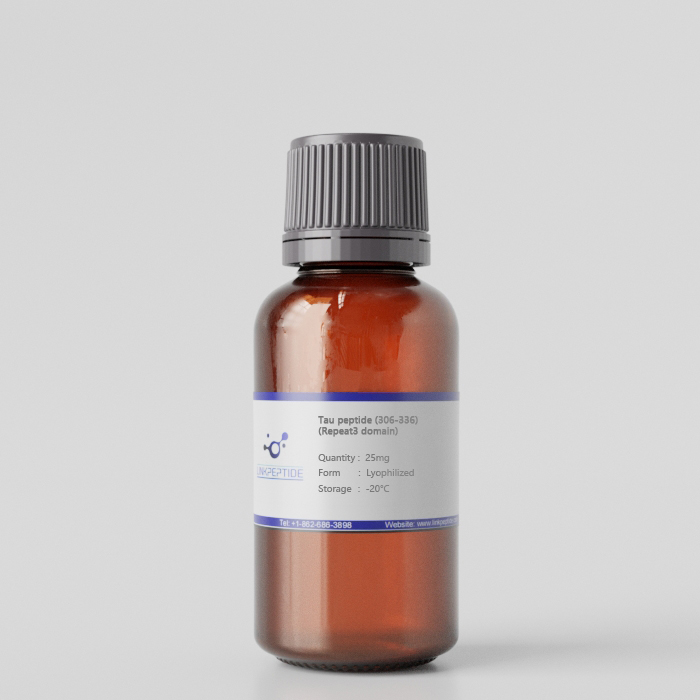
Product Name: Tau peptide (306-336) (Repeat3 domain)
Sequence One Letter Code: VQIVYKPVDLSKVTSKCGSLGNIHHKPGGGQ
Sequence Three Letter Code: Val-Gln-Ile-Val-Tyr-Lys-Pro-Val-Asp-Leu-Ser-Lys-Val-Thr-Ser-Lys-Cys-Gly-Ser-Leu-Gly-Asn-Ile-His-His-Lys-Pro-Gly-Gly-Gly-Gln-OH
Chemical Formula:C143H236N42O42S
Molecular Weight: 3248
Purity: 95%
Form: Lyophilized
Storage Conditions: - 20 °C
Research Area: Alzheimer's Disease
Source / Species: human
Conjugation: Unconjugated
Code Nacres: NA.26
Application: Tau Peptide (306–336) is a 31-amino acid fragment derived from the repeat 3 (R3) microtubule-binding domain of the tau protein. The repeat domains are essential for microtubule stabilization and are central to tau aggregation and neurofibrillary tangle formation in Alzheimer’s disease and related tauopathies. This region contains motifs critical for β-sheet formation and fibrillization. The peptide is frequently used in aggregation assays, structural studies, and compound screening platforms targeting tau pathology. It supports mechanistic investigations into tau misfolding, microtubule interactions, and therapeutic strategies aimed at mitigating tau-mediated neurodegeneration.
Current Research: Tau Peptide (306–336) is a 31–amino acid fragment derived from the third microtubule-binding repeat (R3) of human tau, located within the C-terminal half of the protein. Tau contains either three (3R) or four (4R) repeat domains depending on alternative splicing of exon 10, and these repeats are responsible for microtubule stabilization and assembly. The R3 domain is particularly significant because it contributes directly to tau self-assembly and formation of β-sheet–rich fibrillar structures characteristic of Alzheimer’s disease and other tauopathies. Residues within the 306–336 region include the highly aggregation-prone hexapeptide motif VQIVYK (positions 306–311), often referred to as PHF6. This sequence has strong intrinsic β-sheet–forming propensity and acts as a nucleating core for tau fibrillization. Structural studies demonstrate that PHF6 can self-assemble into steric zipper configurations, forming tightly interdigitated β-sheets that seed filament formation. As a result, Tau (306–336) encompasses one of the most critical determinants of pathological tau aggregation. In vitro, the 306–336 peptide readily forms fibrillar aggregates under physiological or mildly aggregation-promoting conditions, making it a widely used model in aggregation assays. Thioflavin T fluorescence, circular dichroism spectroscopy, transmission electron microscopy, and atomic force microscopy are commonly employed to characterize β-sheet formation and fibril morphology. Because the fragment aggregates more rapidly and reproducibly than full-length tau, it serves as a tractable system for studying nucleation kinetics and structural transitions. Current research leverages Tau (306–336) to investigate mechanisms of tau misfolding and propagation. Aggregation of tau is thought to proceed via a nucleation-dependent polymerization process involving oligomeric intermediates that may exert neurotoxic effects prior to mature filament formation. Studies using defined R3-derived peptides help dissect early aggregation events, examine oligomer stability, and identify structural determinants governing filament polymorphism. The R3 repeat also plays a central role in tau–microtubule interactions. Under physiological conditions, tau binds along microtubules to stabilize axonal cytoskeleton architecture. Post-translational modifications such as hyperphosphorylation reduce tau’s affinity for microtubules, increasing the pool of soluble tau available for aggregation. Although isolated peptides do not fully replicate microtubule-binding dynamics of full-length tau, the 306–336 region supports investigation of sequence elements essential for microtubule association and structural rearrangement. In therapeutic research, Tau (306–336) is widely used as a screening substrate for small molecules, peptides, and antibodies designed to inhibit aggregation. Compounds that disrupt β-sheet formation within the PHF6-containing region can attenuate fibril assembly in vitro. This peptide-based system provides a simplified platform for high-throughput screening before validation in full-length tau or cellular models. Structural biology studies have employed cryo-electron microscopy and solid-state NMR to elucidate how R3-derived sequences contribute to filament core architecture. Comparative analyses reveal that disease-specific tau filament strains differ in the packing of repeat domains, including R3, underscoring the importance of this region in determining fibril polymorphism and pathological diversity. Overall, Tau Peptide (306–336) represents a core aggregation-prone segment of the tau microtubule-binding domain. Its inclusion of critical β-sheet–forming motifs makes it an essential tool for studying tau assembly kinetics, structural transitions, and mechanisms of neurofibrillary tangle formation. As tau-targeted therapies continue to advance, this peptide supports mechanistic and screening efforts aimed at mitigating tau-driven neurodegeneration in Alzheimer’s disease and related disorders.
Get a Quote
 LinkPeptide

![[Phe1Ψ(CH2-NH)Gly2]Nociceptin(1-13)NH2](https://www.linkpeptide.com/wp-content/uploads/2024/10/Phe1¶aCH2-NHGly2Nociceptin1-13NH2-jpg.webp "[Phe1Ψ(CH2-NH)Gly2]Nociceptin(1-13)NH2")