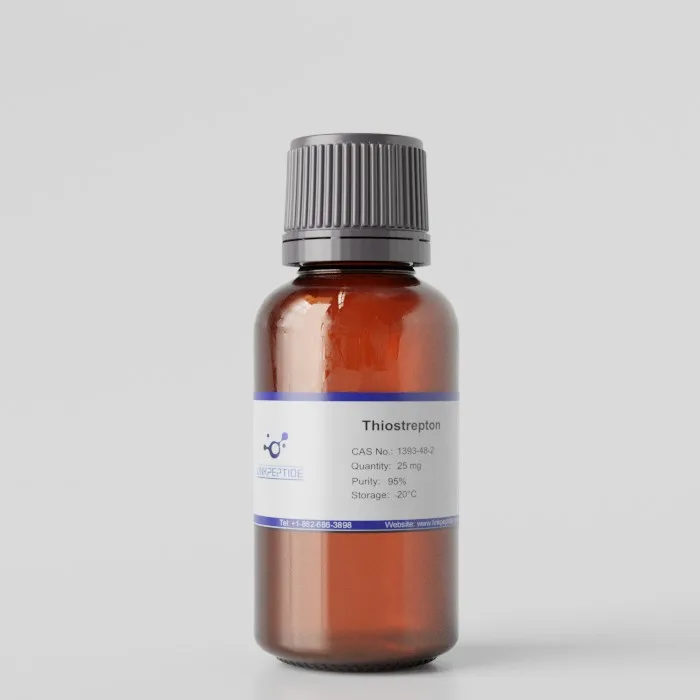
Product Name: Thiostrepton
CAS No: 1393-48-2
Purity: 95%
Molar Mass: 1664.9
Chemical Formula: C72H85N19O18S5
Synonyms: Bryamycin, Gargon, Thiostrepton A
Storage: Store at -20 degrees Celsius
Target: antibiotic
Application:
Thiostrepton is a potent antibiotic peptide that targets bacterial ribosomes, inhibiting protein synthesis. It binds to the 50S subunit of the ribosome, disrupting the assembly of the functional ribosome complex and halting bacterial growth. Thiostrepton is particularly effective against Gram-positive bacteria and some Gram-negative strains, making it a valuable tool in combating resistant bacterial infections. Its unique mechanism of action also renders it useful in molecular biology research, particularly in studying ribosomal function and protein synthesis. Thiostrepton's robust antibacterial properties and research applications make it an essential peptide in both clinical and laboratory settings.
Current Research:
Thiostrepton, a naturally occurring thiopeptide antibiotic, has garnered significant attention in drug discovery due to its unique mechanism of action and versatile therapeutic potential. Isolated from Streptomyces species, thiostrepton is known for its potent antibacterial activity, primarily against Gram-positive pathogens. It operates by binding to the bacterial 23S rRNA within the 50S ribosomal subunit, inhibiting protein synthesis. This distinct mode of action minimizes cross-resistance with other antibiotics, positioning thiostrepton as a valuable tool in tackling antibiotic resistance. Current research extends thiostrepton's utility beyond its antimicrobial properties. In oncology, thiostrepton has emerged as a promising agent due to its ability to inhibit the FOXM1 transcription factor, a critical regulator in cancer cell proliferation, metastasis, and drug resistance. Studies reveal that thiostrepton induces apoptosis and suppresses tumor growth in preclinical models of breast, ovarian, and pancreatic cancers. Its dual role as an antibiotic and anti-cancer agent underscores its potential in multi-modal therapeutic strategies. In the realm of immunology, thiostrepton has demonstrated immunomodulatory effects by attenuating inflammatory pathways, suggesting potential applications in managing autoimmune disorders. Additionally, its efficacy in disrupting biofilm formation and eradicating persister cells makes it an attractive candidate for addressing chronic infections, such as those caused by Staphylococcus aureus. Efforts to optimize thiostrepton's clinical application focus on improving its pharmacokinetic profile and bioavailability. Derivatization strategies and nanoformulation approaches aim to overcome its limited solubility and enhance tissue distribution, broadening its therapeutic scope. For researchers in drug discovery, thiostrepton exemplifies the potential of natural products as scaffolds for novel therapies. Its multifaceted biological activities provide a robust foundation for advancing treatments in infectious diseases, oncology, and beyond, driving innovation in addressing complex clinical challenges.
Reference:
Get a Quote
 LinkPeptide