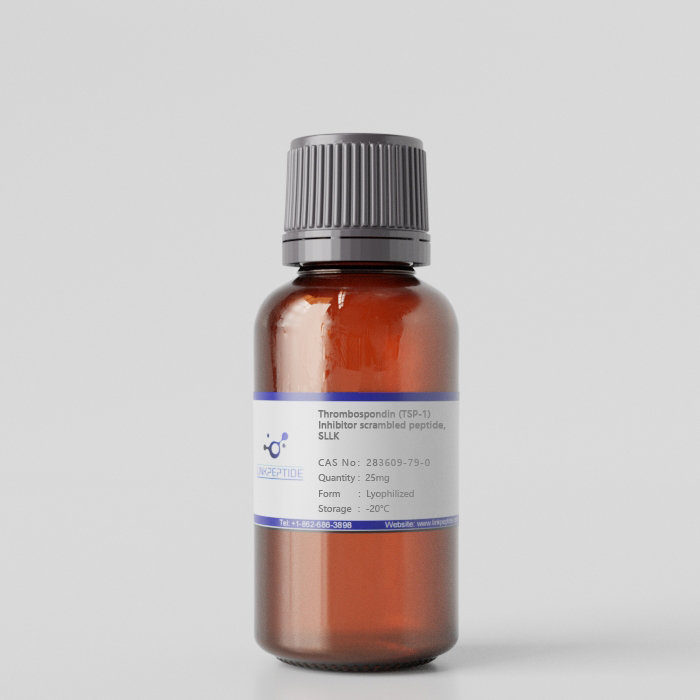
Product Name: Thrombospondin (TSP-1) Inhibitor scrambled peptide, SLLK
Sequence One Letter Code: SLLK-NH2
Sequence Three Letter Code: H-Ser-Leu-Leu-Lys-NH2
Cas No: 283609-79-0
Chemical Formula:C21H42N6O5
Molecular Weight: 458.6
Purity: 95%
Form: Lyophilized
Storage Conditions: - 20 °C
Research Area: Cardiovascular Disease Research
SMILES: CC(C)C[C@@H](C(=O)N[C@@H](CO)C(=O)N[C@@H](CCCCN)C(=O)N[C@@H](CC(C)C)C(=O)N)N
IUPAC: (2S)-6-amino-N-[(2S)-1-amino-4-methyl-1-oxopentan-2-yl]-2-[[(2S)-2-[[(2S)-2-amino-4-methylpentanoyl]amino]-3-hydroxypropanoyl]amino]hexanamide
INCHIKEY: YOKXDNNIFSAXBY-QAETUUGQSA-N
INCHI:
InChI=1S/C21H42N6O5/c1-12(2)9-14(23)19(30)27-17(11-28)21(32)25-15(7-5-6-8-22)20(31)26-16(18(24)29)10-13(3)4/h12-17,28H,5-11,22-23H2,1-4H3,(H2,24,29)(H,25,32)(H,26,31)(H,27,30)/t14-,15-,16-,17-/m0/s1
Source / Species: human
Conjugation: Unconjugated
Code Nacres: NA.26
Application: The SLLK scrambled peptide is a sequence-rearranged control peptide used as a negative control for the thrombospondin-1 inhibitor peptide LSKL. Unlike LSKL, which inhibits thrombospondin-1 (TSP-1) activity and modulates TGF-β activation, the SLLK sequence lacks the specific motif required for biological inhibition of TSP-1 signaling. This property makes SLLK an important experimental control for validating the sequence-dependent activity of LSKL and related peptides. Researchers commonly use the SLLK scrambled peptide in studies examining thrombospondin-1 signaling pathways, extracellular matrix interactions, and regulation of TGF-β activation. By serving as an inactive control, SLLK helps ensure accurate interpretation of peptide-mediated biological effects in cell signaling and matrix biology research.
Current Research: The SLLK scrambled peptide is a sequence-rearranged control peptide commonly used in studies investigating the biological activity of the LSKL peptide, a well-known inhibitor of thrombospondin-1 (TSP-1). While the LSKL peptide interferes with thrombospondin-1–mediated activation of transforming growth factor-β (TGF-β), the SLLK sequence lacks the functional motif required for this inhibitory activity. As a result, SLLK serves as a negative control peptide, enabling researchers to confirm that observed biological effects arise from the specific sequence of LSKL rather than nonspecific peptide interactions. Control peptides such as SLLK are essential in experimental design because they help validate the sequence-dependent mechanisms of peptide-mediated signaling, particularly in complex pathways involving extracellular matrix proteins and growth factor activation. Thrombospondin-1 and TGF-β Activation Thrombospondin-1 is a multifunctional extracellular matrix glycoprotein involved in numerous biological processes, including tissue remodeling, cell adhesion, angiogenesis, and immune regulation. One of its most studied functions is its ability to activate latent transforming growth factor-β (TGF-β). TGF-β is produced in a latent form that must be activated before it can bind its receptors and initiate downstream signaling pathways. Thrombospondin-1 contributes to this process by interacting with the latent TGF-β complex, facilitating its activation and enabling it to participate in cellular signaling events. Because TGF-β plays key roles in fibrosis, inflammation, and tissue repair, the regulation of thrombospondin-1–mediated activation is an important area of biomedical research. The LSKL Peptide and Its Inhibitory Function The LSKL peptide corresponds to a sequence motif that interferes with thrombospondin-1’s ability to activate latent TGF-β. By competing with natural binding interactions within the TSP-1 signaling pathway, the peptide can reduce TGF-β activation and thereby influence downstream cellular responses. Researchers often use the LSKL peptide to explore the role of thrombospondin-1 in processes such as: Extracellular matrix remodeling Regulation of growth factor activation Cellular responses to tissue injury Fibrotic signaling pathways However, when evaluating peptide-mediated biological effects, it is important to determine whether the observed results are truly sequence specific. Purpose of the SLLK Scrambled Peptide The SLLK scrambled peptide is designed by rearranging the amino acid order of the LSKL sequence. Although it contains the same amino acid composition, the altered arrangement eliminates the structural motif responsible for thrombospondin-1 inhibition. Because the scrambled sequence lacks functional activity, SLLK serves as a control peptide in experiments using LSKL or related inhibitors. By including both peptides in experimental designs, researchers can distinguish between: Specific biological effects caused by the active LSKL sequence Non-specific effects related to peptide presence or experimental conditions This comparison improves the reliability and interpretation of experimental results. Applications in TSP-1 and Matrix Biology Research The SLLK scrambled peptide is widely used in studies examining thrombospondin-1 signaling pathways and extracellular matrix regulation. By acting as an inactive control, it helps researchers validate the functional effects of active peptide inhibitors. Common research applications include: Studies of TGF-β activation mechanisms Investigations of extracellular matrix protein interactions Analysis of signaling pathways regulated by thrombospondin-1 Experimental models exploring fibrosis and tissue remodeling These studies contribute to a deeper understanding of how extracellular matrix proteins regulate growth factor activity and cellular communication. Importance of Control Peptides in Experimental Design Scrambled peptides like SLLK play a critical role in biochemical and cell biology experiments. Because many biological systems are sensitive to peptide interactions, control peptides are needed to ensure that experimental outcomes are specifically related to the functional sequence under investigation. Using a scrambled control helps researchers confirm that: Biological responses depend on the precise amino acid sequence Observed effects are not caused by general peptide properties Experimental results accurately reflect mechanistic signaling pathways This approach strengthens experimental conclusions and improves reproducibility in peptide-based studies. Conclusion The SLLK scrambled peptide is a sequence-rearranged control peptide used to validate the activity of the thrombospondin-1 inhibitor peptide LSKL. Because the scrambled sequence lacks the motif required for inhibition of thrombospondin-1–mediated TGF-β activation, it functions as an effective negative control in experimental studies. By allowing researchers to distinguish sequence-specific biological effects from nonspecific peptide interactions, SLLK plays an important role in investigations of thrombospondin-1 signaling, extracellular matrix biology, and TGF-β regulation. Its use helps ensure accurate interpretation of peptide-mediated mechanisms in cell signaling and matrix biology research.
Get a Quote
 LinkPeptide