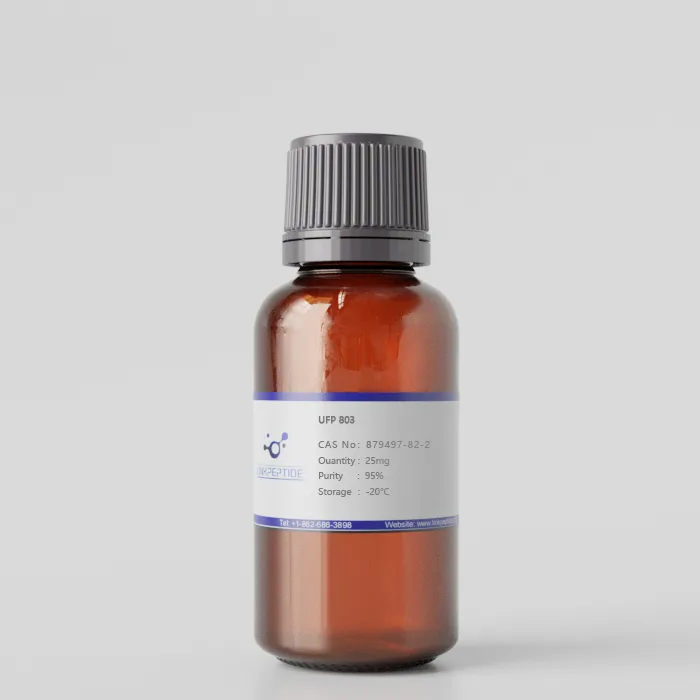
Product Name:UFP 803
CAS No:879497-82-2
Purity:95%
Molar Mass:1061.24
Chemical Formula:C50H64N10O12S2
Storage:Store at -20 degrees Celsius
Sequence:DXFWXYCV
Target:urotensin-II
Application:UFP 803 is a synthetic peptide that acts as a selective antagonist for the neuropeptide S receptor (NPSR). Neuropeptide S (NPS) and its receptor are involved in regulating various physiological processes, including arousal, anxiety, and respiratory function. By blocking the NPSR, UFP 803 is used in research to investigate the neurobiological mechanisms behind anxiety, stress responses, and sleep-wake cycles. It is particularly valuable in preclinical studies aiming to develop therapeutic strategies for anxiety disorders, insomnia, and other neuropsychiatric conditions. This antagonist helps researchers dissect the specific roles of NPS signaling in these processes.
Current Research:
UFP-803 is a synthetic peptide ligand that targets the urotensin-II receptor (UT), a G protein-coupled receptor implicated in various physiological processes, including cardiovascular regulation and central nervous system functions. Structurally, UFP-803 is an octapeptide with the sequence H-Asp-Pen-Phe-Trp-Dab-Tyr-Cys-Val-OH, featuring a disulfide bridge between Pen² and Cys⁷. This configuration enhances its binding affinity and specificity for the UT receptor.
Pharmacologically, UFP-803 functions primarily as a UT receptor antagonist. In vitro studies have demonstrated that UFP-803 can competitively inhibit urotensin-II-induced contractions in rat aortic tissues, with a pA₂ value of 7.46. Additionally, it has been shown to prevent urotensin-II-induced plasma extravasation in murine models, indicating its efficacy in vivo. Notably, UFP-803 exhibits minimal residual agonist activity, making it a valuable tool for dissecting the physiological and pathological roles of the UT system.
The specificity and potency of UFP-803 have facilitated its use in research exploring the UT receptor's involvement in cardiovascular diseases, such as hypertension and heart failure, as well as its potential role in neurological disorders. By selectively modulating UT receptor activity, UFP-803 aids in elucidating the receptor's functions and assessing its viability as a therapeutic target.
In summary, UFP-803 serves as an effective and selective UT receptor ligand with low residual agonist activity, providing researchers with a precise instrument to investigate the UT system's contributions to various physiological and pathological conditions.
Reference:
Get a Quote
 LinkPeptide

![[Nphe1]Nociceptin(1-13)NH2](https://www.linkpeptide.com/wp-content/uploads/2024/10/Nphe1Nociceptin1-13NH2-jpg-3.webp "[Nphe1]Nociceptin(1-13)NH2")