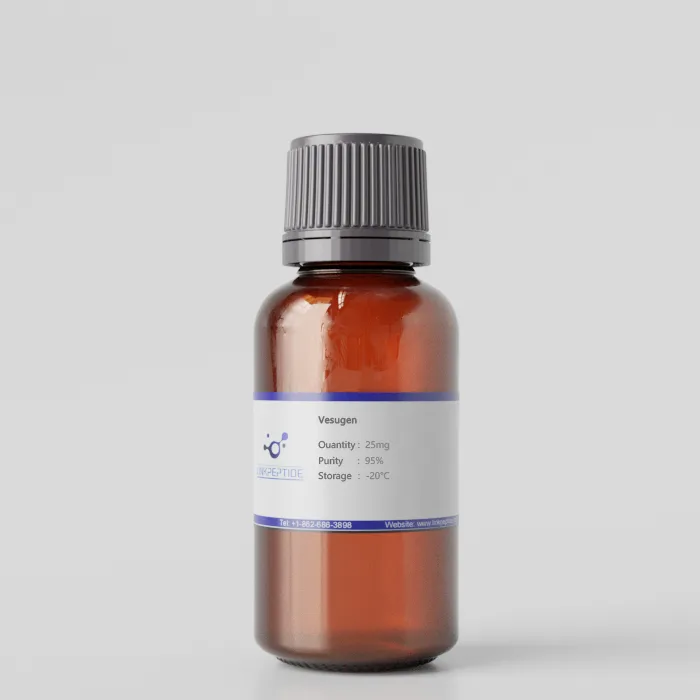
Product Name:Vesugen
Purity:95%
Chemical Formula:C15H26N4O8
Molar Mass:390.39
Synonyms:Lys-Glu-Asp; lysylglutamyl aspartic acid; lysyl-glutamyl-aspartic acid; SCHEMBL3767701
IUPAC Name:(2S)-2-[[(2S)-4-carboxy-2-[[(2S)-2,6-diaminohexanoyl]amino]butanoyl]amino]butanedioic acid
SMILES:C(CCN)C[C@@H](C(=O)N[C@@H](CCC(=O)O)C(=O)N[C@@H](CC(=O)O)C(=O)O)N
InChIKey:LLSUNJYOSCOOEB-GUBZILKMSA-N
InChI:InChI=1S/C15H26N4O8/c16-6-2-1-3-8(17)13(24)18-9(4-5-11(20)21)14(25)19-10(15(26)27)7-12(22)23/h8-10H,1-7,16-17H2,(H,18,24)(H,19,25)(H,20,21)(H,22,23)(H,26,27)/t8-,9-,10-/m0/s1
Storage:-20 degree Celsius
Sequence:KED
Application:Vesugen is a short peptide bioregulator derived from vascular endothelial tissue, developed to support the structural and functional integrity of blood vessels. It regulates gene expression involved in endothelial repair, vascular tone, and microcirculatory balance, making it ideal for studies on cardiovascular aging, hypertension, atherosclerosis, and microvascular dysfunction. Vesugen promotes angiogenesis, collagen-elastin balance, and anti-inflammatory responses within vascular walls. It is widely used in research focused on vascular health maintenance, especially in conditions associated with diabetes, oxidative stress, or age-related endothelial decline, offering a non-pharmaceutical, epigenetic approach to vascular rejuvenation.
Current Research:Introduction: What Is Vesugen? Vesugen is a cytogenetic peptide bioregulator derived from vascular endothelial tissue, specifically designed to restore vascular function and regulate gene expression in the cells lining blood vessels. Developed by the St. Petersburg Institute of Bioregulation and Gerontology, Vesugen is part of a class of organ-specific peptides that interact directly with nuclear DNA, modulating transcription to support organ regeneration and functional homeostasis. Vesugen targets vascular endothelial cells, which are vital for maintaining blood vessel tone, barrier function, and inflammatory balance throughout the circulatory system. Mechanism of Action: Epigenetic Vascular Regulation Vesugen operates via chromatin-level modulation, binding to GC-rich DNA regions in endothelial cell nuclei. This allows it to: Stimulate transcription of genes related to: Nitric oxide (NO) synthesis Angiogenesis (e.g., VEGF pathways) Antioxidant defense enzymes Collagen and elastin synthesis Downregulate inflammatory mediators such as: TNF-α, IL-1β Matrix metalloproteinases (MMPs) This coordinated effect helps stabilize vascular walls, restore microvascular tone, and enhance tissue perfusion, particularly under conditions of chronic stress, aging, or metabolic dysfunction. Applications in Cardiovascular Aging Aging vascular systems suffer from: Loss of endothelial elasticity Increased arterial stiffness Decreased nitric oxide bioavailability Heightened systemic inflammation Vesugen has been studied in elderly populations and animal models for its ability to: Improve vascular compliance Reduce arterial stiffness Support capillary density Lower inflammatory cytokine expression These effects contribute to enhanced circulatory efficiency, particularly in the brain, retina, kidneys, and peripheral tissues, making Vesugen a candidate for supporting healthy vascular aging. Support in Hypertension and Atherosclerosis In experimental models of hypertension and atherogenesis, Vesugen was observed to: Normalize vascular tone Reduce oxidative stress within the vascular wall Improve endothelial barrier function Inhibit plaque development and vascular inflammation Its modulation of collagen-elastin homeostasis supports arterial flexibility, while nitric oxide enhancement promotes vasodilation without pharmacologic receptor stimulation, offering a gentler mode of vascular tone management. Microcirculatory and Diabetic Complications Vesugen has shown value in models of diabetic microangiopathy, where small blood vessels are damaged due to chronic hyperglycemia. It improves: Capillary perfusion Endothelial repair and turnover Mitochondrial energy production in endothelial cells This suggests its relevance for research into diabetic neuropathy, retinopathy, and chronic wound healing, where impaired microvascular flow is a major limiting factor. Neurovascular Protection and Stroke Recovery Vesugen has also been studied for its ability to support cerebral blood flow in aging and post-ischemic models. It: Enhances angiogenesis in ischemic brain tissue Reduces blood–brain barrier leakage Improves oxygen and nutrient delivery to neurons Reduces stroke-induced inflammation These effects may support recovery of cognitive function and post-stroke rehabilitation, particularly when combined with neuroprotective peptides. Conclusion Vesugen is a vascular-specific peptide bioregulator with a wide range of applications in cardiovascular, microcirculatory, and endothelial health research. By influencing gene expression in vascular cells, it supports vascular tone, tissue perfusion, and inflammatory balance, especially under conditions of aging, metabolic stress, or chronic disease. Vesugen offers a non-pharmacologic, epigenetic method for promoting vascular resilience and longevity, making it an essential tool in the advancement of peptide-based regenerative medicine.
Reference:
Get a Quote
 LinkPeptide