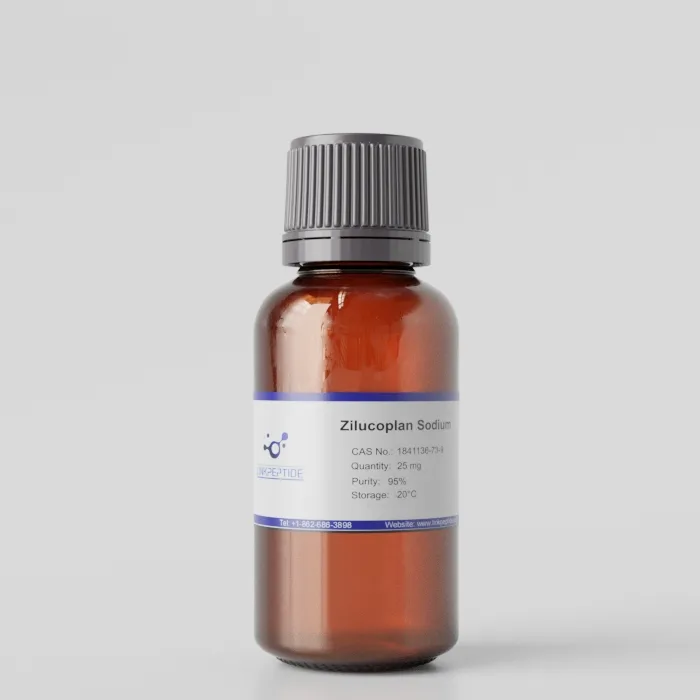
Product Name: Zilucoplan Sodium
Form: Acetate salt
CAS No: 1841136-73-9
Molar Mass: 3562.18
Chemical Formula: C172H278N24O55
Synonyms: RA101495
Storage: Store at -20℃
Target: complement component 5
Application:
Zilucoplan sodium (CAS: 1841136-73-9) is a synthetic peptide-based inhibitor of complement component 5 (C5), a key protein in the complement cascade involved in immune response regulation. Zilucoplan functions by binding to C5 and preventing its cleavage into C5a and C5b, thereby inhibiting the formation of the membrane attack complex (MAC) and downstream inflammatory responses mediated by C5a. This inhibition helps to mitigate excessive complement activation, which is implicated in the pathogenesis of various autoimmune diseases, particularly neuromuscular disorders such as myasthenia gravis. Zilucoplan sodium is being investigated for its potential in the treatment of myasthenia gravis, offering a targeted approach to modulating the dysregulated immune response underlying this condition. In pharmaceutical chemistry, zilucoplan sodium's specific inhibition of C5 represents a promising advancement in autoimmune disease therapy, providing a novel therapeutic option for patients with myasthenia gravis who may not respond adequately to conventional immunosuppressive treatments. Ongoing clinical trials aim to further evaluate its safety, efficacy, and long-term outcomes, with the goal of improving disease management and quality of life for individuals with myasthenia gravis.
Current Research:
Zilucoplan sodium is a novel, investigational peptide-based therapy designed for the treatment of autoimmune diseases, particularly generalized myasthenia gravis (gMG). It is a complement inhibitor that works by binding to the complement component C5, thereby preventing its cleavage into C5a and C5b, which are crucial in the activation of the complement system. This mechanism of action helps to reduce inflammation and the damage caused by the immune system in diseases like myasthenia gravis. By inhibiting the complement cascade, Zilucoplan has the potential to significantly improve muscle strength and reduce the severity of symptoms in patients suffering from autoimmune conditions.
Mechanism of Action
Zilucoplan sodium works by targeting and inhibiting C5, a key protein in the complement system, which is part of the body’s immune response. Specifically, it prevents the activation of C5 into its active fragments, C5a and C5b. C5a is involved in inflammatory processes, and C5b contributes to the formation of the membrane attack complex (MAC), which can damage healthy tissues. By inhibiting C5 activation, Zilucoplan sodium reduces the excessive inflammation and cellular damage seen in autoimmune diseases like generalized myasthenia gravis (gMG). This inhibition is key to modulating the immune system’s attack on neuromuscular junctions, thus helping to improve muscle function and reduce fatigue in affected individuals.
Indications and Uses
Zilucoplan sodium is primarily being investigated for the treatment of generalized myasthenia gravis (gMG), a severe form of myasthenia gravis characterized by muscle weakness and fatigue due to autoantibodies attacking neuromuscular junctions. The drug is being developed to help alleviate the symptoms of gMG, particularly in patients who do not respond adequately to traditional treatments like acetylcholinesterase inhibitors or immunosuppressants. Additionally, Zilucoplan has potential applications in other autoimmune conditions where complement activation plays a central role, such as complement-mediated diseases, paroxysmal nocturnal hemoglobinuria (PNH), and dry age-related macular degeneration (AMD).
Efficacy and Clinical Benefits
Clinical trials have demonstrated that Zilucoplan sodium can significantly reduce the severity of symptoms associated with generalized myasthenia gravis. In phase 2 studies, patients treated with Zilucoplan showed improved muscle strength and reduced fatigue compared to those receiving placebo. The improvement in Quantitative Myasthenia Gravis (QMG) scores, which is a primary endpoint for assessing muscle strength and function, was substantial, indicating its potential as an effective treatment option for this debilitating condition. In addition, Zilucoplan has shown a rapid onset of action, with improvements observed within the first few weeks of treatment, which is critical for patients suffering from acute symptoms of gMG.
Safety and Tolerability
Zilucoplan sodium has shown a generally favorable safety and tolerability profile in clinical trials. The most common side effects observed were mild to moderate injection site reactions, including pain, redness, and swelling. These reactions are typical of subcutaneous injections and tend to resolve after a short time. Some patients reported mild headaches and gastrointestinal symptoms such as nausea. Serious adverse events were rare, but like other therapies targeting the immune system, there may be an increased risk of infections due to immune modulation. Monitoring for infections and regular assessment of liver and kidney function is recommended, especially with long-term use.
Advantages and Limitations
One of the major advantages of Zilucoplan sodium is its rapid onset of action, which is particularly beneficial for patients with generalized myasthenia gravis who experience frequent and debilitating symptoms. Additionally, as a complement inhibitor, it offers a novel mechanism of action that addresses the underlying immunologic cause of the disease, rather than simply managing symptoms. This makes it an attractive option for patients who have not responded to traditional immunosuppressive therapies. However, its use is currently limited to subcutaneous injection, which may not be convenient for all patients. Further research is needed to assess its long-term safety profile and the full extent of its benefits across a wider range of autoimmune disorders.
Future Directions
The future development of Zilucoplan sodium will focus on confirming its long-term safety and efficacy in generalized myasthenia gravis and other complement-mediated autoimmune diseases. Ongoing clinical trials aim to establish its role as a first-line treatment or adjunctive therapy for gMG, especially for patients with severe forms of the disease or those who are refractory to existing treatments. Additionally, Zilucoplan’s potential in other complement-related diseases, such as paroxysmal nocturnal hemoglobinuria (PNH) and age-related macular degeneration (AMD), is being explored. As research progresses, the goal will be to optimize dosing, identify biomarkers for patient selection, and potentially expand its use to other autoimmune and inflammatory conditions.
Reference:
Get a Quote
 LinkPeptide