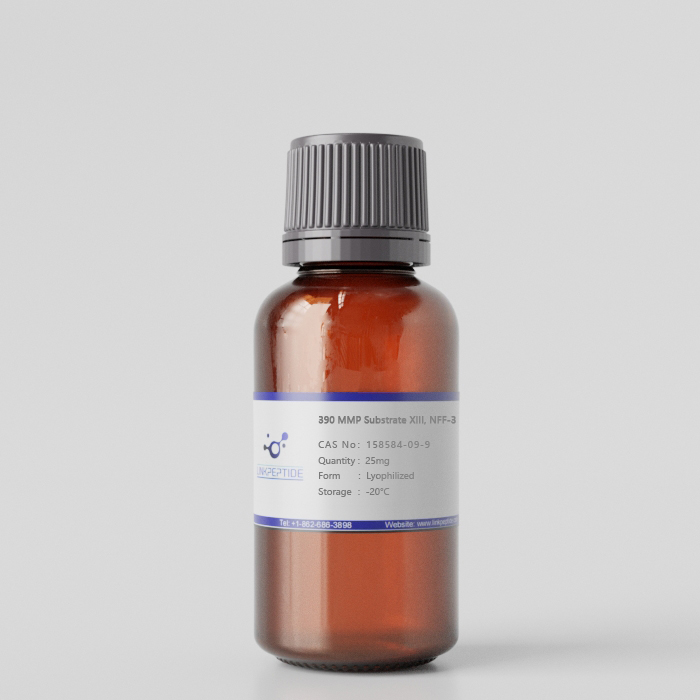
Product Name: 390 MMP Substrate XIII, NFF-3
Sequence One Letter Code: Mca-RPKPVE-Nva-WR-K(Dnp)-NH2
Sequence Three Letter Code: Mca-Arg-Pro-Lys-Pro-Val-Glu-Nva-Trp-Arg-Lys(Dnp)-NH2
Cas No: 158584-09-9
Chemical Formula:C78H110N22O20
Molecular Weight: 1675.9
Purity: 95%
Form: Lyophilized
Storage Conditions: - 20 °C Protected from light
Research Area: peptide substrate
SMILES: CCC[C@@H](C(=O)N[C@@H](CC1=CNC2=CC=CC=C21)C(=O)N[C@@H](CCCNC(=N)N)C(=O)N[C@@H](CCCCNC3=C(C=C(C=C3)[N+](=O)[O-])[N+](=O)[O-])C(=O)N)NC(=O)[C@H](CCC(=O)O)NC(=O)[C@H](C(C)C)NC(=O)[C@@H]4CCCN4C(=O)[C@H](CCCCN)NC(=O)[C@@H]5CCCN5C(=O)[C@H](CCCNC(=N)N)NC(=O)CC6=CC(=O)OC7=C6C=CC(=C7)OC
IUPAC: (4S)-4-[[(2S)-2-[[(2S)-1-[(2S)-6-amino-2-[[(2S)-1-[(2S)-5-carbamimidamido-2-[[2-(7-methoxy-2-oxochromen-4-yl)acetyl]amino]pentanoyl]pyrrolidine-2-carbonyl]amino]hexanoyl]pyrrolidine-2-carbonyl]amino]-3-methylbutanoyl]amino]-5-[[(2S)-1-[[(2S)-1-[[(2S)-1-[[(2S)-1-amino-6-(2,4-dinitroanilino)-1-oxohexan-2-yl]amino]-5-carbamimidamido-1-oxopentan-2-yl]amino]-3-(1H-indol-3-yl)-1-oxopropan-2-yl]amino]-1-oxopentan-2-yl]amino]-5-oxopentanoic acid
INCHIKEY: TVZDWYYXHAIMCR-BKNSPTOHSA-N
INCHI:
InChI=1S/C78H110N22O20/c1-5-16-53(68(106)95-58(37-45-42-88-50-18-7-6-17-48(45)50)71(109)92-54(21-12-33-86-77(81)82)69(107)90-52(67(80)105)19-9-11-32-85-51-28-25-46(99(115)116)40-61(51)100(117)118)91-70(108)55(29-30-64(102)103)93-74(112)66(43(2)3)96-73(111)60-24-15-36-98(60)76(114)57(20-8-10-31-79)94-72(110)59-23-14-35-97(59)75(113)56(22-13-34-87-78(83)84)89-63(101)38-44-39-65(104)120-62-41-47(119-4)26-27-49(44)62/h6-7,17-18,25-28,39-43,52-60,66,85,88H,5,8-16,19-24,29-38,79H2,1-4H3,(H2,80,105)(H,89,101)(H,90,107)(H,91,108)(H,92,109)(H,93,112)(H,94,110)(H,95,106)(H,96,111)(H,102,103)(H4,81,82,86)(H4,83,84,87)/t52-,53-,54-,55-,56-,57-,58-,59-,60-,66-/m0/s1
Conjugation: Conjugated
Conjugation Type: Double dyes
Code Nacres: NA.26
Application: MMP Substrate XIII, NFF-3 is a synthetic fluorogenic peptide developed for selective analysis of matrix metalloproteinase activity, particularly MMP-3. Matrix metalloproteinases are zinc-dependent endopeptidases involved in extracellular matrix remodeling and regulation of biological processes such as cell migration, proliferation, angiogenesis, and inflammation. NFF-3 is hydrolyzed efficiently by MMP-3, exhibiting a catalytic efficiency (kcat/Km) of 218,000 s⁻¹·M⁻¹, while showing minimal activity toward MMP-9 and negligible cleavage by MMP-1 or MMP-2. This selectivity enables discrimination of MMP-3 activity within complex enzymatic mixtures. Proteolytic cleavage generates a fluorescence signal detected at absorption and emission wavelengths of 325 and 393 nm. The substrate is suitable for kinetic studies, inhibitor evaluation, and comparative profiling of metalloproteinase activity in cancer, inflammation, and extracellular matrix biology research applications.
Current Research: MMP Substrate XIII, NFF-3 is a synthetic fluorogenic peptide specifically developed for selective detection of matrix metalloproteinase-3 (MMP-3) activity. Matrix metalloproteinases (MMPs) are zinc-dependent endopeptidases that regulate extracellular matrix (ECM) degradation and process a wide range of bioactive molecules involved in cell migration, proliferation, angiogenesis, and inflammatory signaling. Among them, MMP-3 (stromelysin-1) plays a key role in tissue remodeling and can activate additional MMP family members, amplifying proteolytic cascades in pathological settings. NFF-3 has been optimized to provide high catalytic efficiency toward MMP-3 while maintaining limited susceptibility to other MMP isoforms. It is hydrolyzed efficiently by MMP-3, with a catalytic efficiency (kcat/Km) of approximately 218,000 s⁻¹·M⁻¹. In contrast, it exhibits minimal activity toward MMP-9 and negligible cleavage by MMP-1 or MMP-2. This selectivity profile allows researchers to discriminate MMP-3 activity within complex enzymatic mixtures, including conditioned media, tissue extracts, or multi-enzyme assay systems. Such specificity is particularly valuable given the structural similarity and overlapping substrate preferences among MMP family members. The substrate operates on a fluorogenic detection principle. In its intact form, fluorescence is quenched due to intramolecular interactions within the peptide construct. Upon proteolytic cleavage by MMP-3, the fluorophore is released or structurally separated from its quenched state, resulting in a measurable fluorescence increase. The signal can be detected at absorption and emission wavelengths of approximately 325 nm and 393 nm, respectively. Because fluorescence intensity directly reflects enzymatic cleavage, the assay supports real-time kinetic monitoring as well as endpoint quantification. MMP Substrate XIII, NFF-3 is well suited for kinetic characterization of MMP-3 activity. Researchers can determine reaction velocities, evaluate enzyme concentration–dependent responses, and calculate kinetic parameters under defined experimental conditions. Continuous fluorescence measurement enhances temporal resolution and enables accurate modeling of catalytic behavior. In inhibitor development and pharmacological profiling, NFF-3 provides a sensitive platform for evaluating MMP-3–selective inhibitors. Given the role of MMP-3 in tumor invasion, inflammatory tissue damage, and joint degradation in diseases such as rheumatoid arthritis, selective targeting of this enzyme is of significant therapeutic interest. The substrate’s specificity ensures that observed reductions in fluorescence signal primarily reflect inhibition of MMP-3 rather than off-target suppression of related metalloproteinases. Beyond inhibitor screening, the substrate supports comparative enzyme profiling across MMP isoforms. By assessing cleavage efficiency in parallel assays, investigators can characterize substrate selectivity patterns and better understand structural determinants of enzyme–substrate recognition. This contributes to broader efforts aimed at defining isoform-specific biological functions within the MMP family. In cancer biology, NFF-3 enables analysis of MMP-3 activity associated with tumor microenvironment remodeling and metastasis. In inflammation and fibrosis research, it supports investigation of proteolytic processes that influence cytokine activation and ECM turnover. Its compatibility with microplate-based formats further facilitates medium- to high-throughput applications. Overall, MMP Substrate XIII, NFF-3 provides a selective and quantitative tool for analyzing MMP-3 catalytic function. Its defined specificity, high catalytic efficiency, and fluorescence-based detection make it well suited for kinetic studies, inhibitor evaluation, and mechanistic exploration of metalloproteinase activity in extracellular matrix and disease-related research contexts.
Get a Quote
 LinkPeptide