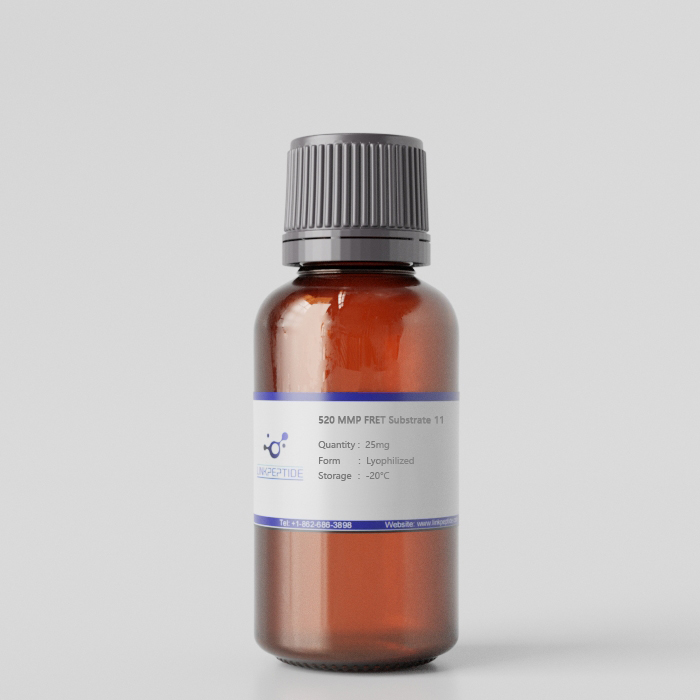
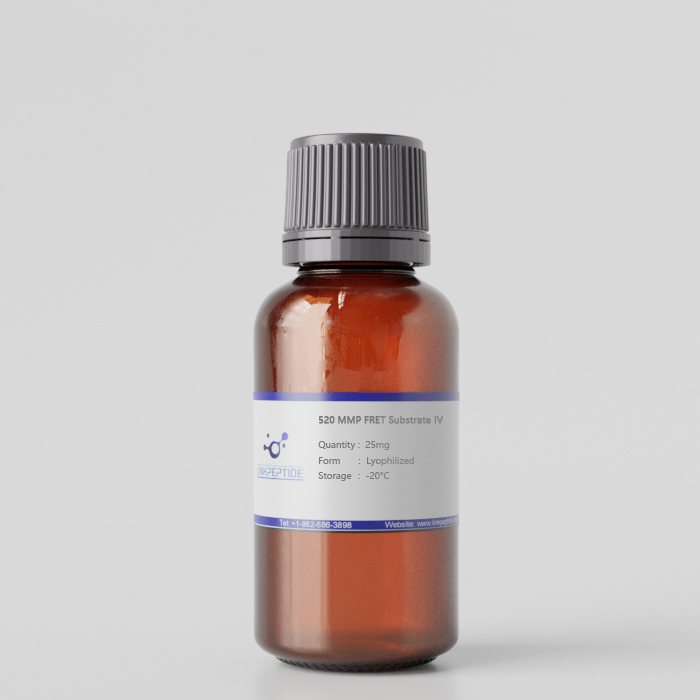
Product Name: 520 MMP FRET Substrate 11
Sequence One Letter Code: 5-FAM-P-Cha-G-Nva-HA-Dap(QXL® 520)-NH2
Sequence Three Letter Code: 5-FAM-Pro-Cha-Gly-Nva-His-Ala-Dap(QXL® 520)-NH2
Molecular Weight: 1567.6
Purity: 95%
Form: Lyophilized
Storage Conditions: - 20 °C Protected from light
Research Area: Cancer Immunotherapy
Conjugation: Conjugated
Conjugation Type: Double dyes
Code Nacres: NA.26
Application: 520 MMP FRET Substrate 11 is a quenched fluorogenic peptide optimized for quantitative detection of matrix metalloproteinase activity in biochemical and cellular assays. Upon proteolytic cleavage by target MMP isoforms—including MMP-1, -2, -7, -8, -12, and -13—the donor–quencher pair is separated, generating a measurable fluorescence signal (Ex/Em 494/521 nm). This design enables real-time kinetic analysis and high-throughput screening of MMP modulators. Matrix metalloproteinases are zinc-dependent enzymes central to extracellular matrix remodeling, cytokine processing, and tumor invasion. Accordingly, this substrate is widely applied in cancer biology, inflammation research, angiogenesis studies, and tissue remodeling investigations. Its robust signal-to-background performance and compatibility with microplate readers make it suitable for enzyme characterization, inhibitor profiling, and cell-based activity monitoring in translational research settings.
Current Research: 520 MMP FRET Substrate 11 is a quenched fluorogenic peptide engineered for sensitive and quantitative measurement of matrix metalloproteinase (MMP) activity in biochemical, cellular, and high-throughput screening assays. Incorporating a fluorescence resonance energy transfer (FRET) donor–quencher pair, the intact substrate remains minimally fluorescent due to proximity-dependent quenching. Upon proteolytic cleavage by target MMP isoforms—including MMP-1, -2, -7, -8, -12, and -13—the fluorophore is physically separated from the quencher, resulting in a measurable fluorescence increase at Ex/Em 494/521 nm. This signal directly correlates with enzymatic activity, enabling real-time kinetic analysis. Mechanistic Basis of Detection Matrix metalloproteinases are zinc-dependent endopeptidases responsible for extracellular matrix (ECM) turnover and remodeling. They cleave structural proteins such as collagen, elastin, and gelatin, as well as bioactive molecules including cytokines and growth factors. The 520 MMP FRET Substrate 11 contains an optimized cleavage sequence recognized by multiple MMP family members, allowing broad profiling of enzymatic activity across key isoforms implicated in pathology. The FRET-based design provides several analytical advantages: Continuous monitoring of proteolysis High sensitivity with strong signal-to-background ratio Quantitative correlation between fluorescence intensity and cleavage rate Compatibility with microplate-based fluorescence readers Because fluorescence is generated only after enzymatic cleavage, background interference from uncleaved substrate is minimized, supporting accurate determination of kinetic parameters such as V_max and K_m. Applications in Cancer Research MMPs play a pivotal role in tumor progression by facilitating ECM degradation, basement membrane disruption, and metastatic dissemination. Elevated MMP activity is associated with epithelial–mesenchymal transition (EMT), angiogenesis, and invasive phenotypes in multiple cancer types. 520 MMP FRET Substrate 11 is widely used to: Quantify secreted MMP activity in tumor cell supernatants Assess the impact of oncogenic signaling on protease expression Evaluate candidate MMP inhibitors in drug discovery pipelines Monitor proteolytic remodeling in 3D tumor spheroid models Its real-time kinetic capability allows detailed comparison of inhibitor potency and mechanism of action. Role in Inflammation and Tissue Remodeling Studies Beyond oncology, MMPs regulate inflammatory processes through cytokine activation and leukocyte migration. MMP-8 and MMP-12, for example, are implicated in macrophage-driven inflammatory responses and tissue injury. The substrate enables dynamic measurement of protease activity in immune cell cultures, wound healing assays, and fibrosis models. In angiogenesis research, MMP-mediated ECM remodeling is essential for endothelial cell migration and vessel sprouting. Fluorogenic monitoring supports investigation of pro-angiogenic signaling pathways and matrix degradation kinetics under controlled experimental conditions. High-Throughput Screening and Enzyme Profiling The spectral properties (Ex 494 nm / Em 521 nm) are compatible with standard fluorescence microplate instrumentation, facilitating scalable workflows for: Inhibitor screening Structure–activity relationship (SAR) studies Comparative isoform profiling Evaluation of metalloproteinase modulators Because the substrate supports multiplexed assay formats and reproducible kinetic readouts, it is particularly suitable for translational research and early-stage therapeutic development. Experimental Advantages Broad reactivity across major MMP isoforms Robust fluorescence increase upon cleavage Real-time quantitative monitoring Adaptable to biochemical and cell-based systems Suitable for high-throughput applications Overall, 520 MMP FRET Substrate 11 provides a reliable and sensitive platform for investigating matrix metalloproteinase biology. By enabling precise quantification of proteolytic activity, it supports mechanistic studies of extracellular matrix remodeling, tumor invasion, inflammatory signaling, and therapeutic inhibitor development in modern translational research settings.
Get a Quote
 LinkPeptide