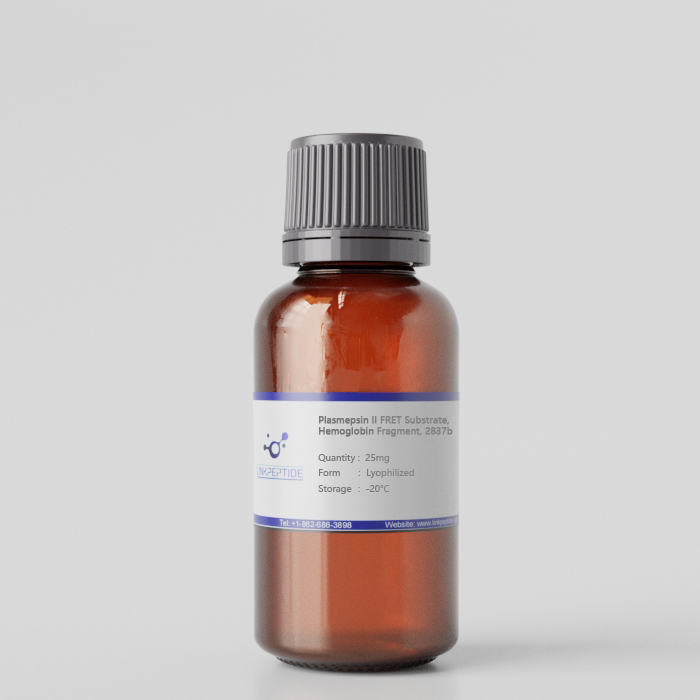
Product Name: Plasmepsin II FRET Substrate, Hemoglobin Fragment, 2837b
Sequence One Letter Code: EDANS-CO-CH2-CH2-CO-ALERMFLSFP-Dap(DABCYL)OH
Sequence Three Letter Code: EDANS-CO-CH2-CH2-CO-Ala-Leu-Glu-Arg-Met-Phe-Leu-Ser-Phe-Pro-Dap(DABCYL)-OH
Molecular Weight: 1896
Purity: 95%
Form: Lyophilized
Storage Conditions: - 20 °C Protected from light
Research Area: Infection Disease Research
Source / Species: Plasmodium
Conjugation: Conjugated
Conjugation Type: Double dyes
Code Nacres: NA.26
Application: Plasmepsin II FRET Substrate 2837b is a synthetic peptide modeled on the primary cleavage site of plasmepsin II within the hemoglobin α-chain. Plasmepsin II is an aspartic protease essential for hemoglobin degradation during the intraerythrocytic stage of Plasmodium development. The peptide incorporates a fluorescence resonance energy transfer (FRET) reporter pair, allowing real-time detection of proteolytic cleavage through fluorescence signal increase. It is suitable for quantitative enzyme kinetics, inhibitor screening, and mechanistic studies of parasite protease activity. This substrate supports malaria research focused on antimalarial drug discovery targeting hemoglobin-degrading proteases.
Current Research: Plasmepsin II is a key aspartic protease expressed by Plasmodium species during the intraerythrocytic stage of malaria infection. Within infected erythrocytes, the parasite degrades host hemoglobin inside the acidic digestive vacuole to obtain amino acids required for growth and replication. Plasmepsin II initiates this proteolytic cascade by cleaving the hemoglobin α-chain at defined primary sites, facilitating subsequent processing by additional parasite proteases. Because hemoglobin degradation is essential for parasite survival, plasmepsin II represents a validated molecular target in antimalarial drug discovery. Plasmepsin II FRET Substrate 2837b is a synthetic peptide engineered to mimic the principal cleavage sequence within the hemoglobin α-chain recognized by plasmepsin II. By modeling the native substrate context, the peptide preserves key sequence determinants required for efficient enzyme recognition and catalysis. This design ensures physiologically relevant interaction kinetics while offering the experimental flexibility of a defined synthetic substrate. A distinguishing feature of this substrate is the incorporation of a fluorescence resonance energy transfer (FRET) reporter pair. Typically, the peptide is labeled at opposing termini with a donor fluorophore and an acceptor (quencher) moiety. In the intact peptide, proximity between the donor and acceptor suppresses fluorescence emission through energy transfer. Upon proteolytic cleavage at the plasmepsin II recognition site, the donor and acceptor are physically separated, resulting in an increase in fluorescence intensity. This signal change provides a direct and real-time readout of enzymatic activity. The FRET-based format enables continuous kinetic monitoring without the need for secondary detection reagents or endpoint assays. Reaction progress curves can be recorded in microplate readers under controlled pH conditions that replicate the acidic environment of the parasite digestive vacuole. From these measurements, researchers can determine fundamental kinetic parameters, including Km, Vmax, kcat, and catalytic efficiency. Such quantitative data are essential for mechanistic characterization of enzyme function and comparison of wild-type and mutant proteases. In drug discovery applications, Plasmepsin II FRET Substrate 2837b is particularly suited for high-throughput inhibitor screening. Candidate compounds can be evaluated for their ability to reduce fluorescence signal generation, reflecting inhibition of substrate cleavage. Because the assay is homogeneous and compatible with microplate formats, it supports rapid evaluation of large compound libraries. Dose–response analyses yield IC50 values, and subsequent kinetic modeling can differentiate between competitive, noncompetitive, or mixed inhibition mechanisms. Mechanistic investigations of plasmepsin II also benefit from this substrate. The defined sequence allows precise mapping of cleavage specificity and examination of how structural features within the active site govern substrate binding. Comparative studies with related parasite aspartic proteases, such as plasmepsin I or other hemoglobin-degrading enzymes, can elucidate differences in substrate preference and catalytic efficiency. Such distinctions are critical for designing selective inhibitors that minimize off-target effects. The substrate additionally supports research into resistance-associated mutations and structure–function relationships. By testing enzyme variants against the same FRET-based substrate, investigators can assess how amino acid substitutions influence catalytic performance or inhibitor susceptibility. Coupled with structural biology approaches, these data inform rational design strategies for next-generation antimalarial therapeutics. Overall, Plasmepsin II FRET Substrate 2837b provides a sensitive, quantitative, and physiologically relevant platform for monitoring parasite protease activity. By combining a hemoglobin-derived cleavage sequence with a fluorescence-based detection system, it enables real-time kinetic analysis, inhibitor screening, and mechanistic evaluation. As efforts continue to identify novel antimalarial agents targeting hemoglobin-degrading proteases, this substrate serves as a valuable tool in advancing therapeutic discovery and understanding parasite biology.
Get a Quote
 LinkPeptide