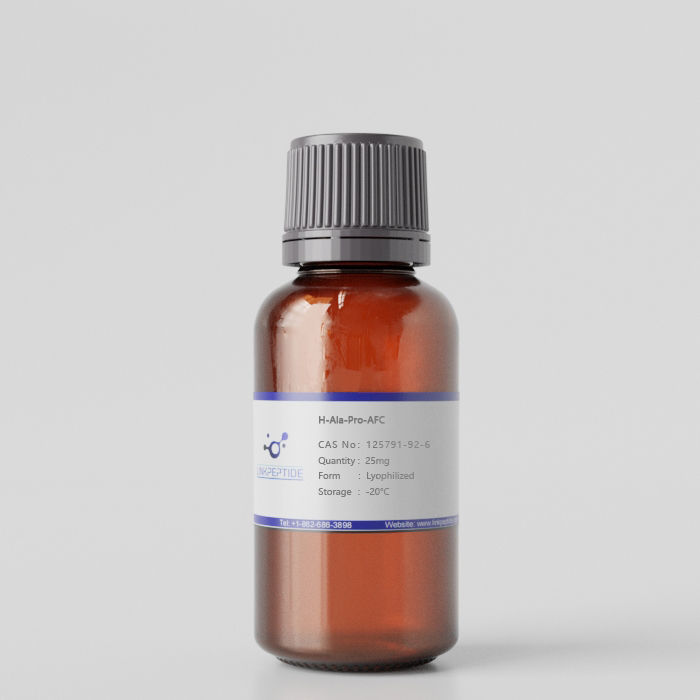
Product Name: H-Ala-Pro-AFC
Sequence One Letter Code: AP-AFC
Sequence Three Letter Code: H-Ala-Pro-AFC
Cas No: 125791-92-6
Chemical Formula:C18H18F3N3O4
Molecular Weight: 397.4
Purity: 95%
Form: Lyophilized
Storage Conditions: - 20 °C Protected from light
Research Area: peptide substrate
SMILES: C[C@@H](C(=O)N1CCC[C@H]1C(=O)NC2=CC3=C(C=C2)C(=CC(=O)O3)C(F)(F)F)N
IUPAC: (2S)-1-[(2S)-2-aminopropanoyl]-N-[2-oxo-4-(trifluoromethyl)chromen-7-yl]pyrrolidine-2-carboxamide
INCHIKEY: GGRRKBLWOMKWNS-ZANVPECISA-N
INCHI: InChI=1S/C18H18F3N3O4/c1-9(22)17(27)24-6-2-3-13(24)16(26)23-10-4-5-11-12(18(19,20)21)8-15(25)28-14(11)7-10/h4-5,7-9,13H,2-3,6,22H2,1H3,(H,23,26)/t9-,13-/m0/s1
Source / Species: Synthetic construct
Conjugation: Conjugated
Conjugation Type: Fluorescent dyes
Code Nacres: NA.26
Application: H-Ala-Pro-AFC is a fluorogenic dipeptide substrate designed for enzymatic assays of proline-specific peptidases. It is efficiently hydrolyzed by dipeptidyl peptidase IV (DPP IV/CD26) and Xaa-Pro dipeptidase, enzymes implicated in metabolic regulation and immune function. Enzymatic cleavage releases the AFC fluorophore, producing measurable fluorescence (Ex 380 nm, Em 500 nm) that enables sensitive, real-time monitoring of enzyme activity. This substrate is well suited for kinetic studies, inhibitor screening, and functional analysis of proline-directed peptidases.
Current Research: H-Ala-Pro-AFC is a fluorogenic dipeptide substrate developed for sensitive detection of proline-specific peptidase activity. The substrate consists of the dipeptide Ala–Pro conjugated to 7-amino-4-trifluoromethylcoumarin (AFC), a fluorescent reporter that is released upon enzymatic cleavage. It is efficiently hydrolyzed by enzymes such as dipeptidyl peptidase IV (DPP IV/CD26) and Xaa–Pro dipeptidase, both of which play significant roles in metabolic and immune regulatory pathways. Upon cleavage of the peptide bond adjacent to the proline residue, free AFC is liberated, generating a fluorescent signal measurable at approximately excitation 380 nm and emission 500 nm. This fluorescence increase directly correlates with enzymatic activity, enabling real-time kinetic monitoring. Biological Context Dipeptidyl Peptidase IV (DPP IV/CD26) DPP IV is a membrane-associated serine protease widely expressed on epithelial, endothelial, and immune cells. It selectively removes N-terminal dipeptides from peptides containing proline or alanine at the penultimate position. DPP IV is critically involved in: Glucose metabolism (inactivation of incretin hormones such as GLP-1 and GIP) Immune regulation (T cell activation and cytokine processing) Inflammatory signaling Because DPP IV inhibitors are established therapeutics in type 2 diabetes, accurate measurement of DPP IV activity is central to metabolic research and drug development. Xaa–Pro Dipeptidase This enzyme hydrolyzes dipeptides containing C-terminal proline and contributes to peptide turnover and amino acid metabolism. Functional analysis often requires sensitive substrates that distinguish proline-specific cleavage. Mechanism of Detection H-Ala-Pro-AFC remains minimally fluorescent when intact. Enzymatic cleavage between the dipeptide and the AFC moiety releases free AFC, resulting in: Increased fluorescence intensity Continuous signal accumulation over time Direct proportionality between fluorescence output and enzymatic rate This design allows both endpoint measurements and continuous kinetic analysis without secondary reagents. Research Applications 1. Enzyme Kinetics The substrate is well suited for determining kinetic parameters (Km, Vmax) of DPP IV and related enzymes under controlled conditions. 2. Inhibitor Screening H-Ala-Pro-AFC is commonly used in high-throughput screening assays to evaluate small-molecule inhibitors targeting DPP IV or other proline-directed peptidases. Decreased AFC release indicates effective inhibition. 3. Metabolic and Endocrine Research In studies investigating incretin biology or glucose homeostasis, this substrate enables functional assessment of DPP IV activity in serum, plasma, or cell lysates. 4. Immunological Studies Because CD26/DPP IV participates in T cell activation and immune signaling, the substrate supports research into immune modulation and inflammatory mechanisms. Experimental Considerations Assay performance depends on buffer composition, pH (typically near neutral to slightly alkaline), and appropriate substrate concentration relative to enzyme Km. Fluorescence measurements should be performed using a calibrated fluorimeter with suitable excitation and emission filters. Inclusion of selective DPP IV inhibitors (e.g., sitagliptin analogs) can confirm assay specificity.
Get a Quote
 LinkPeptide