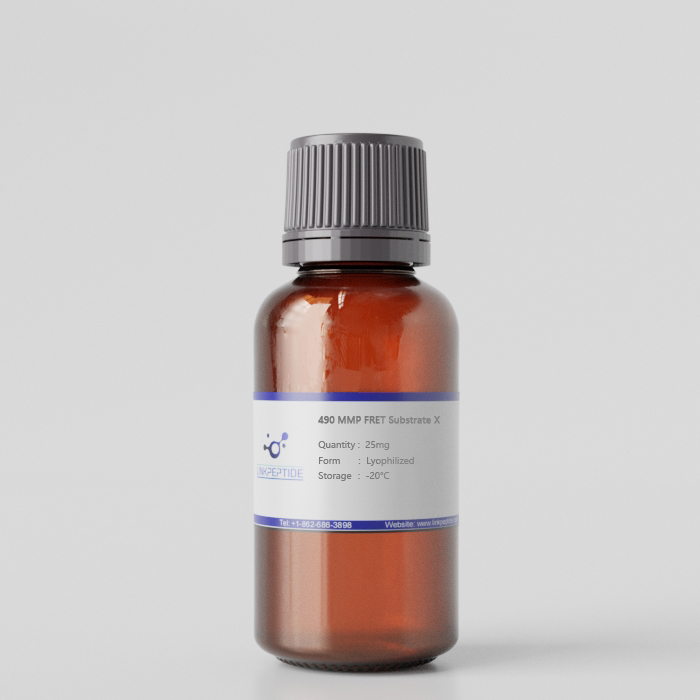
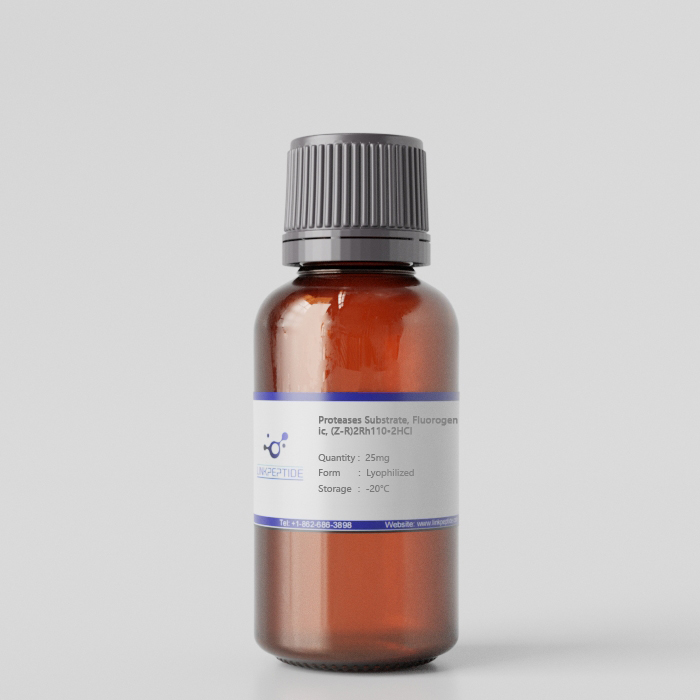
Product Name: 490 MMP FRET Substrate X
Sequence One Letter Code: DABCYL-RPLALWRS-EDANS
Sequence Three Letter Code: DABCYL-Arg-Pro-Leu-Ala-Leu-Trp-Arg-Ser-EDANS
Chemical Formula:C73H100N20O13S
Molecular Weight: 1497.8
Purity: 95%
Form: Lyophilized
Storage Conditions: - 20 °C Protected from light
Research Area: peptide substrate
Conjugation: Conjugated
Conjugation Type: Double dyes
Code Nacres: NA.26
Application: 490 MMP FRET Substrate X is a fluorogenic peptide substrate optimized for selective detection of matrix metalloproteinase-7 (MMP-7) activity. Matrix metalloproteinases are zinc-dependent endopeptidases that regulate extracellular matrix remodeling and process bioactive molecules involved in inflammation, tissue repair, and cell signaling. This substrate incorporates an MMP-7–preferred cleavage sequence, with hydrolysis occurring specifically at the Ala–Leu bond. In its intact form, fluorescence resonance energy transfer (FRET) maintains signal quenching. Proteolytic cleavage disrupts FRET, generating a measurable fluorescence increase detected at excitation and emission wavelengths of 340 and 490 nm. The substrate enables sensitive and quantitative assessment of MMP-7 catalytic activity in biochemical assays and cell-based systems. It is well suited for kinetic characterization, comparative enzyme profiling, and high-throughput screening of selective MMP-7 inhibitors in cancer, inflammation, and extracellular matrix biology research applications.
Current Research: 490 MMP FRET Substrate X is a fluorogenic peptide substrate specifically engineered for sensitive detection of matrix metalloproteinase-7 (MMP-7) activity. MMP-7, also known as matrilysin, is a zinc-dependent endopeptidase that plays a central role in extracellular matrix (ECM) remodeling and the proteolytic processing of bioactive molecules. Unlike many other matrix metalloproteinases that are primarily produced by stromal cells, MMP-7 is frequently expressed by epithelial and tumor cells, linking its activity to cancer progression, inflammation, and tissue repair processes. This substrate incorporates a peptide sequence preferentially recognized by MMP-7, with enzymatic cleavage occurring specifically at the Ala–Leu bond. The design ensures high selectivity and efficient catalytic turnover, allowing accurate measurement of enzyme activity in both purified systems and complex biological samples. By modeling a physiologically relevant cleavage motif, the substrate provides a reliable biochemical tool for characterizing MMP-7–mediated proteolysis. The assay principle is based on fluorescence resonance energy transfer (FRET). In the intact peptide, a donor fluorophore and a quencher are positioned in close proximity, resulting in efficient energy transfer and suppression of fluorescence emission. Upon proteolytic cleavage by MMP-7, the donor and quencher are physically separated, disrupting FRET and producing a measurable increase in fluorescence. The resulting signal can be detected at excitation and emission wavelengths of approximately 340 nm and 490 nm, respectively. This fluorescence gain directly correlates with enzymatic activity, enabling real-time kinetic monitoring or endpoint quantification. 490 MMP FRET Substrate X supports a broad range of experimental applications. In kinetic studies, it allows determination of catalytic parameters such as Km and Vmax, providing insight into substrate affinity and turnover efficiency. These measurements are essential for understanding enzyme regulation, activation mechanisms, and differences between wild-type and variant forms of MMP-7. Because fluorescence generation is continuous and quantitative, reaction rates can be precisely monitored over time without the need for additional processing steps. The substrate is also suitable for comparative profiling among related matrix metalloproteinases. Although optimized for MMP-7, it can be used to evaluate relative cleavage efficiency across MMP family members, helping define substrate specificity and selectivity. Such comparisons are particularly important given the structural similarities among MMP catalytic domains and the overlapping substrate preferences that can complicate biological interpretation. In drug discovery and translational research, 490 MMP FRET Substrate X is widely applied in inhibitor screening campaigns. MMP-7 activity is implicated in tumor invasion, metastasis, and inflammatory tissue remodeling. The fluorogenic readout provides a robust assay window compatible with microplate-based and high-throughput screening formats. Candidate inhibitors can be evaluated for potency and selectivity by measuring reductions in fluorescence generation relative to untreated controls. This approach supports structure–activity relationship studies and optimization of selective MMP-7–targeted therapeutics. Beyond oncology, the substrate facilitates investigation of MMP-7 roles in wound healing, epithelial barrier regulation, and cytokine processing. In cell-based assays, it enables monitoring of secreted or membrane-associated enzyme activity under physiologically relevant conditions. Integration with imaging systems or conditioned media analysis expands its utility in studying dynamic proteolytic events. Overall, 490 MMP FRET Substrate X provides a sensitive, quantitative, and adaptable platform for assessing MMP-7 catalytic function. Its selective cleavage sequence, FRET-based detection mechanism, and compatibility with kinetic and high-throughput applications make it a valuable reagent for research in cancer biology, inflammation, and extracellular matrix remodeling.
Get a Quote
 LinkPeptide