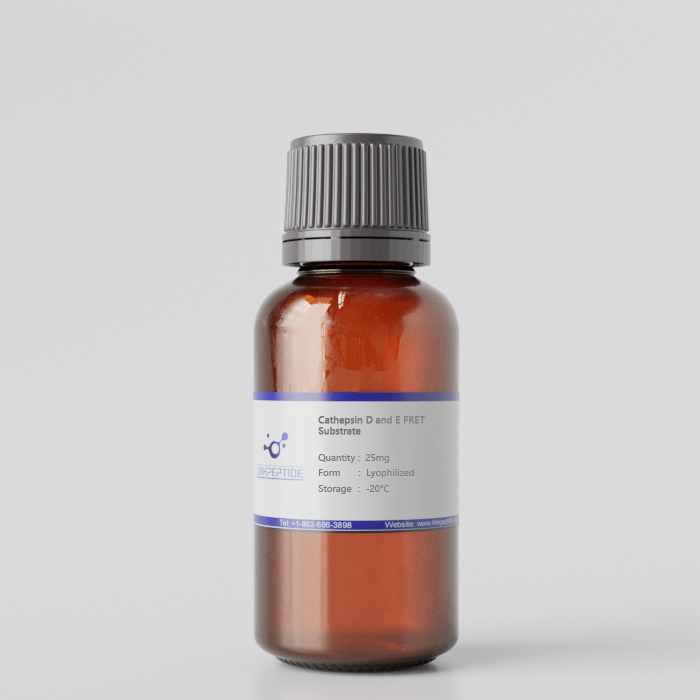
Product Name: Cathepsin D and E FRET Substrate
Sequence One Letter Code: Mca-GKPILFFRLK(Dnp)-r-NH2
Sequence Three Letter Code: 7-Methoxycoumarin-4-Acetyl-Gly-Lys-Pro-Ile-Leu-Phe-Phe-Arg-Leu-Lys(Dnp)-D-Arg-NH2
Molecular Weight: 1756.1
Purity: 95%
Form: Lyophilized
Storage Conditions: - 20 °C Protected from light
Research Area: peptide substrate
Conjugation: Conjugated
Conjugation Type: Double dyes
Code Nacres: NA.26
Application: This internally quenched fluorogenic peptide substrate is designed for selective measurement of cathepsin D and cathepsin E activity. Cathepsins are aspartic proteases that function in lysosomal protein degradation, antigen processing, and various extracellular signaling processes. The peptide contains a Phe–Phe cleavage site that is specifically recognized by cathepsins D and E. Upon enzymatic cleavage, the quenched fluorophore becomes fluorescent, producing a strong signal with excitation and emission maxima around 328 and 393 nm. The substrate exhibits high specificity for cathepsins D and E and shows minimal activity toward other cathepsin family members such as B, H, and L. It is widely used in enzymatic activity assays, inhibitor screening, and studies of protease function in cell and tissue extracts.
Current Research: Proteases play essential roles in cellular physiology by regulating protein turnover, signal transduction, and immune responses. Among them, cathepsins represent a major group of proteolytic enzymes primarily localized within lysosomes. These enzymes participate in protein degradation, antigen processing, and various signaling pathways associated with cellular homeostasis and disease. Within this family, cathepsin D and cathepsin E are classified as aspartic proteases and are widely studied for their roles in intracellular proteolysis and extracellular regulatory processes. Fluorogenic peptide substrates designed for these enzymes provide a powerful approach for measuring protease activity in biochemical and cellular systems. One such research tool is an internally quenched fluorogenic peptide substrate engineered for selective detection of cathepsin D and cathepsin E activity. This substrate incorporates a specific cleavage sequence and a fluorescence-based detection system that allows highly sensitive monitoring of enzymatic activity. Cathepsin D and Cathepsin E in Cellular Proteolysis Cathepsin D and cathepsin E belong to the aspartic protease family, characterized by catalytic aspartate residues that mediate peptide bond hydrolysis. Although both enzymes share structural similarities, they differ in cellular localization and physiological roles. Cathepsin D is primarily located in lysosomes and is involved in: Degradation of intracellular proteins Turnover of damaged or misfolded proteins Regulation of apoptosis and autophagy Processing of certain bioactive peptides In contrast, cathepsin E is mainly found in endosomal and secretory compartments and plays roles in: Antigen processing for immune presentation Protein maturation within secretory pathways Regulation of immune and inflammatory responses Because these enzymes contribute to protein homeostasis and immune signaling, abnormal cathepsin activity has been linked to diseases such as cancer, neurodegeneration, and inflammatory disorders. Design of the Fluorogenic Peptide Substrate The fluorogenic substrate is designed with an internally quenched fluorescence system, allowing enzymatic activity to be measured through changes in fluorescence intensity. In the intact peptide, the fluorophore is positioned close to a quencher group, suppressing fluorescence emission. A key feature of this substrate is the inclusion of a Phe–Phe (phenylalanine–phenylalanine) cleavage site, which is preferentially recognized by cathepsins D and E. When the enzyme cleaves this peptide bond, the fluorophore becomes physically separated from the quencher. This separation restores fluorescence, producing a measurable signal. Upon cleavage, the released fluorophore exhibits excitation and emission maxima around 328 nm and 393 nm, enabling detection using standard fluorescence spectrometers or microplate readers. High Specificity for Cathepsins D and E One advantage of this fluorogenic peptide is its high selectivity for cathepsin D and cathepsin E. The Phe–Phe recognition motif is efficiently processed by these aspartic proteases but shows minimal susceptibility to cleavage by other members of the cathepsin family. In particular, the substrate demonstrates low activity toward cysteine cathepsins, including: Cathepsin B Cathepsin H Cathepsin L This specificity helps reduce background signal and ensures more accurate measurement of cathepsin D/E activity in complex biological samples. Applications in Enzyme Activity Assays Fluorogenic peptide substrates are widely used in protease activity assays because they provide rapid, quantitative readouts of enzymatic reactions. The cathepsin D/E substrate is commonly applied in experiments designed to measure enzyme activity in purified systems or biological extracts. Typical experimental uses include: Kinetic assays to determine enzyme activity and catalytic efficiency Protease profiling in cell or tissue lysates Comparative studies of protease expression in different biological conditions Quantification of lysosomal proteolytic activity Because fluorescence increases in proportion to substrate cleavage, researchers can monitor enzyme activity continuously in real time. Use in Inhibitor Screening and Drug Discovery Cathepsins D and E are increasingly investigated as potential therapeutic targets due to their involvement in disease processes such as tumor progression, immune dysregulation, and neurodegeneration. As a result, fluorogenic substrates are often used in high-throughput screening assays designed to identify inhibitors of these enzymes. By measuring changes in fluorescence in the presence of candidate compounds, researchers can rapidly evaluate how different molecules influence protease activity. This approach supports the discovery and characterization of potential modulators of cathepsin function. Studying Protease Function in Biological Systems Beyond purified enzyme assays, the fluorogenic substrate can also be used to investigate protease activity in cell and tissue extracts. These experiments help researchers understand how cathepsin activity is regulated under different physiological or pathological conditions. For example, activity-based measurements can reveal how cathepsin expression or activation changes during cellular stress, immune responses, or disease progression. Supporting Research on Proteolytic Regulation Proteolytic enzymes are central to many biological processes, and precise tools are required to study their activity in complex systems. The internally quenched fluorogenic peptide substrate for cathepsins D and E provides a sensitive and selective method for monitoring aspartic protease activity. By combining a specific cleavage sequence with a fluorescence-based detection system, this substrate enables accurate measurement of enzyme activity in biochemical assays, inhibitor screening studies, and investigations of protease function in cells and tissues. As research continues to explore the roles of cathepsins in health and disease, fluorogenic substrates remain essential tools for advancing our understanding of protease biology.
Get a Quote
 LinkPeptide