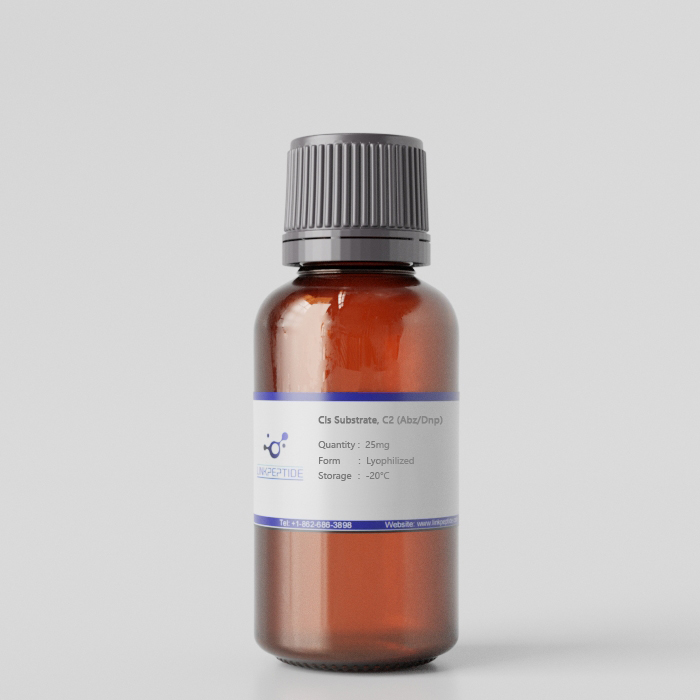
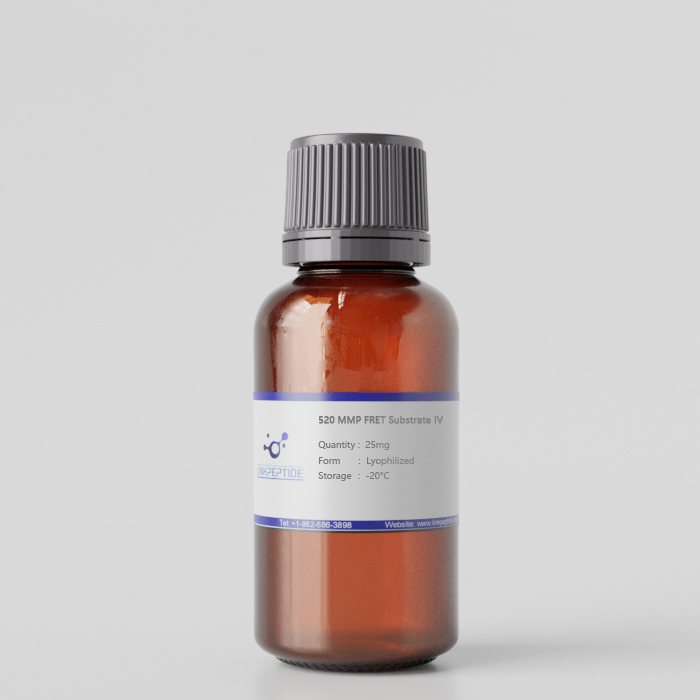
Product Name: Cls Substrate, C2 (Abz/Dnp)
Sequence One Letter Code: 2Abz-SLGRKIQIK(Dnp)-NH2
Sequence Three Letter Code: 2Abz-Ser-Leu-Gly-Arg-Lys-Ile-Gln-Ile-Lys(Dnp)-NH2
Molecular Weight: 1326.6
Purity: 95%
Form: Lyophilized
Storage Conditions: - 20 °C Protected from light
Research Area: peptide substrate
Source / Species: synthetic
Conjugation: Conjugated
Conjugation Type: Double dyes Code Nacres: NA.26 Application: C1s Substrate, C2 (Abz/Dnp) is a synthetic fluorogenic peptide derived from complement component C2, the physiological substrate of the serine protease C1s within the C1 complex. C1s activation initiates the classical complement pathway, a key component of innate immunity and inflammatory signaling. This peptide incorporates an Abz/Dnp fluorescence resonance energy transfer (FRET) pair, enabling sensitive and quantitative measurement of C1s proteolytic activity. Upon enzymatic cleavage, fluorescence increases, allowing real-time kinetic analysis. The substrate is suitable for complement activation studies, enzyme kinetics assays, inhibitor screening, and research on inflammatory and immune-mediated disorders involving complement pathway dysregulation. Current Research: C1s Substrate, C2 (Abz/Dnp) is a synthetic fluorogenic peptide designed from the cleavage site of complement component C2, the physiological substrate of the serine protease C1s within the C1 complex. C1s is a core enzymatic component of the classical complement pathway and becomes activated following C1q recognition of immune complexes. Once activated, C1s cleaves C4 and C2, generating the C3 convertase (C4b2a) and thereby initiating downstream complement cascade amplification. This peptide substrate incorporates an Abz/Dnp fluorescence resonance energy transfer (FRET) pair, typically consisting of o-aminobenzoic acid (Abz) as the fluorophore and 2,4-dinitrophenyl (Dnp) as the quencher. In the intact peptide, proximity between Abz and Dnp suppresses fluorescence through intramolecular quenching. Upon cleavage by C1s at the engineered recognition site, the fluorophore and quencher are spatially separated, resulting in increased fluorescence emission. This design enables real-time monitoring of proteolytic activity with high sensitivity and temporal resolution. Because C1s specifically recognizes and cleaves defined sequences within C2, this substrate provides a physiologically relevant tool for evaluating C1s enzymatic function. The assay format is particularly suitable for kinetic measurements, allowing determination of parameters such as initial reaction velocity, Km, kcat, and catalytic efficiency under controlled conditions. Continuous fluorescence readout facilitates high-throughput screening and quantitative comparison across enzyme variants or experimental treatments. In complement biology research, the C1s Substrate, C2 (Abz/Dnp) is widely applied to study activation mechanisms of the classical pathway. It supports analysis of C1 complex assembly, autoactivation processes, and regulatory influences from complement control proteins. Because dysregulation of the classical complement pathway contributes to autoimmune diseases, inflammatory disorders, and certain renal pathologies, this substrate enables mechanistic dissection of C1s-mediated cleavage events in disease-relevant models. The peptide is also valuable for inhibitor screening and drug discovery efforts targeting complement-mediated pathology. Small-molecule inhibitors, monoclonal antibodies, or engineered regulatory proteins designed to block C1s activity can be quantitatively evaluated using FRET-based assays. Changes in fluorescence intensity directly reflect enzymatic inhibition, making the system suitable for IC50 determination and mechanistic characterization of competitive or noncompetitive inhibitors. In addition, this fluorogenic substrate supports comparative studies of related serine proteases within the complement system, helping to define substrate specificity and cleavage preferences. By modifying sequence elements within the peptide backbone, researchers can probe recognition determinants and map active site interactions. Such structure–activity analyses contribute to understanding how C1s discriminates between physiological substrates and non-specific targets. Methodologically, assays using the Abz/Dnp substrate are typically performed in buffered systems optimized for serine protease activity, with fluorescence monitored using excitation and emission wavelengths appropriate for the Abz fluorophore. The real-time kinetic format reduces the need for endpoint measurements and minimizes assay variability. Overall, C1s Substrate, C2 (Abz/Dnp) is a sensitive and quantitative tool for investigating classical complement pathway activation. By enabling real-time measurement of C1s proteolytic activity, it supports enzyme kinetics studies, complement activation research, inhibitor development, and mechanistic exploration of inflammatory and immune-mediated disorders associated with complement dysregulation.
Get a Quote
 LinkPeptide