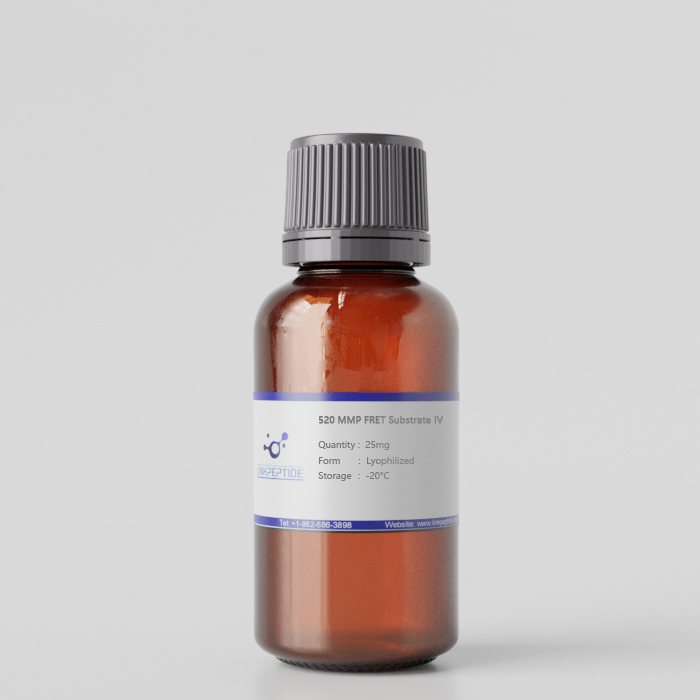
Product Name: 520 MMP FRET Substrate IV
Sequence One Letter Code: QXL® 520-PLGLWArK(5-FAM)-NH2
Sequence Three Letter Code: QXL®520-Pro-Leu-Gly-Leu-Trp-Ala-D-Arg-Lys(5-FAM)-NH2
Molecular Weight: 1788.9
Purity: 95%
Form: Lyophilized
Storage Conditions: - 20 °C Protected from light
Research Area: peptide substrate
Conjugation: Conjugated
Conjugation Type: Double dyes
Code Nacres: NA.26
Application: 520 MMP FRET Substrate IV is a fluorogenic peptide designed for selective analysis of matrix metalloproteinase activity in extracellular matrix research. MMPs regulate matrix degradation, growth factor activation, and signaling pathways governing proliferation, migration, angiogenesis, apoptosis, and host defense. This FRET-based substrate is rapidly hydrolyzed by MMP-13 and more slowly cleaved by MMP-1, -2, -3, -8, -9, and -12, enabling preferential assessment of MMP-13 activity. Enzymatic cleavage disrupts fluorescence quenching and generates a measurable signal at Ex/Em 494/521 nm, supporting sensitive kinetic measurements and inhibitor studies.
Current Research: 520 MMP FRET Substrate IV is a fluorogenic peptide substrate developed for selective and sensitive analysis of matrix metalloproteinase (MMP) activity in extracellular matrix (ECM) research. The substrate incorporates a fluorescence resonance energy transfer (FRET) donor–quencher pair that maintains low background fluorescence in its intact state. Proteolytic cleavage by target MMPs disrupts quenching, resulting in a measurable fluorescence signal at approximately Ex 494 nm / Em 521 nm. This substrate is rapidly hydrolyzed by MMP-13 (collagenase-3) and more slowly cleaved by MMP-1, -2, -3, -8, -9, and -12, making it particularly useful for preferential assessment of MMP-13 activity in mixed protease environments. Biological Context Matrix metalloproteinases are zinc-dependent endopeptidases that regulate ECM turnover and remodeling. They play essential roles in: Collagen and elastin degradation Growth factor release and activation Cell migration and invasion Angiogenesis Apoptosis and tissue repair Host defense and inflammatory responses MMP-13 is especially implicated in cartilage degradation, tumor invasion, and fibrotic processes, making selective activity profiling important in musculoskeletal, oncologic, and inflammatory disease research. Mechanism of Detection The substrate contains a peptide sequence recognized by collagenase-family MMPs and a FRET pair engineered for efficient quenching. In the intact molecule: The donor fluorophore emission is suppressed by proximity to the quencher. Upon enzymatic cleavage: The peptide bond is hydrolyzed at the MMP recognition site. Donor and quencher are physically separated. Fluorescence intensity increases proportionally to enzymatic activity. This design enables real-time kinetic monitoring with high sensitivity and minimal background interference. Research Applications 1. Selective MMP-13 Profiling Because of its rapid hydrolysis by MMP-13, the substrate is particularly suited for studies examining collagenase-3 activity in cartilage degradation, osteoarthritis models, and tumor microenvironment remodeling. 2. Extracellular Matrix Remodeling Studies The substrate supports functional analysis of ECM turnover in cancer progression, wound healing, fibrosis, and angiogenesis research. 3. Inhibitor Screening 520 MMP FRET Substrate IV is compatible with high-throughput screening formats for evaluating small-molecule or biologic inhibitors targeting MMP-13 or related MMPs. 4. Comparative MMP Activity Analysis Its differential cleavage rates allow assessment of relative MMP subtype contributions in complex biological samples, such as conditioned media or tissue extracts. Advantages High sensitivity FRET-based detection Low background fluorescence Preferential responsiveness to MMP-13 Real-time kinetic measurement capability Suitable for purified enzymes and complex samples Experimental Considerations Optimal assay performance requires appropriate buffer conditions including zinc and calcium ions necessary for MMP catalytic function. Pro-MMP activation (e.g., via APMA treatment) may be required prior to analysis. Inclusion of selective MMP inhibitors can confirm specificity in mixed protease systems.
Get a Quote
 LinkPeptide