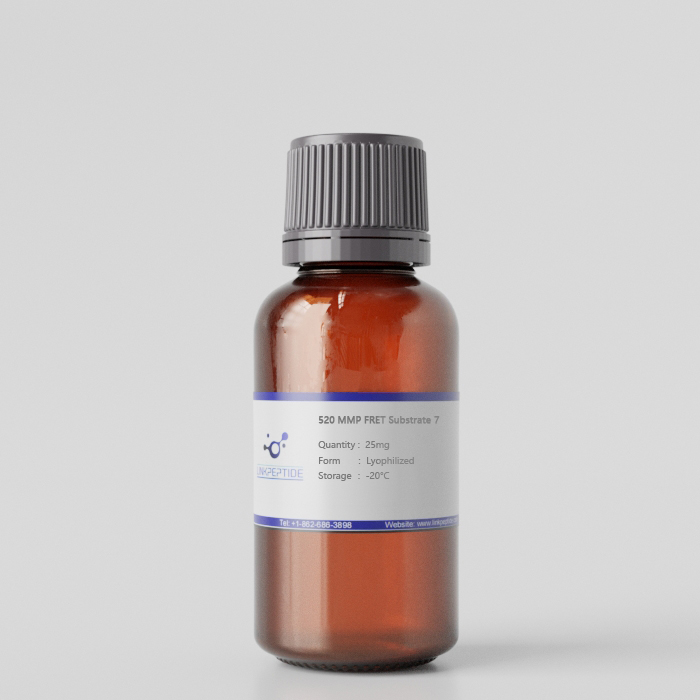
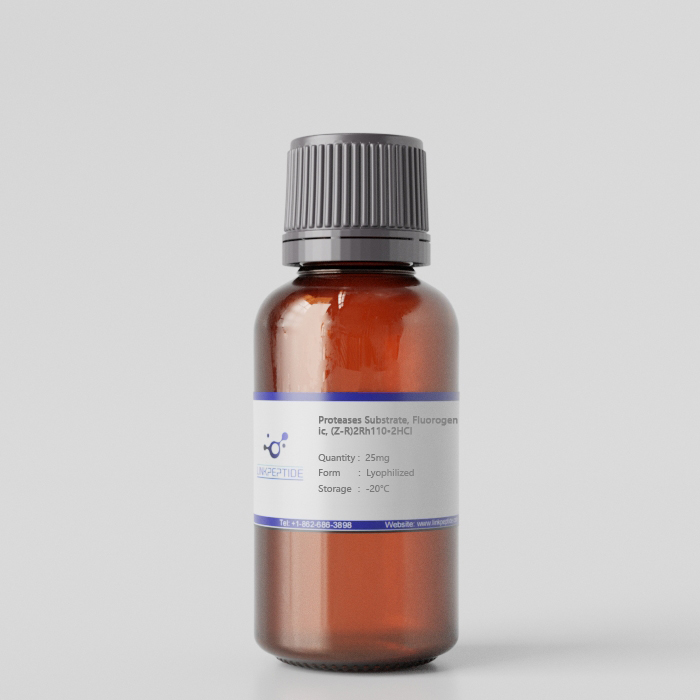
Product Name: 520 MMP FRET Substrate 7
Sequence One Letter Code: QXL® 520-PYAYWMRK(5-FAM)-NH2
Sequence Three Letter Code: QXL® 520-Pro-Tyr-Ala-Tyr-Trp-Met-Arg-Lys(5-FAM)-NH2
Molecular Weight: 1963.1
Purity: 95%
Form: Lyophilized
Storage Conditions: - 20 °C Protected from light
Research Area: peptide substrate
Conjugation: Conjugated
Conjugation Type: Double dyes
Code Nacres: NA.26
Application: 520 MMP FRET Substrate 7 is a fluorogenic peptide substrate developed for targeted detection of MMP-7, MMP-12, and MMP-13 activity in extracellular matrix research. Cleavage of the FRET pair relieves fluorescence quenching and generates a measurable signal at excitation/emission 494/521 nm. The substrate supports kinetic analysis, inhibitor evaluation, and functional characterization of MMP-mediated proteolytic pathways involved in tissue remodeling and inflammatory signaling.
Current Research: 520 MMP FRET Substrate 7 is a fluorogenic peptide substrate engineered for selective detection of matrix metalloproteinase (MMP) activity, with preferential responsiveness to MMP-7 (matrilysin), MMP-12 (macrophage elastase), and MMP-13 (collagenase-3). The substrate incorporates a fluorescence resonance energy transfer (FRET) donor–quencher pair that maintains minimal baseline fluorescence in its intact state. Proteolytic cleavage separates the fluorophore from the quencher, generating a fluorescence signal measurable at approximately Ex 494 nm / Em 521 nm. This design enables sensitive, real-time monitoring of specific MMP activity in biochemical and complex biological systems. Biological Context MMP-7, MMP-12, and MMP-13 play important roles in extracellular matrix remodeling and inflammatory processes: MMP-7: Degrades ECM components and processes bioactive molecules; implicated in epithelial remodeling and tumor progression. MMP-12: Primarily expressed by macrophages; contributes to elastin degradation and inflammatory tissue damage. MMP-13: A potent collagenase involved in cartilage breakdown, fibrosis, and cancer-associated matrix remodeling. Targeted measurement of these enzymes is critical in studies of chronic inflammation, arthritis, pulmonary disease, fibrosis, and tumor invasion. Mechanism of Detection The substrate contains: An MMP recognition sequence optimized for MMP-7, -12, and -13 A fluorophore emitting at ~521 nm A proximal quencher suppressing fluorescence via FRET In the uncleaved state, fluorescence is quenched. Upon enzymatic hydrolysis: The peptide bond at the cleavage site is broken. Donor and quencher are spatially separated. Fluorescence intensity increases proportionally to enzymatic activity. This FRET-based approach provides high sensitivity and a favorable signal-to-background ratio. Research Applications 1. Targeted MMP Activity Profiling The substrate is suited for assessing MMP-7, MMP-12, and MMP-13 activity in cell culture supernatants, tissue extracts, or inflammatory samples. 2. Tissue Remodeling Studies It supports investigation of proteolytic pathways driving cartilage degradation, pulmonary elastin breakdown, and tumor microenvironment remodeling. 3. Inflammatory Signaling Research MMP-12 and MMP-13 are implicated in inflammatory disease progression. The substrate enables mechanistic analysis of protease-mediated signaling and ECM turnover. 4. Inhibitor Screening The fluorescence readout is compatible with high-throughput formats for evaluating selective MMP inhibitors. Reduced fluorescence indicates effective inhibition. Advantages Targeted responsiveness to MMP-7, -12, and -13 Low background fluorescence due to FRET quenching Real-time kinetic measurement capability Suitable for purified enzymes and complex biological samples Compatible with standard fluorescence instrumentation Experimental Considerations Assay conditions should include zinc and calcium ions required for MMP catalytic activity. Activation of pro-MMP forms may be necessary prior to analysis. Inclusion of selective MMP inhibitors can confirm enzyme specificity in mixed protease systems.
Get a Quote
 LinkPeptide