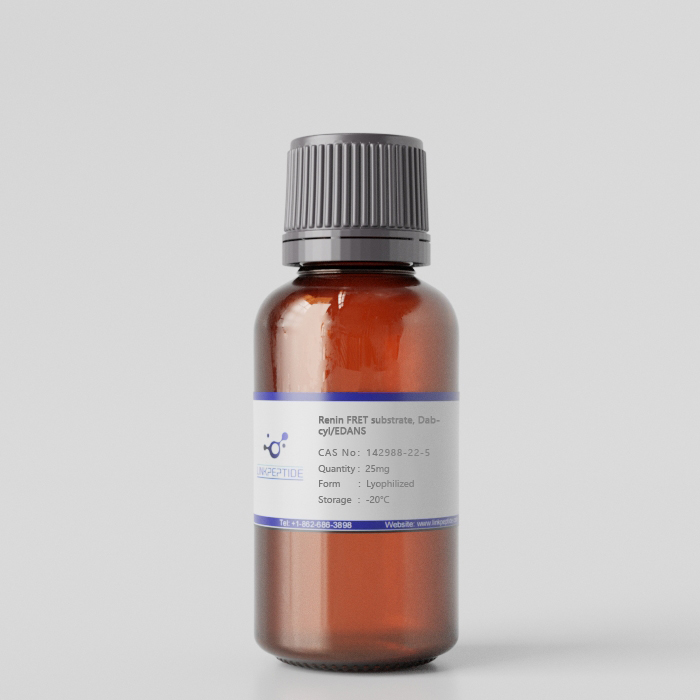
Product Name: Renin FRET Substrate, R-E(EDANS)--K(Dabcyl)
Sequence One Letter Code: R-E(EDANS)-IHPFHLVIHT-K(DABCYL)-R
Sequence Three Letter Code: H-Arg-Glu(EDANS)-Ile-His-Pro-Phe-His-Leu-Val-Ile-His-Thr-Lys(DABCYL)-Arg-OH
Cas No: 791068-69-4
Chemical Formula:C109H157N31O22S2
Molecular Weight: 2282.8
Purity: 95%
Form: Lyophilized
Storage Conditions: - 20 °C Protected from light
Research Area: peptide substrate
Source / Species: human
Conjugation: Conjugated
Conjugation Type: Double dyes
Code Nacres: NA.26
Application: Renin FRET Peptide Substrate (EDANS/DABCYL-Labeled) is a fluorogenic peptide derived from angiotensinogen and specifically engineered for fluorescence-based renin activity assays. The substrate incorporates a FRET donor–quencher pair (EDANS/DABCYL) that suppresses fluorescence until enzymatic cleavage occurs. When renin cleaves the peptide, the donor and quencher separate, generating a measurable fluorescence signal. Renin is the rate-limiting enzyme of the renin–angiotensin system (RAS), which regulates blood pressure, electrolyte balance, and fluid homeostasis through angiotensin signaling pathways. This FRET substrate enables sensitive monitoring of renin enzymatic activity, supporting kinetic characterization, inhibitor screening, and cardiovascular drug discovery studies in hypertension and renal disease research.
Current Research: The renin–angiotensin system (RAS) is a central hormonal pathway that regulates blood pressure, electrolyte balance, and fluid homeostasis. At the top of this cascade is renin, an aspartyl protease that catalyzes the first and rate-limiting step of the pathway. Because renin activity directly influences the production of angiotensin peptides and downstream cardiovascular signaling, precise methods for measuring renin function are essential in biomedical research. The Renin FRET Peptide Substrate (EDANS/DABCYL-labeled) provides a sensitive fluorescence-based system for detecting renin activity in biochemical and screening assays. Renin and the Renin–Angiotensin System Renin is secreted primarily by juxtaglomerular cells in the kidney in response to changes in blood pressure, sodium levels, or sympathetic nervous system stimulation. The enzyme initiates the RAS cascade by cleaving angiotensinogen, a circulating precursor protein produced by the liver. This cleavage produces angiotensin I, which is subsequently converted by angiotensin-converting enzyme (ACE) into angiotensin II, a potent vasoactive peptide. Angiotensin II exerts multiple physiological effects, including: Vasoconstriction of blood vessels Stimulation of aldosterone secretion Regulation of sodium and water balance Modulation of blood pressure Because renin controls the initial step in this pathway, its enzymatic activity determines the overall output of the RAS. Dysregulation of renin signaling is associated with hypertension, cardiovascular disease, and kidney disorders. Design of the Renin FRET Peptide Substrate The Renin FRET substrate is a synthetic peptide derived from the natural angiotensinogen cleavage site recognized by renin. The peptide is engineered with a fluorescence resonance energy transfer (FRET) pair, consisting of: EDANS (5-[(2-aminoethyl)amino]naphthalene-1-sulfonic acid) – fluorescent donor DABCYL (4-(dimethylaminoazo)benzene-4-carboxyl) – fluorescence quencher When the peptide substrate remains intact, the donor fluorophore and quencher are positioned close enough that fluorescence from EDANS is effectively suppressed through FRET quenching by DABCYL. This configuration ensures that the substrate produces minimal fluorescence signal before enzymatic cleavage, providing a low background for sensitive detection. Fluorescence Activation by Renin Cleavage When renin cleaves the peptide at the angiotensinogen-derived sequence, the EDANS donor and DABCYL quencher become physically separated. This separation disrupts the FRET interaction and restores fluorescence emission from EDANS. As a result, cleavage of the substrate produces a detectable increase in fluorescence, which can be measured using fluorescence plate readers or spectrofluorometers. Because fluorescence intensity increases proportionally with substrate cleavage, the assay allows quantitative measurement of renin enzymatic activity in real time. Applications in Enzyme Kinetics and Activity Assays The EDANS/DABCYL-labeled substrate is widely used in renin activity assays to analyze enzymatic properties under controlled conditions. Researchers frequently employ this substrate to determine: Reaction kinetics and catalytic efficiency Substrate specificity of renin Effects of mutations or structural changes in renin Enzyme activity in biological samples Continuous fluorescence monitoring enables real-time observation of enzymatic reactions, making it suitable for detailed kinetic studies. Inhibitor Screening and Drug Discovery Because the renin–angiotensin system is a major regulator of cardiovascular physiology, renin is an important target in antihypertensive drug development. Fluorescent FRET substrates provide an efficient platform for screening potential renin inhibitors. In screening assays, candidate compounds are tested for their ability to reduce substrate cleavage. Effective inhibitors decrease the fluorescence signal by suppressing renin activity. This approach allows rapid identification of molecules that may influence renin-mediated pathways. Such screening strategies are widely used in cardiovascular pharmacology and drug discovery programs. Applications in Cardiovascular and Renal Research Renin activity assays are valuable for studying the molecular regulation of the renin–angiotensin system in both physiological and pathological contexts. Using the FRET substrate, researchers can examine how renin activity changes in response to: Altered blood pressure regulation Kidney function and renal signaling pathways Hormonal regulation of fluid balance Pharmacological modulation of the RAS These studies contribute to understanding the mechanisms underlying hypertension, heart disease, and kidney disorders. Supporting Research on Renin Signaling The Renin FRET Peptide Substrate (EDANS/DABCYL-labeled) combines a renin-specific cleavage sequence with a sensitive fluorescence detection system. By enabling accurate monitoring of enzymatic activity, the substrate provides a powerful tool for studying renin function in biochemical assays. Through applications in enzyme kinetics analysis, inhibitor screening, and cardiovascular research, this fluorogenic peptide substrate supports ongoing efforts to understand and therapeutically target the renin–angiotensin system.
Get a Quote
 LinkPeptide