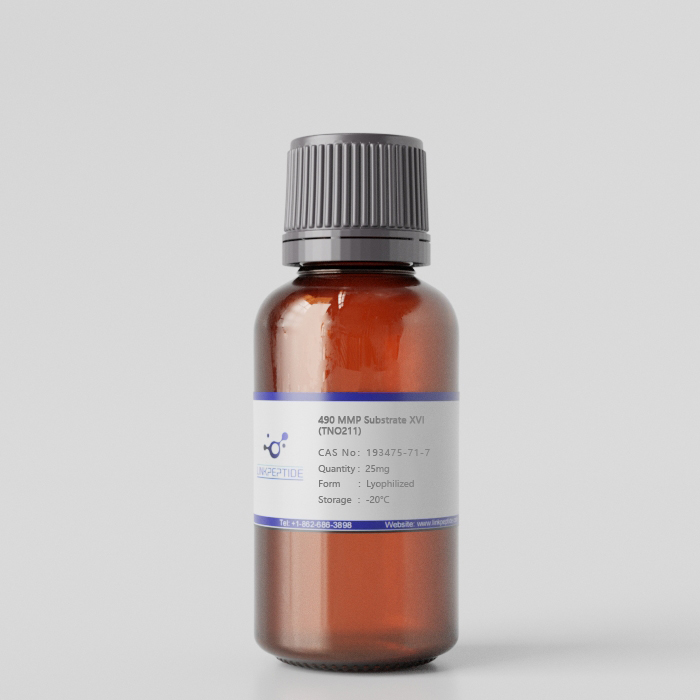
Product Name: 490 MMP Substrate XVI (TNO211)
Sequence One Letter Code: DABCYL-(γ-Abu)-PQGL-E(EDANS)AK-NH2
Sequence Three Letter Code: DABCYL-(γ-Abu)-Pro-Gln-Gly-Leu-Glu(EDANS)-Ala-Lys-NH2
Cas No: 193475-71-7
Chemical Formula:C63H88N16O14S
Molecular Weight: 1325.6
Purity: 95%
Form: Lyophilized
Storage Conditions: - 20 °C Protected from light
Research Area: peptide substrate
SMILES: C[C@@H](C(=O)N[C@@H](CCCCN)C(=O)N)NC(=O)[C@H](CCC(=O)OS(=O)(=O)C1=CC=CC2=C(C=CC=C21)CCN)NC(=O)[C@H](CC(C)C)NC(=O)CNC(=O)[C@H](CCC(=O)N)NC(=O)[C@@H]3CCCN3C(=O)CCCNC(=O)C4=CC=C(C=C4)N=NC5=CC=C(C=C5)N(C)C
IUPAC: [5-(2-aminoethyl)naphthalen-1-yl]sulfonyl (4S)-4-[[(2S)-2-[[2-[[(2S)-5-amino-2-[[(2S)-1-[4-[[4-[[4-(dimethylamino)phenyl]diazenyl]benzoyl]amino]butanoyl]pyrrolidine-2-carbonyl]amino]-5-oxopentanoyl]amino]acetyl]amino]-4-methylpentanoyl]amino]-5-[[(2S)-1-[[(2S)-1,6-diamino-1-oxohexan-2-yl]amino]-1-oxopropan-2-yl]amino]-5-oxopentanoate
INCHIKEY: IZGNTKLGZGISLF-HPRKGXSHSA-N
INCHI:
InChI=1S/C63H87N15O14S/c1-38(2)36-50(62(88)73-49(61(87)70-39(3)58(84)72-47(57(67)83)15-6-7-32-64)28-30-56(82)92-93(90,91)52-17-9-13-45-40(31-33-65)12-8-14-46(45)52)71-54(80)37-69-60(86)48(27-29-53(66)79)74-63(89)51-16-11-35-78(51)55(81)18-10-34-68-59(85)41-19-21-42(22-20-41)75-76-43-23-25-44(26-24-43)77(4)5/h8-9,12-14,17,19-26,38-39,47-51H,6-7,10-11,15-16,18,27-37,64-65H2,1-5H3,(H2,66,79)(H2,67,83)(H,68,85)(H,69,86)(H,70,87)(H,71,80)(H,72,84)(H,73,88)(H,74,89)/t39-,47-,48-,49-,50-,51-/m0/s1
Conjugation: Conjugated
Conjugation Type: Double dyes
Code Nacres: NA.26
Application: 490 MMP Substrate XVI (TNO211) is a highly soluble fluorogenic peptide substrate designed for sensitive detection of matrix metalloproteinase activity. It is cleaved by MMP-2, -8, -12, -13, and -14 at a Gly–Leu site and incorporates an EDANS/DABCYL FRET pair for low-background fluorescence measurement. Upon cleavage, fluorescence is detected at Ex 340 nm and Em 490 nm. This substrate is suitable for profiling MMP activity in complex samples, supporting research in extracellular matrix remodeling, angiogenesis, inflammation, and tissue pathology.
Current Research: 490 MMP Substrate XVI (TNO211) is a highly soluble, fluorogenic peptide substrate developed for sensitive detection and profiling of matrix metalloproteinase (MMP) activity. The substrate incorporates a defined cleavage site at a Gly–Leu bond and is recognized by multiple MMP family members, including MMP-2, MMP-8, MMP-12, MMP-13, and MMP-14. It is engineered with an EDANS/DABCYL fluorescence resonance energy transfer (FRET) pair, enabling low-background detection. In the intact substrate, fluorescence is quenched due to proximity between EDANS (donor) and DABCYL (quencher). Upon proteolytic cleavage at the Gly–Leu site, the donor and quencher are separated, resulting in a measurable fluorescence signal at approximately Ex 340 nm and Em 490 nm. Mechanistic Design Matrix metalloproteinases are zinc-dependent endopeptidases that degrade extracellular matrix (ECM) components and regulate tissue remodeling. TNO211 is designed to: Mimic natural MMP cleavage sequences Provide broad reactivity across key MMP subtypes Generate a robust fluorescence signal upon enzymatic cleavage Maintain high aqueous solubility for use in complex biological matrices The FRET-based design significantly reduces background fluorescence and enhances assay sensitivity compared to single-fluorophore substrates. Research Applications 1. MMP Activity Profiling TNO211 is widely used to measure total or subtype-specific MMP activity in: Conditioned media Tissue homogenates Cell lysates Serum or plasma samples Its sensitivity makes it suitable for detecting low-abundance enzymatic activity in complex samples. 2. Extracellular Matrix Remodeling Studies MMP-2 and MMP-14 play central roles in collagen degradation and basement membrane remodeling. This substrate supports mechanistic studies in: Tumor invasion and metastasis Fibrosis and wound healing Developmental tissue remodeling 3. Angiogenesis and Vascular Biology MMP-mediated matrix degradation is critical for endothelial cell migration and neovascularization. TNO211 enables functional assessment of proteolytic activity during angiogenic processes. 4. Inflammation and Tissue Pathology MMP-8, -12, and -13 are associated with inflammatory responses and connective tissue degradation. The substrate supports studies in arthritis, pulmonary inflammation, and chronic tissue injury. 5. Inhibitor Screening TNO211 is suitable for evaluating small-molecule or biological MMP inhibitors. Reduced fluorescence following inhibitor treatment allows determination of IC₅₀ values and comparative potency. Advantages High solubility in aqueous buffers Low background fluorescence due to FRET quenching Broad MMP subtype compatibility Real-time kinetic monitoring capability Suitable for complex biological samples Experimental Considerations Optimal assay performance requires appropriate buffer conditions, including zinc and calcium ions necessary for MMP catalytic activity. Activation of pro-MMPs (e.g., via APMA treatment) may be required in certain systems. Inclusion of selective MMP inhibitors can help confirm substrate specificity when profiling mixed protease samples.
Get a Quote
 LinkPeptide