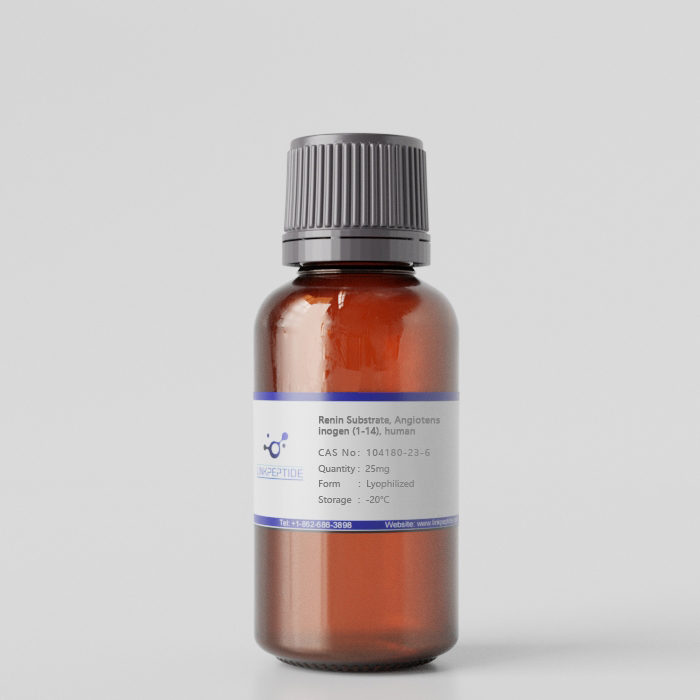
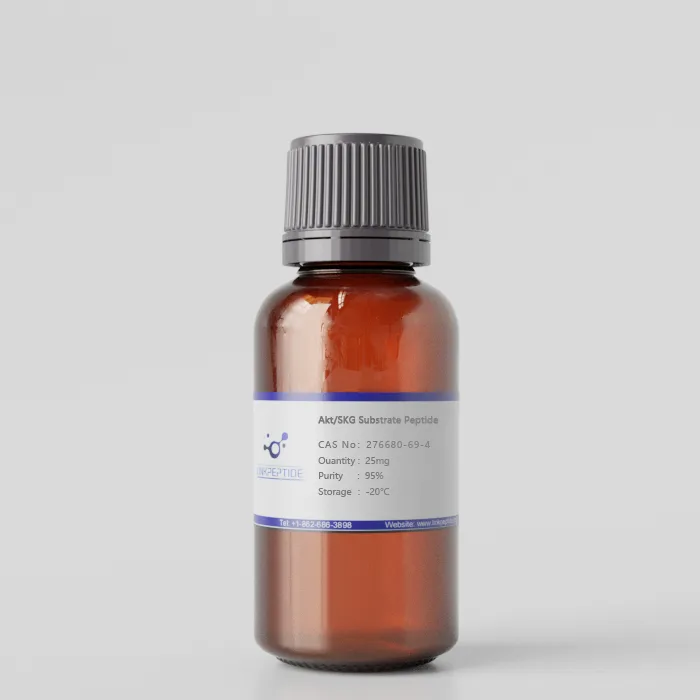
Product Name: Renin Substrate, Angiotensinogen (1-14), human
Sequence One Letter Code: DRVYIHPFHLVIHN
Sequence Three Letter Code: H - Asp - Arg - Val - Tyr - Ile - His - Pro - Phe - His - Leu - Val - Ile - His - Asn - OH
Cas No: 104180-23-6
Chemical Formula:C83H122N24O19
Molecular Weight: 1760.1
Purity: 95%
Form: Lyophilized
Storage Conditions: - 20 °C
Research Area: Cardiovascular Disease Research
SMILES: CCC(C)C(C(=O)NC(CC1=CNC=N1)C(=O)N2CCCC2C(=O)NC(CC3=CC=CC=C3)C(=O)NC(CC4=CNC=N4)C(=O)NC(CC(C)C)C(=O)NC(C(C)C)C(=O)NC(C(C)CC)C(=O)NC(CC5=CNC=N5)C(=O)NC(CC(=O)N)C(=O)O)NC(=O)C(CC6=CC=C(C=C6)O)NC(=O)C(C(C)C)NC(=O)C(CCCNC(=N)N)NC(=O)C(CC(=O)O)N
IUPAC: 3-amino-4-[[1-[[1-[[1-[[1-[[1-[2-[[1-[[1-[[1-[[1-[[1-[[1-[(3-amino-1-carboxy-3-oxopropyl)amino]-3-(1H-imidazol-4-yl)-1-oxopropan-2-yl]amino]-3-methyl-1-oxopentan-2-yl]amino]-3-methyl-1-oxobutan-2-yl]amino]-4-methyl-1-oxopentan-2-yl]amino]-3-(1H-imidazol-4-yl)-1-oxopropan-2-yl]amino]-1-oxo-3-phenylpropan-2-yl]carbamoyl]pyrrolidin-1-yl]-3-(1H-imidazol-4-yl)-1-oxopropan-2-yl]amino]-3-methyl-1-oxopentan-2-yl]amino]-3-(4-hydroxyphenyl)-1-oxopropan-2-yl]amino]-3-methyl-1-oxobutan-2-yl]amino]-5-carbamimidamido-1-oxopentan-2-yl]amino]-4-oxobutanoic acid
INCHIKEY: UYYRANYWSOXAEK-UHFFFAOYSA-N
INCHI:
InChI=1S/C83H122N24O19/c1-11-45(9)67(105-75(118)57(30-48-22-24-52(108)25-23-48)99-77(120)65(43(5)6)103-70(113)54(20-16-26-91-83(86)87)95-69(112)53(84)34-64(110)111)80(123)101-60(33-51-38-90-41-94-51)81(124)107-27-17-21-62(107)76(119)98-56(29-47-18-14-13-15-19-47)71(114)97-58(31-49-36-88-39-92-49)72(115)96-55(28-42(3)4)74(117)104-66(44(7)8)78(121)106-68(46(10)12-2)79(122)100-59(32-50-37-89-40-93-50)73(116)102-61(82(125)126)35-63(85)109/h13-15,18-19,22-25,36-46,53-62,65-68,108H,11-12,16-17,20-21,26-35,84H2,1-10H3,(H2,85,109)(H,88,92)(H,89,93)(H,90,94)(H,95,112)(H,96,115)(H,97,114)(H,98,119)(H,99,120)(H,100,122)(H,101,123)(H,102,116)(H,103,113)(H,104,117)(H,105,118)(H,106,121)(H,110,111)(H,125,126)(H4,86,87,91)
Source / Species: human
Conjugation: Unconjugated
Code Nacres: NA.26
Application: Renin Substrate, Angiotensinogen (1–14), human is a synthetic peptide encompassing the native N-terminal renin cleavage site of human angiotensinogen. Renin-mediated hydrolysis of this sequence represents the rate-limiting step in activation of the renin–angiotensin system, initiating angiotensin I formation. This peptide provides a defined substrate for quantitative measurement of renin activity in enzymatic assays. It is extensively used in cardiovascular and renal research to characterize enzyme kinetics, evaluate renin inhibitors, and model early-stage angiotensin generation. The substrate supports mechanistic studies of blood pressure regulation, fluid balance, and pharmacological modulation of the renin–angiotensin pathway in experimental systems.
Current Research: Renin Substrate, Angiotensinogen (1–14), human is a synthetic peptide encompassing the native N-terminal sequence of human angiotensinogen that contains the physiological renin cleavage site. Renin-mediated hydrolysis of this sequence represents the rate-limiting step in activation of the renin–angiotensin system (RAS), generating angiotensin I and initiating downstream angiotensin II formation. By reproducing the authentic cleavage region, this peptide provides a defined and quantitative substrate for measuring renin enzymatic activity under controlled experimental conditions. Role in the Renin–Angiotensin System The renin–angiotensin system is a central regulator of blood pressure, vascular tone, and fluid–electrolyte balance. Renin, an aspartyl protease secreted by juxtaglomerular cells of the kidney, cleaves angiotensinogen between Leu10 and Val11 to produce the decapeptide angiotensin I. This reaction constitutes the rate-limiting step of the RAS cascade and is tightly regulated by renal perfusion pressure, sodium balance, and sympathetic nervous system activity. Angiotensin I is subsequently converted to angiotensin II by angiotensin-converting enzyme (ACE), leading to vasoconstriction, aldosterone secretion, and sodium retention. Because renin controls the initiation of this cascade, precise quantification of renin activity is essential for understanding cardiovascular and renal physiology. Defined Substrate for Enzymatic Assays Angiotensinogen (1–14) reproduces the minimal N-terminal sequence required for renin recognition and cleavage. Its defined structure eliminates variability associated with full-length protein substrates, allowing reproducible kinetic analysis in purified enzyme systems. This substrate supports: Measurement of renin catalytic activity Determination of kinetic parameters (K_m, V_max) Comparative analysis of recombinant or mutant renin variants Time-course studies of angiotensin I generation Because it contains the native cleavage motif, the peptide closely mimics physiological substrate recognition while offering simplified assay conditions. Applications in Inhibitor Evaluation Renin inhibition represents a therapeutic strategy for hypertension and cardiovascular disease. Small-molecule renin inhibitors target the enzyme’s active site to prevent angiotensin I formation. Angiotensinogen (1–14) serves as a reliable substrate for: Screening of renin inhibitors Determination of IC₅₀ values Structure–activity relationship (SAR) studies Evaluation of inhibitor selectivity and potency Quantitative monitoring of peptide cleavage enables precise assessment of pharmacological modulation at the level of the RAS initiation step. Cardiovascular and Renal Research Applications This peptide is widely employed in studies investigating: Mechanisms of blood pressure regulation Renal endocrine control of fluid balance Hormonal cross-talk within the RAS Pathophysiology of hypertension Experimental models of cardiovascular remodeling In both biochemical and translational research settings, the substrate provides a controlled platform for modeling early-stage angiotensin generation without interference from downstream enzymatic processes. Experimental Advantages Native human renin cleavage sequence Defined minimal substrate for reproducible kinetics Suitable for purified enzyme and inhibitor assays Compatible with HPLC, mass spectrometry, or coupled detection methods Enables quantitative evaluation of RAS activation Its short, well-characterized sequence simplifies assay design and supports accurate mechanistic interpretation. Research Significance Renin Substrate, Angiotensinogen (1–14), human is a foundational reagent for studying the initiation of the renin–angiotensin system. By providing a precise substrate for renin activity measurement, it facilitates investigation of cardiovascular regulation, renal endocrine signaling, and pharmacological inhibition strategies. Its application in enzymology and drug development continues to support advances in hypertension and cardiovascular disease research.
Get a Quote
 LinkPeptide