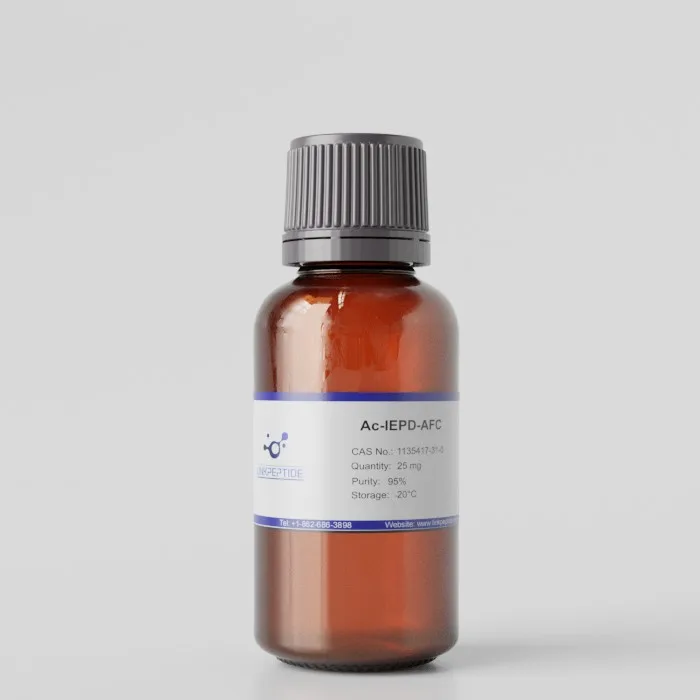
Product Name: Ac-IEPD-AFC
CAS No: 1135417-31-0
Purity: 95%
Molar Mass: 725.7
Chemical Formula: C32H38F3N5O11
Storage: Store at -20 degree celsius
Sequence: XEPD
Application: Ac-IEPD-AFC is a synthetic peptide substrate commonly used to study caspase-8 activity. This peptide sequence, acetyl-Ile-Glu-Pro-Asp, is linked to 7-amino-4-trifluoromethylcoumarin (AFC), a fluorescent reporter. Upon cleavage by caspase-8, AFC is released, emitting a fluorescent signal that can be quantitatively measured. This mechanism allows for precise monitoring of caspase-8 activity, which is crucial in apoptosis research. In pharmaceutical research, Ac-IEPD-AFC is utilized to screen potential inhibitors of caspase-8, aiding in the development of therapies for diseases involving apoptosis dysregulation, such as cancer and neurodegenerative disorders.
Current Research:
Ac-IEPD-AFC is a synthetic fluorogenic substrate designed specifically for detecting and quantifying granzyme B activity. The peptide sequence IEPD is cleaved by granzyme B, releasing 7-amino-4-trifluoromethylcoumarin (AFC), a fluorescent moiety. This enzymatic cleavage produces a measurable fluorescence signal with an excitation maximum at 400 nm and an emission maximum at 505 nm, allowing for precise monitoring of granzyme B activity. Applications in Research Immunological Studies Ac-IEPD-AFC is widely used to study granzyme B function in cytotoxic T lymphocytes and natural killer cells. Granzyme B plays a critical role in immune-mediated apoptosis, and this substrate enables researchers to explore the mechanisms of immune cell-mediated cell death and evaluate immunotherapeutic strategies. Enzyme Kinetics The substrate is also used to characterize recombinant granzyme B proteins. By monitoring the hydrolysis rate of Ac-IEPD-AFC, researchers can measure the specific activity of granzyme B and study its enzyme kinetics under various experimental conditions. Significance The specificity and sensitivity of Ac-IEPD-AFC make it a valuable tool for apoptosis research, immunological studies, and drug development targeting granzyme B-mediated pathways. Its fluorogenic properties facilitate easy quantification and visualization, enhancing its utility in both basic and applied research.
Get a Quote
 LinkPeptide