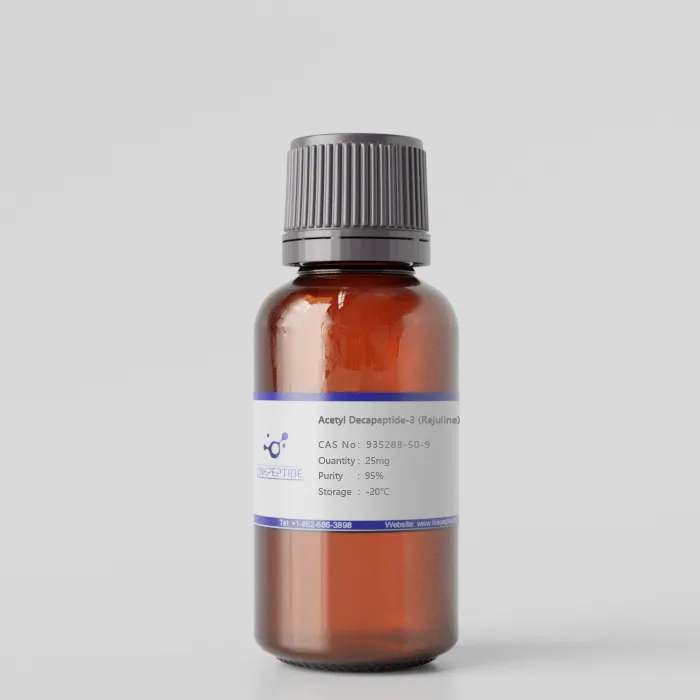
Product Name: Acetyl Decapeptide-3 (Rejuline)
Cas No: 935288-50-9
Purity: 95%
Storage: Keep in dark and cool dry place -5~8 degree Celsius
Sequence: Ac-Tyr-Arg-Ser-Arg-Lys-Tyr-Thr-Ser-Trp-Tyr-NH2
Molar Mass: 1450.6
Chemical Formula: C68H95N19O17
IUPAC Name: (2S)-2-[[(2S)-2-[[(2S)-2-[[(2S)-2-[[(2S)-2-acetamido-3-(4-hydroxyphenyl)propanoyl]amino]-5-carbamimidamidopentanoyl]amino]-3-hydroxypropanoyl]amino]-5-carbamimidamidopentanoyl]amino]-6-amino-N-[(2S)-1-[[(2S,3R)-1-[[(2S)-1-[[(2S)-1-[[(2S)-1-amino-3-(4-hydroxyphenyl)-1-oxopropan-2-yl]amino]-3-(1H-indol-3-yl)-1-oxopropan-2-yl]amino]-3-hydroxy-1-oxopropan-2-yl]amino]-3-hydroxy-1-oxobutan-2-yl]amino]-3-(4-hydroxyphenyl)-1-oxopropan-2-yl]hexanamide
SMILES: C[C@H]([C@@H](C(=O)N[C@@H](CO)C(=O)N[C@@H](CC1=CNC2=CC=CC=C21)C(=O)N[C@@H](CC3=CC=C(C=C3)O)C(=O)N)NC(=O)[C@H](CC4=CC=C(C=C4)O)NC(=O)[C@H](CCCCN)NC(=O)[C@H](CCCNC(=N)N)NC(=O)[C@H](CO)NC(=O)[C@H](CCCNC(=N)N)NC(=O)[C@H](CC5=CC=C(C=C5)O)NC(=O)C)O
InChIKey: CGPSWQBETUSORI-MTUNXJOQSA-N
InChI: InChI=1S/C68H95N19O17/c1-36(90)56(66(104)86-55(35-89)65(103)84-53(32-41-33-77-46-10-4-3-9-45(41)46)62(100)82-50(57(70)95)29-38-14-20-42(92)21-15-38)87-63(101)52(31-40-18-24-44(94)25-19-40)83-59(97)47(11-5-6-26-69)79-58(96)48(12-7-27-75-67(71)72)81-64(102)54(34-88)85-60(98)49(13-8-28-76-68(73)74)80-61(99)51(78-37(2)91)30-39-16-22-43(93)23-17-39/h3-4,9-10,14-25,33,36,47-56,77,88-90,92-94H,5-8,11-13,26-32,34-35,69H2,1-2H3,(H2,70,95)(H,78,91)(H,79,96)(H,80,99)(H,81,102)(H,82,100)(H,83,97)(H,84,103)(H,85,98)(H,86,104)(H,87,101)(H4,71,72,75)(H4,73,74,76)/t36-,47+,48+,49+,50+,51+,52+,53+,54+,55+,56+/m1/s1
Application:
Acetyl Decapeptide-3 (Rejuline) is a biomimetic growth factor–inspired peptide designed to support visible skin regeneration, firmness, and overall rejuvenation. By enhancing cellular signaling involved in epidermal and dermal renewal, Rejuline helps improve elasticity, refine texture, and reduce the appearance of fine lines. It is widely used in cosmetic research exploring boosted collagen production, increased skin density, and faster recovery from environmental stress. With excellent stability and solubility, Acetyl Decapeptide-3 integrates seamlessly into serums, ampoules, and advanced anti-aging formulations aimed at restoring smoothness, vitality, and a youthful, radiant complexion.
Current Research:
Acetyl Decapeptide-3 (Rejuline): Current Research Overview
Acetyl Decapeptide-3, trade name Rejuline? (often CG-Rejuline), is a synthetic 10–amino acid peptide designed as a biomimetic growth factor for skin regeneration and anti-aging. Structurally, it reproduces a short sequence from basic fibroblast growth factor (bFGF / FGF-2), giving it the ability to imitate some of bFGF’s key actions on fibroblasts and keratinocytes.
bFGF is a central regulator of skin development, wound healing, and ECM remodeling. By echoing this biology in a compact, stable peptide, Acetyl Decapeptide-3 is positioned as a high-performance active for wrinkle reduction, elasticity, and post-damage repair.
Mechanism of Action: bFGF-Mimetic Signal Peptide
Acetyl Decapeptide-3 is classified as a signal peptide: it binds to and activates receptors on skin cells, triggering cascades that increase extracellular matrix synthesis.
Key mechanistic themes from in vitro and technical data:
Stimulation of fibroblast proliferation and activity
Promotes fibroblast growth and survival, similar to bFGF, supporting dermal renewal and ECM production.
Encourages keratinocyte proliferation, aiding epidermal turnover and surface smoothness.
Up-regulation of collagen, elastin, and ECM proteins
Increases expression and synthesis of collagen types I, II, and IV, as well as elastin, thickening and strengthening the dermis.
Enhances levels of fibronectin and laminin, key structural glycoproteins that organize the ECM and support cell adhesion.
Technical sources also describe stimulation of hyaluronic acid production, improving hydration, turgor, and plumpness.
Support for wound healing and tissue repair
By promoting cell proliferation and ECM synthesis, Acetyl Decapeptide-3 participates in normal skin growth, wound closure, and post-procedure repair, echoing bFGF’s role in healing.
Overall, it acts as a growth-factor-like “youth signal”, driving both regeneration and structural rebuilding.
Role in Modern Cosmetic Peptide Science
Within the cosmetic peptide taxonomy, Acetyl Decapeptide-3 sits in the growth-factor-mimetic signal peptide class, distinct from classic matrikines or simple neurotransmitter peptides. Its bFGF inspiration gives you a scientifically strong story around:
Regeneration: boosting cell turnover and wound repair.
Matrix rebuilding: collagen, elastin, fibronectin, laminin, and HA.
Global anti-aging: firmness, wrinkle reduction, and skin quality.
Recent peptide reviews highlight such growth-factor-like short peptides as attractive alternatives to recombinant proteins: they are more stable, easier to formulate, and less immunogenic, yet still capable of activating similar pathways in fibroblasts and keratinocytes.
In Vitro, Ex Vivo, and Application Data
Most available information is from supplier studies, ingredient guides, and technical articles, but they present a consistent efficacy profile:
In vitro / ex vivo
Increased fibroblast proliferation and metabolic activity.
Up-regulated production of collagen I/II/IV, elastin, fibronectin, and laminin, leading to thicker, more elastic dermal tissue in skin models.
Enhanced hyaluronic acid content and water-binding capacity, associated with better hydration and plumpness.
Evidence of improved wound closure and re-epithelialization in scratch or injury models.
Cosmetic-style use tests
Descriptions of reduced fine lines and wrinkles, particularly in crow’s-feet and nasolabial zones, after several weeks of daily use.
Improved firmness, elasticity, and skin thickness, linked to increased dermal ECM.
Better texture, smoothness, and overall skin quality, consistent with enhanced cell renewal.
These are typical cosmetic-grade studies (small size, manufacturer-run), but the mechanisms align well with broader bFGF and ECM-stimulation research.
Get a Quote
 LinkPeptide