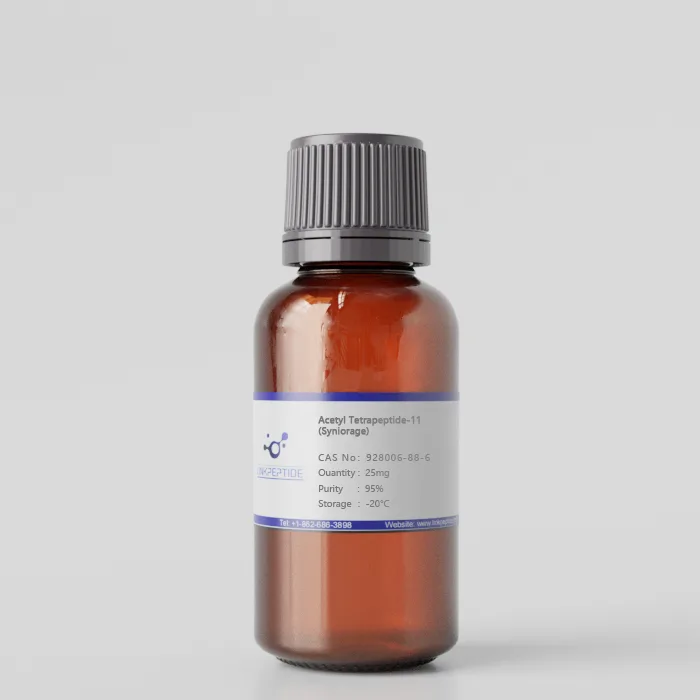
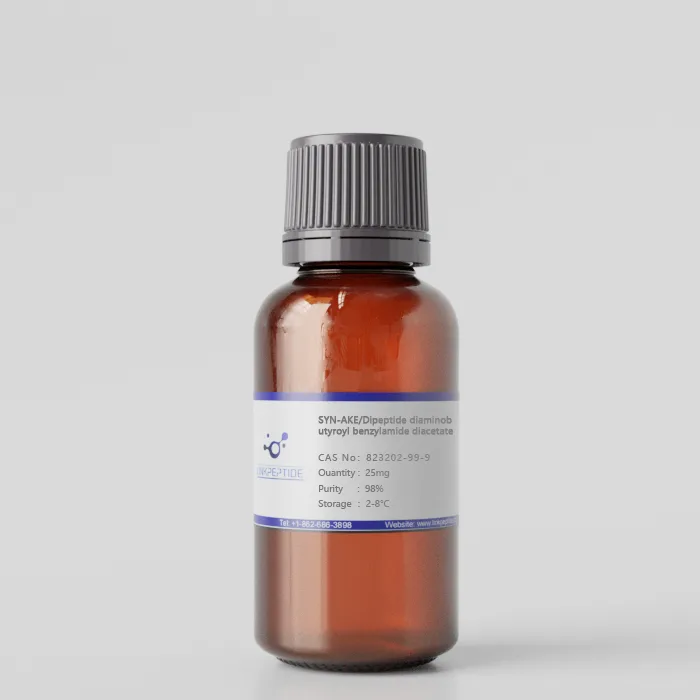
Product Name: Acetyl Tetrapeptide-11 (Syniorage)
Cas No: 928006-88-6
Purity: 95%
Storage: Keep in dark and cool dry place -5~8 degree Celsius
Sequence: Ac-Pro-Pro-Tyr-Leu-OH
Molar Mass: 530.6
Chemical Formula: C27H38N4O7
IUPAC Name: (2S)-2-[[(2S)-2-[[(2S)-1-[(2S)-1-acetylpyrrolidine-2-carbonyl]pyrrolidine-2-carbonyl]amino]-3-(4-hydroxyphenyl)propanoyl]amino]-4-methylpentanoic acid
SMILES: CC(C)C[C@@H](C(=O)O)NC(=O)[C@H](CC1=CC=C(C=C1)O)NC(=O)[C@@H]2CCCN2C(=O)[C@@H]3CCCN3C(=O)C
InChIKey: KQEQPUBSXXOUGC-MLCQCVOFSA-N
InChI: InChI=1S/C27H38N4O7/c1-16(2)14-21(27(37)38)29-24(34)20(15-18-8-10-19(33)11-9-18)28-25(35)22-6-4-13-31(22)26(36)23-7-5-12-30(23)17(3)32/h8-11,16,20-23,33H,4-7,12-15H2,1-3H3,(H,28,35)(H,29,34)(H,37,38)/t20-,21-,22-,23-/m0/s1
Application:
Acetyl Tetrapeptide-11 (Syniorage) is a biomimetic peptide designed to strengthen the skin’s structural network and enhance visible firmness. By supporting key components of the extracellular matrix—particularly integrins involved in dermal–epidermal cohesion—it helps improve elasticity, refine texture, and promote a more lifted appearance. In cosmetic research, Syniorage is valued for its ability to restore suppleness and reduce early signs of aging by reinforcing skin architecture. Its excellent stability and compatibility with serums, emulsions, and advanced anti-aging formulations make it ideal for treatments aimed at achieving smoother, denser, and more resilient-looking skin.
Current Research:
Acetyl Tetrapeptide-11 (Syniorage): Research Overview
Acetyl Tetrapeptide-11 is a synthetic signal tetrapeptide developed to target epidermal cohesion, dermal–epidermal junction (DEJ) architecture, and superficial dermal matrix organization. It is supplied as an N-terminally acetylated four–amino-acid sequence (INCI: Acetyl Tetrapeptide-11), designed via peptide screening on keratinocytes and fibroblasts to identify sequences capable of improving structural and surface parameters characteristic of mature skin.
Acetyl Tetrapeptide-11 is:
A linear tetrapeptide with N-terminal acetylation to improve stability and reduce susceptibility to exopeptidases.
Hydrophilic and fully water-soluble, with a molecular weight in the low-peptide range, compatible with topical penetration into viable epidermis and the upper dermis when supported by suitable delivery systems.
Designed as a signal peptide, meaning its role is not as a structural building block but as a low-dose regulator of cell and matrix behavior.
Terminal acetylation and sequence selection give the peptide predictable charge and solubility profiles under typical cosmetic pH conditions.
Syniorage is specifically positioned around cohesion and structural reorganization rather than simple collagen stimulation. Research emphasizes:
Epidermal cohesion: modulation of genes and proteins involved in corneocyte adhesion and desmosome/corneodesmosome function.
DEJ quality: influence on basement-membrane–related markers and papillary dermis structure.
The peptide’s activity profile has been associated with improved expression of selected adhesion molecules and structural proteins related to cell–cell and cell–matrix contact, supporting a tighter and more organized interface between epidermal layers and between epidermis and dermis.
In vitro studies on human keratinocytes and reconstructed epidermis models report that Acetyl Tetrapeptide-11:
Modulates differentiation-related markers associated with cornified envelope formation and stratum corneum organization.
Enhances cell–cell adhesion markers, consistent with stronger cohesion in the upper epidermal layers.
Contributes to more compact and regular stratum corneum architecture in model systems.
These effects translate conceptually into improved microrelief regularity and surface uniformity, as a more coherent corneocyte “brick” organization is maintained.
The peptide has also been studied for its role at the dermal–epidermal junction:
Biopsy and ex vivo data indicate improved DEJ morphology, with a more defined and less flattened junction in treated samples compared with untreated mature skin.
Enhanced appearance of papillary structures in the upper dermis, suggesting better integration of collagen and associated ECM close to the DEJ.
Rather than acting as a strong collagen stimulator, Acetyl Tetrapeptide-11 is associated with reorganization and consolidation of existing structures, helping restore aspects of a younger, more intricate DEJ architecture.
Transcriptomic analyses from supplier and technical studies indicate that Acetyl Tetrapeptide-11 impacts a panel of genes involved in:
Extracellular matrix organization (ECM structural constituents and regulators).
Cell adhesion and junctional complexes, including components of desmosomes and hemidesmosomes.
Epidermal differentiation and cornified envelope formation.
These gene-level changes are aligned with observed tissue-level outcomes such as more regular epidermal layering, denser DEJ region, and refined papillary dermis microstructure.
In cosmetic-style in vivo evaluations, formulations containing Acetyl Tetrapeptide-11 are typically assessed for:
Surface roughness and microrelief (fine-line parameters, texture indices).
Perceived firmness and density (biomechanical measurements and visual grading).
Uniformity of skin surface (2D or 3D imaging, contrast and homogeneity metrics).
Improvements in these parameters are interpreted as the macroscopic expression of its cohesion- and structure-oriented mechanism: more compact and organized epidermis, better DEJ integrity, and refined superficial matrix, rather than volumetric filling.
Compared with classic collagen-stimulating matrikines, Acetyl Tetrapeptide-11 is characterized by:
A primary focus on organization and cohesion (epidermal and DEJ) rather than strong proliferation or high-level collagen induction.
Activity that fits into the concept of “mature skin re-architecture”, addressing sagging and surface texture through micro-structural optimization.
Complementarity with peptides that target collagen synthesis, elastin support, or anti-glycation pathways.
This makes it conceptually suitable within multi-pathway approaches where different actives target matrix quantity, matrix quality, barrier function, and biochemical protection.
Acetyl Tetrapeptide-11:
Is generally supplied in aqueous or glycolic solution at low active concentration.
Is incorporated in the cool-down phase of emulsions, or directly into water-based serums and gels, to preserve peptide integrity.
Is stable within conventional cosmetic pH and temperature ranges when protected from strong oxidants and prolonged high heat.
Is used at low dosage typical for signal peptides, leveraging receptor-level or pathway-level modulation rather than bulk contribution.
Summary
Acetyl Tetrapeptide-11 (Syniorage) is a signal tetrapeptide characterized in research by its ability to modulate epidermal cohesion markers, improve dermal–epidermal junction morphology, and refine papillary dermis organization. Its activity profile is centered on restructuring and consolidating existing tissue architecture—particularly in mature skin—complementing other matrix-active peptides that primarily act on synthesis or protection.
Get a Quote
 LinkPeptide