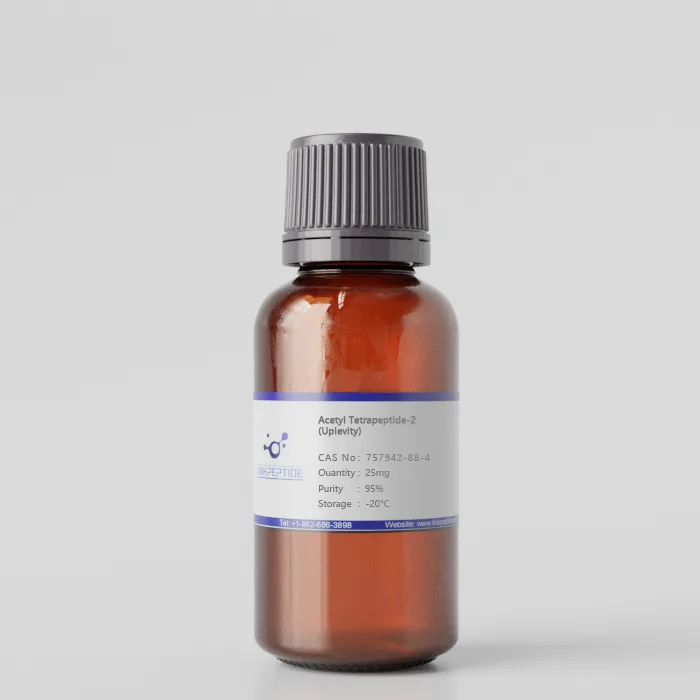
Product Name: Acetyl Tetrapeptide-2 (Uplevity)
Cas No: 757942-88-4
Purity: 95%
Storage: Keep in dark and cool dry place -5~8 degree Celsius
Sequence: Ac-Lys-Asp-Val-Tyr
Molar Mass: 565.6
Chemical Formula: C26H39N5O9
IUPAC Name: (3S)-3-[[(2S)-2-acetamido-6-aminohexanoyl]amino]-4-[[(2S)-1-[[(1S)-1-carboxy-2-(4-hydroxyphenyl)ethyl]amino]-3-methyl-1-oxobutan-2-yl]amino]-4-oxobutanoic acid
SMILES: CC(C)[C@@H](C(=O)N[C@@H](CC1=CC=C(C=C1)O)C(=O)O)NC(=O)[C@H](CC(=O)O)NC(=O)[C@H](CCCCN)NC(=O)C
InChIKey: ITIMHIATVYROGF-XWUOBKMESA-N
InChI: InChI=1S/C26H39N5O9/c1-14(2)22(25(38)30-20(26(39)40)12-16-7-9-17(33)10-8-16)31-24(37)19(13-21(34)35)29-23(36)18(28-15(3)32)6-4-5-11-27/h7-10,14,18-20,22,33H,4-6,11-13,27H2,1-3H3,(H,28,32)(H,29,36)(H,30,38)(H,31,37)(H,34,35)(H,39,40)/t18-,19-,20-,22-/m0/s1
Application:
Acetyl Tetrapeptide-2 (Uplevity) is an advanced biomimetic peptide designed to enhance visible skin firmness, elasticity, and contour definition. By supporting key components of the dermal?Cepidermal junction and promoting elastin and fibrillin organization, Uplevity helps counteract the appearance of sagging and structural decline associated with aging. In cosmetic research, it is widely used to explore improved skin density, smoother texture, and a more lifted, sculpted look. Its excellent stability and compatibility with serums and high-performance anti-aging creams make Acetyl Tetrapeptide-2 ideal for formulations targeting firmness, resilience, and youthful facial contours.
Current Research:
Acetyl Tetrapeptide-2 (Uplevity): Current Research Overview
Acetyl Tetrapeptide-2, marketed as Uplevity?, is a biomimetic peptide designed to address age-related skin sagging, loss of firmness, and decreased facial definition. It is inspired by structural proteins of the extracellular matrix (ECM), particularly elastin and laminin, and is positioned as a “skin architectural peptide” that helps restore the three-dimensional organization of the dermis.
From a structural perspective, Acetyl Tetrapeptide-2 is a short, acetylated peptide optimized for stability and compatibility with cosmetic formulations. Its main claim to fame is its ability to modulate the expression of key mechanotransduction proteins involved in dermal support: integrins and syndecans.
Mechanism of Action: Dermal Architecture and Mechanotransduction
Unlike classic signal peptides that simply up-regulate collagen, Acetyl Tetrapeptide-2 focuses on remodeling the skin’s internal scaffolding by acting on the dermal-epidermal junction and the connective tissue network.
In vitro studies suggest that Uplevity:
Up-regulates integrin β1 and syndecan-4, two membrane proteins that anchor cells to the ECM and transmit mechanical signals.
Enhances the structural connection between fibroblasts and ECM fibers, improving the skin’s ability to resist gravitational deformation.
Supports the organization of collagen and elastin fibers, contributing to better tensile strength and elasticity.
By strengthening this mechanobiological interface, the peptide helps the skin maintain a more lifted, firm, and defined appearance, especially in areas like the jawline, cheeks, and neck where sagging and loss of contour are most visible.
Fit Within Current Cosmetic Peptide Science
Contemporary cosmetic research increasingly emphasizes mechanobiology—how cells sense and respond to mechanical forces—as a key dimension of skin aging. Young skin maintains firmness not only because of abundant collagen and elastin, but also because of robust cell–matrix signaling. With age, this mechanotransduction weakens, contributing to laxity and structural collapse.
Acetyl Tetrapeptide-2 fits neatly into this next-generation “skin architect” peptide category. Rather than being limited to collagen stimulation, it targets the cell-matrix interaction machinery that governs how collagen and elastin are organized and anchored. This makes it particularly attractive for anti-sagging, lifting, and contour refinement claims.
Reviews of cosmetic peptides often differentiate between:
Signal peptides (stimulate collagen synthesis),
Carrier peptides (deliver trace elements), and
Matrix or structural peptides (influence ECM integrity and architecture).
Uplevity is typically positioned in this third group, associated with firming, lifting, and anti-gravity effects as opposed to just wrinkle volume reduction.
In Vitro, Ex Vivo, and Clinical Evidence
Available data (largely from ingredient developers and technical dossiers) highlight a multi-tiered approach:
In vitro (cell culture) data
Increased expression of integrin β1 and syndecan-4 in fibroblasts.
Improved attachment of cells to ECM components, indicating strengthened cell–matrix cohesion.
Ex vivo (skin explant) data
Enhanced organization of collagen and elastin networks.
More compact and coherent dermal structure, suggesting resistance to deformation and sagging.
Small-scale clinical or instrumental studies on finished formulations (as reported by suppliers)
Improved skin firmness and elasticity measured by cutometry or other biomechanical methods.
Visible improvements in jawline definition and reduction in the appearance of lower-face sagging after several weeks of use.
Smoother, more lifted contour in the neck and lower face region.
While these data sets are promising, most remain supplier-generated rather than large, independently published clinical trials. However, the mechanistic rationale is consistent with broader anti-aging research on integrins, syndecans, and ECM remodeling.
Safety and Formulation Considerations
Acetyl Tetrapeptide-2 is intended for leave-on facial and neck products, often used in:
Firming serums and concentrates
Anti-sagging creams and contouring treatments
Products targeting jawline, neck, and lower face
Standard cosmetic safety testing (irritation, sensitization compatibility) indicates good skin tolerance at typical usage levels. As with other cosmetic peptides, its role is purely aesthetic: improving the appearance of firmness, lift, and contour, not treating medical conditions.
Get a Quote
 LinkPeptide