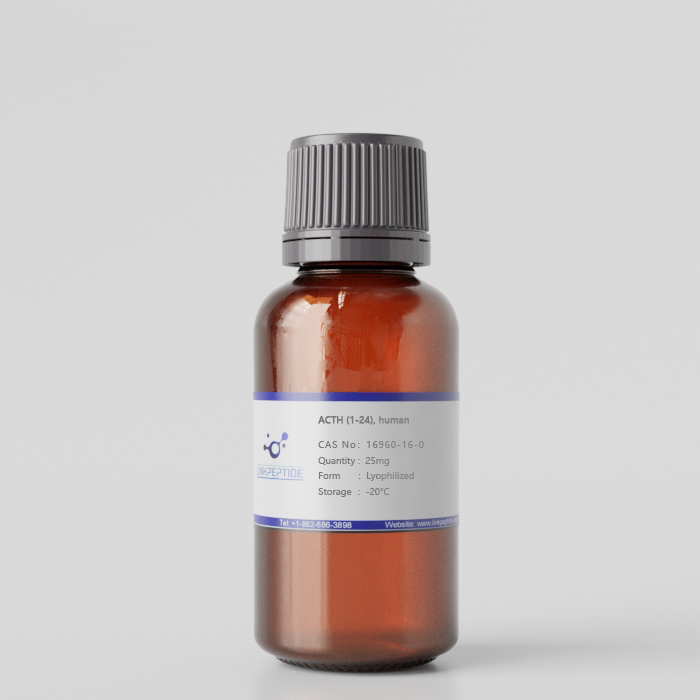
Product Name: ACTH (1-24), human
Sequence One Letter Code: SYSMEHFRWGKPVGKKRRPVKVYP
Sequence Three Letter Code: H-Ser-Tyr-Ser-Met-Glu-His-Phe-Arg-Trp-Gly-Lys-Pro-Val-Gly-Lys-Lys-Arg-Arg-Pro-Val-Lys-Val-tyr-pro-OH
Cas No: 16960-16-0
Chemical Formula:C136H210N40O31S
Molecular Weight: 2933.6
Purity: 95%
Form: Lyophilized
Storage Conditions: - 20 °C
Research Area: Neurological Disease
SMILES: CC(C)[C@@H](C(=O)NCC(=O)N[C@H](CCCCN)C(=O)N[C@H](CCCCN)C(=O)N[C@H](CCCNC(=N)N)C(=O)N[C@H](CCCNC(=N)N)C(=O)N1CCC[C@H]1C(=O)N[C@@H](C(C)C)C(=O)N[C@@H](CCCCN)C(=O)N[C@@H](C(C)C)C(=O)N[C@@H](CC2=CC=C(C=C2)O)C(=O)N3CCC[C@H]3C(=O)O)NC(=O)[C@@H]4CCCN4C(=O)[C@H](CCCCN)NC(=O)CNC(=O)[C@H](CC5=CNC6=CC=CC=C65)NC(=O)[C@H](CCCNC(=N)N)NC(=O)[C@H](CC7=CC=CC=C7)NC(=O)[C@H](CC8=CNC=N8)NC(=O)[C@H](CCC(=O)O)NC(=O)[C@H](CCSC)NC(=O)[C@H](CO)NC(=O)[C@H](CC9=CC=C(C=C9)O)NC(=O)C(CO)N
IUPAC: (2S)-1-[(2S)-2-[[(2S)-2-[[(2S)-6-amino-2-[[(2S)-2-[[(2S)-1-[(2R)-2-[[(2R)-2-[[(2R)-6-amino-2-[[(2R)-6-amino-2-[[2-[[(2S)-2-[[(2S)-1-[(2S)-6-amino-2-[[2-[[(2S)-2-[[(2S)-2-[[(2S)-2-[[(2S)-2-[[(2S)-2-[[(2S)-2-[[(2S)-2-[[(2S)-2-[(2-amino-3-hydroxypropanoyl)amino]-3-(4-hydroxyphenyl)propanoyl]amino]-3-hydroxypropanoyl]amino]-4-methylsulfanylbutanoyl]amino]-4-carboxybutanoyl]amino]-3-(1H-imidazol-4-yl)propanoyl]amino]-3-phenylpropanoyl]amino]-5-carbamimidamidopentanoyl]amino]-3-(1H-indol-3-yl)propanoyl]amino]acetyl]amino]hexanoyl]pyrrolidine-2-carbonyl]amino]-3-methylbutanoyl]amino]acetyl]amino]hexanoyl]amino]hexanoyl]amino]-5-carbamimidamidopentanoyl]amino]-5-carbamimidamidopentanoyl]pyrrolidine-2-carbonyl]amino]-3-methylbutanoyl]amino]hexanoyl]amino]-3-methylbutanoyl]amino]-3-(4-hydroxyphenyl)propanoyl]pyrrolidine-2-carboxylic acid
INCHIKEY: ZOEFCCMDUURGSE-CQVUSSRSSA-N
INCHI:
InChI=1S/C136H210N40O31S/c1-75(2)109(127(200)154-71-106(181)156-88(31-13-17-52-137)114(187)158-89(32-14-18-53-138)115(188)159-91(35-21-56-149-134(142)143)116(189)164-96(37-23-58-151-136(146)147)131(204)175-60-25-39-104(175)126(199)173-111(77(5)6)128(201)163-90(33-15-19-54-139)120(193)171-110(76(3)4)129(202)169-101(65-80-43-47-84(180)48-44-80)132(205)176-61-26-40-105(176)133(206)207)172-125(198)103-38-24-59-174(103)130(203)95(34-16-20-55-140)157-107(182)70-153-113(186)99(66-81-68-152-87-30-12-11-29-85(81)87)167-117(190)92(36-22-57-150-135(144)145)160-121(194)98(63-78-27-9-8-10-28-78)166-123(196)100(67-82-69-148-74-155-82)168-118(191)93(49-50-108(183)184)161-119(192)94(51-62-208-7)162-124(197)102(73-178)170-122(195)97(165-112(185)86(141)72-177)64-79-41-45-83(179)46-42-79/h8-12,27-30,41-48,68-69,74-77,86,88-105,109-111,152,177-180H,13-26,31-40,49-67,70-73,137-141H2,1-7H3,(H,148,155)(H,153,186)(H,154,200)(H,156,181)(H,157,182)(H,158,187)(H,159,188)(H,160,194)(H,161,192)(H,162,197)(H,163,201)(H,164,189)(H,165,185)(H,166,196)(H,167,190)(H,168,191)(H,169,202)(H,170,195)(H,171,193)(H,172,198)(H,173,199)(H,183,184)(H,206,207)(H4,142,143,149)(H4,144,145,150)(H4,146,147,151)/t86?,88-,89-,90+,91-,92+,93+,94+,95+,96-,97+,98+,99+,100+,101+,102+,103+,104+,105+,109+,110+,111+/m1/s1
Source / Species: human
Conjugation: Unconjugated
Code Nacres: NA.26
Application: ACTH (1–24), human is a synthetic peptide corresponding to the N-terminal 24 amino acids of adrenocorticotropic hormone (ACTH), retaining full biological activity of the native hormone. ACTH is produced by the anterior pituitary and plays a central role in regulating adrenal cortex function by stimulating cortisol synthesis and secretion. The 1–24 fragment contains the essential receptor-binding and activation domains required for interaction with the melanocortin 2 receptor (MC2R). Due to its well-defined activity, ACTH (1–24) is widely used in endocrine research to study adrenal steroidogenesis, hypothalamic–pituitary–adrenal (HPA) axis regulation, and stress response mechanisms. It is also applied in pharmacological and physiological studies investigating hormone signaling and adrenal function.
Current Research: ACTH (1–24), human is a synthetic peptide corresponding to the N-terminal 24 amino acids of the full-length adrenocorticotropic hormone (ACTH). This fragment retains full biological activity, encompassing the essential domains required for receptor binding and activation. As a result, ACTH (1–24) is widely used as a functional analogue of native ACTH in endocrine, physiological, and pharmacological research. Role of ACTH in Endocrine Regulation ACTH is produced by the anterior pituitary gland and serves as a key regulator of the hypothalamic–pituitary–adrenal (HPA) axis. Its primary function is to stimulate the adrenal cortex to produce and release glucocorticoids, particularly cortisol. This process is initiated when ACTH binds to the melanocortin 2 receptor (MC2R) on adrenal cortical cells, triggering signaling pathways that promote steroid hormone synthesis. Cortisol, in turn, plays a central role in: Metabolic regulation, including glucose metabolism Stress response and adaptation Immune modulation and anti-inflammatory effects Through feedback mechanisms, cortisol also regulates ACTH secretion, maintaining endocrine balance. Structural and Functional Features The ACTH (1–24) fragment contains the critical sequence elements necessary for biological activity. Structure–function studies have demonstrated that: The N-terminal region is essential for receptor activation The peptide retains full affinity for MC2R It effectively stimulates cAMP-mediated signaling pathways Because the remaining C-terminal portion of the full-length ACTH molecule is not required for receptor activation, the 1–24 fragment provides a compact and efficient model peptide for experimental use. Mechanism of Action Upon binding to MC2R, ACTH (1–24) activates a G protein–coupled receptor signaling cascade, leading to: Increased intracellular cAMP levels Activation of protein kinase A (PKA) Upregulation of steroidogenic enzymes Enhanced cholesterol transport into mitochondria These processes collectively drive cortisol biosynthesis in adrenal cells. Applications in Endocrine and Physiological Research ACTH (1–24) is extensively used in research focused on adrenal physiology and hormone regulation. Its well-defined activity and reproducibility make it a preferred tool for studying endocrine signaling. Common applications include: Adrenal steroidogenesis assays to measure cortisol production HPA axis studies investigating stress and hormonal regulation Receptor-binding and signaling analyses involving MC2R Pharmacological studies evaluating compounds that affect adrenal function Cell-based assays using adrenal cortical models These applications support a deeper understanding of how hormonal signals regulate physiological processes. Role in Stress and HPA Axis Studies The HPA axis is a central system for coordinating the body’s response to physical and psychological stress. ACTH (1–24) is frequently used to model this response in experimental settings, allowing researchers to examine: Hormonal feedback regulation Stress-induced changes in cortisol levels Interactions between endocrine and immune systems Such studies are important for understanding conditions associated with chronic stress and endocrine imbalance. Relevance to Disease and Therapeutic Research Dysregulation of ACTH signaling is associated with several disorders, including: Adrenal insufficiency Cushing’s syndrome Stress-related metabolic and immune disorders Using ACTH (1–24), researchers can investigate the mechanisms underlying these conditions and evaluate potential therapeutic strategies targeting the HPA axis and adrenal function. A Reliable Tool for Studying Adrenal Hormone Signaling ACTH (1–24), human provides a biologically active and experimentally efficient representation of the native hormone. Its ability to fully activate the melanocortin 2 receptor and stimulate cortisol production makes it an indispensable reagent for studying adrenal physiology, hormone signaling, and stress response mechanisms. Through its application in biochemical, cellular, and in vivo models, ACTH (1–24) continues to support advances in understanding the endocrine regulation of metabolism, stress, and adrenal function.
Get a Quote
 LinkPeptide