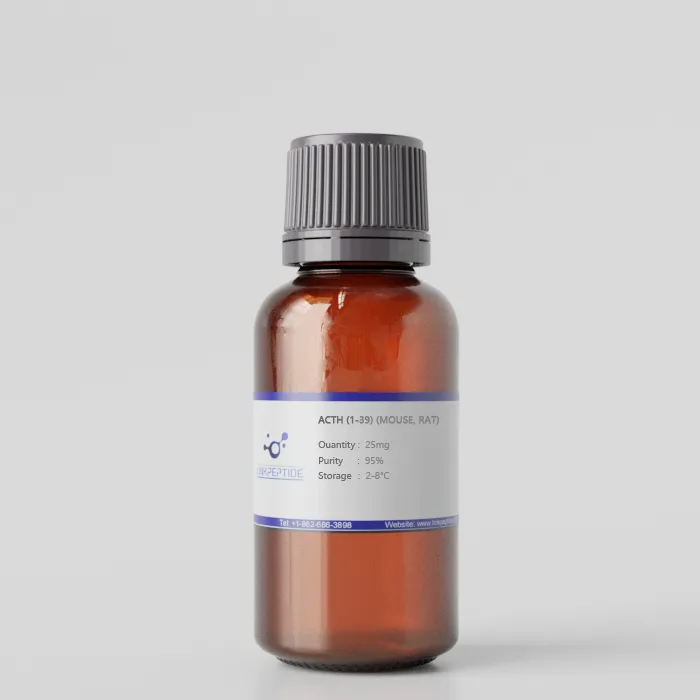
Product Name:ACTH (1-39) (MOUSE, RAT)
Purity:95%
Storage:2-8 degree Celsius
Molar Mass:4582.16
Chemical Formula:C210H315N57O57S1
Sequence:Ser-Tyr-Ser-Met-Glu-His-Phe-Arg-Trp-Gly-Lys-Pro-Val-Gly-Lys-Lys-Arg-Arg-Pro-Val-Lys-Val-Tyr-Pro-Asn-Val-Ala-Glu-Asn-Glu-Ser-Ala-Glu-Ala-Phe-Pro-Leu-Glu-Phe
Application:ACTH (1-39), Mouse/Rat is a full-length adrenocorticotropic hormone (ACTH) peptide that regulates adrenal corticosteroid synthesis via activation of the melanocortin 2 receptor (MC2R). This peptide is essential for hypothalamic-pituitary-adrenal (HPA) axis function, playing a central role in stress response, metabolic regulation, and immune modulation. It is widely used in rodent models to study adrenal function, neuroendocrine signaling, and inflammatory responses. Due to species-specific physiological differences, ACTH (1-39) from mouse and rat models is valuable for comparative endocrinology, stress physiology, and peptide-receptor interaction studies in neurology, endocrinology, and immunology research.
Current Research:
Introduction
Adrenocorticotropic hormone (ACTH (1-39)) is a key regulatory peptide in the hypothalamic-pituitary-adrenal (HPA) axis, stimulating the adrenal cortex to release glucocorticoids such as corticosterone (in rodents) and cortisol (in humans). The mouse and rat forms of ACTH (1-39) share high sequence homology with the human peptide but exhibit species-specific receptor binding dynamics. This makes rodent ACTH (1-39) a critical tool in comparative endocrinology, stress research, and metabolic disease studies.
Regulation of Adrenal Function and Stress Response
ACTH (1-39) is the primary ligand for the melanocortin 2 receptor (MC2R) in the adrenal cortex, triggering steroidogenesis. Studies in mouse and rat models explore:
HPA axis dysregulation in stress-related disorders, including chronic stress, PTSD, and depression.
Corticosterone release and feedback regulation, providing insights into adrenal insufficiency and Cushing’s syndrome.
Species-specific differences in ACTH signaling, which influence glucocorticoid sensitivity and metabolic adaptation.
Since rodents primarily secrete corticosterone instead of cortisol, ACTH (1-39) (mouse/rat) is essential for accurate modeling of HPA axis function in laboratory settings.
Neuroendocrine and Cognitive Research
ACTH-derived peptides have been studied for their neuromodulatory roles beyond adrenal activation. Research indicates that ACTH (1-39) in rodent models:
Regulates stress-induced neuroplasticity, affecting learning, memory, and mood-related behaviors.
Interacts with melanocortin receptors in the brain, influencing dopamine and serotonin neurotransmission.
Exhibits potential neuroprotective effects, making it relevant for Alzheimer’s and Parkinson’s disease models.
These findings highlight ACTH (1-39) as an important tool for investigating stress-related cognitive impairments and neuropsychiatric disorders.
Immunomodulatory and Anti-Inflammatory Effects
Rodent ACTH (1-39) is widely used in immune system research, as melanocortin peptides influence inflammatory cytokine production and immune cell function. Studies show that ACTH:
Regulates inflammatory responses via melanocortin receptors (MC1R, MC3R, MC5R).
Modulates cytokine release, reducing pro-inflammatory markers such as TNF-α and IL-6.
Has potential therapeutic implications in autoimmune diseases, multiple sclerosis, and inflammatory disorders.
These effects support ACTH-based therapies for immune suppression, neuroinflammation, and metabolic inflammation.
Species-Specific Differences in ACTH Function
Although ACTH (1-39) is highly conserved across species, mouse and rat models display distinct physiological responses:
Rodents rely on corticosterone rather than cortisol, affecting glucocorticoid receptor sensitivity.
Differences in receptor expression alter ACTH’s binding affinity and metabolic impact.
Rodent HPA axis regulation may exhibit faster adaptation to stress compared to humans.
These differences must be considered when translating rodent research findings to human applications.
Potential Research and Therapeutic Applications
Due to its endocrine, neurological, and immunological roles, ACTH (1-39) (mouse/rat) is widely studied in:
HPA axis dysfunction models, including adrenal disorders and chronic stress studies.
Neurodegenerative and neuropsychiatric disease research, focusing on stress-related brain changes.
Immune modulation studies, targeting autoimmune and inflammatory diseases.
Conclusion
ACTH (1-39), mouse/rat, is a crucial peptide for studying adrenal function, neuroendocrine signaling, and immune modulation. Its role in glucocorticoid regulation, neuroprotection, and inflammatory control makes it a valuable tool in comparative endocrinology, stress physiology, and immune research. Ongoing studies continue to refine its applications in adrenal disorders, neuropsychiatric diseases, and immune-mediated conditions.
Get a Quote
 LinkPeptide