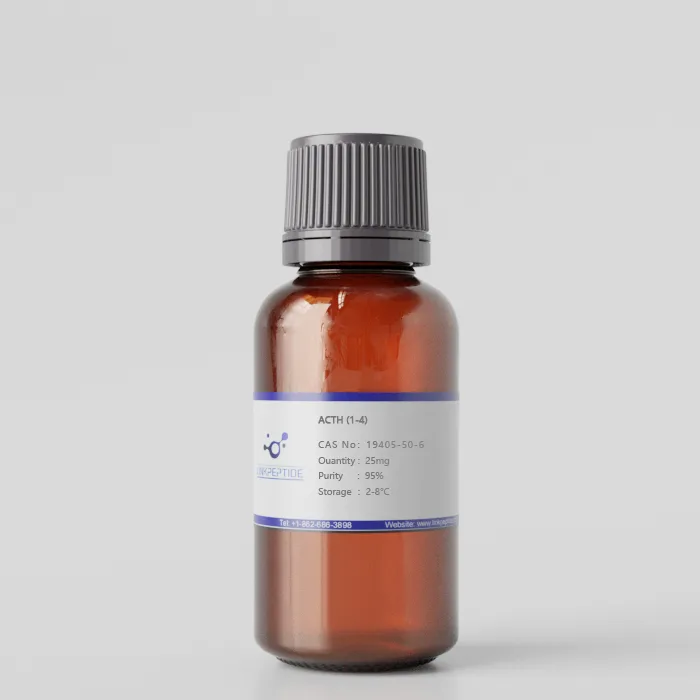
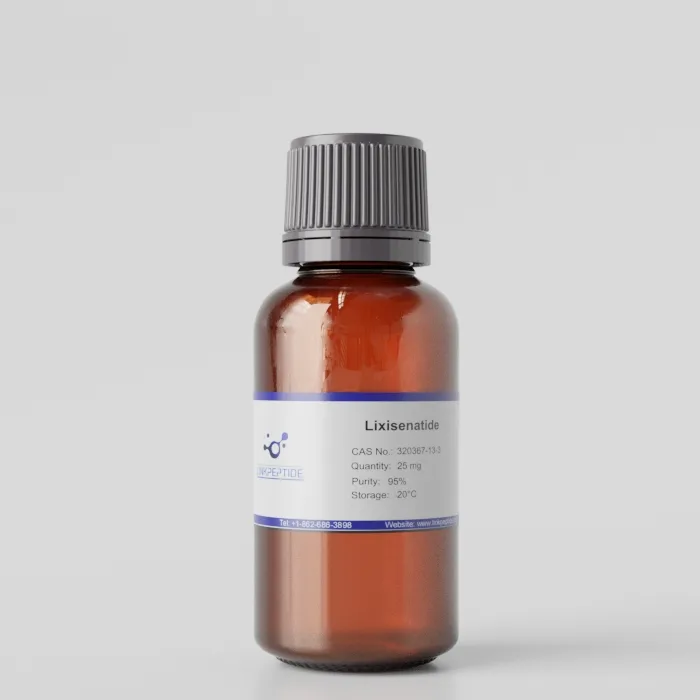
Product Name:ACTH (1-4)
Form:TFA salt
Purity:95%
Storage:2-8 degree Celsius
Cas No:19405-50-6
Molar Mass:486.5
Chemical Formula:C20H30N4O8S1
IUPAC Name:(2S)-2-[[(2S)-2-[[(2S)-2-[[(2S)-2-amino-3-hydroxypropanoyl]amino]-3-(4-hydroxyphenyl)propanoyl]amino]-3-hydroxypropanoyl]amino]-4-methylsulfanylbutanoic acid
SMILES:CSCC[C@@H](C(=O)O)NC(=O)[C@H](CO)NC(=O)[C@H](CC1=CC=C(C=C1)O)NC(=O)[C@H](CO)N
InChIKey:GTYVWTFUSMUWHM-VGWMRTNUSA-N
InChI:InChI=1S/C20H30N4O8S/c1-33-7-6-14(20(31)32)22-19(30)16(10-26)24-18(29)15(23-17(28)13(21)9-25)8-11-2-4-12(27)5-3-11/h2-5,13-16,25-27H,6-10,21H2,1H3,(H,22,30)(H,23,28)(H,24,29)(H,31,32)/t13-,14-,15-,16-/m0/s1
Sequence:Ser-Tyr-Ser-Met
Application:ACTH (1-4) is a short N-terminal fragment of adrenocorticotropic hormone (ACTH), consisting of the sequence Ser-Tyr-Ser-Met. While this peptide lacks the full sequence required for melanocortin receptor activation and adrenal steroidogenesis, it has been studied for its neuromodulatory and biochemical properties. Research suggests ACTH (1-4) may influence peptide-receptor interactions, enzymatic degradation pathways, and neuropeptide signaling. It is primarily used in biochemical and pharmacological studies related to peptide metabolism, receptor binding, and neuropeptide function. Due to its small size, ACTH (1-4) is also valuable for investigating peptide modifications, stability, and ACTH-derived therapeutic development.
Current Research:Introduction ACTH (1-4) is the shortest N-terminal ACTH fragment containing the initial four amino acids of the hormone. While full-length ACTH (1-39) stimulates adrenal corticosteroid production via melanocortin receptor activation (MC2R), this minimal fragment lacks the full receptor-binding domain required for direct adrenal activation. Instead, ACTH (1-4) is studied primarily for its biochemical, peptide degradation, and receptor interaction properties, with potential neuromodulatory functions in certain biological systems. Neurobiological and Peptide Interaction Research Although ACTH (1-4) is too short to activate melanocortin receptors, studies suggest it may: Serve as a model peptide for understanding ACTH metabolism, stability, and enzymatic degradation. Be involved in neuropeptide signaling, potentially influencing synaptic communication and neurotransmitter interactions. Act as a peptide fragment in receptor studies, particularly in understanding how short peptides influence neuropeptide pathways. These properties make ACTH (1-4) useful in biochemical research and peptide-based drug development. Enzymatic Degradation and Peptide Stability Studies ACTH (1-4) is commonly studied as a substrate for proteases and peptidases, as it represents the N-terminal cleavage product of ACTH metabolism. Research in this area includes: Understanding how ACTH is broken down in biological systems, influencing its half-life and activity. Assessing peptide stability and degradation, which is critical for pharmacokinetic studies. Investigating structural modifications to improve peptide stability and bioavailability in drug design. Since ACTH-based peptides are being explored for therapeutic applications, ACTH (1-4) provides a useful framework for studying peptide modifications that enhance resistance to enzymatic degradation. Neuroimmune and Anti-Inflammatory Research While full-length ACTH exhibits immunomodulatory properties, it is unclear whether ACTH (1-4) retains any anti-inflammatory or immune-modulating effects. Some studies suggest: Short ACTH fragments may influence immune signaling, although more research is needed. Peptide breakdown products such as ACTH (1-4) could contribute to neuropeptide-related immune regulation. Further research is required to determine if ACTH (1-4) has any independent biological activity beyond its role in peptide metabolism. Potential Research and Therapeutic Applications Due to its small size and structural properties, ACTH (1-4) is used in: Peptide stability and enzymatic degradation studies, particularly in drug metabolism research. Neuropeptide receptor interaction studies, focusing on short peptide fragments. ACTH-based therapeutic development, aiding in the design of longer, stabilized analogs. Conclusion ACTH (1-4) is a short ACTH-derived peptide used primarily in biochemical and neuropeptide research. While it does not stimulate adrenal steroidogenesis, it plays an important role in peptide metabolism, stability, and receptor interaction studies. Ongoing research continues to explore its potential applications in pharmacokinetics, neuropeptide signaling, and ACTH-based peptide drug development.
Get a Quote
 LinkPeptide