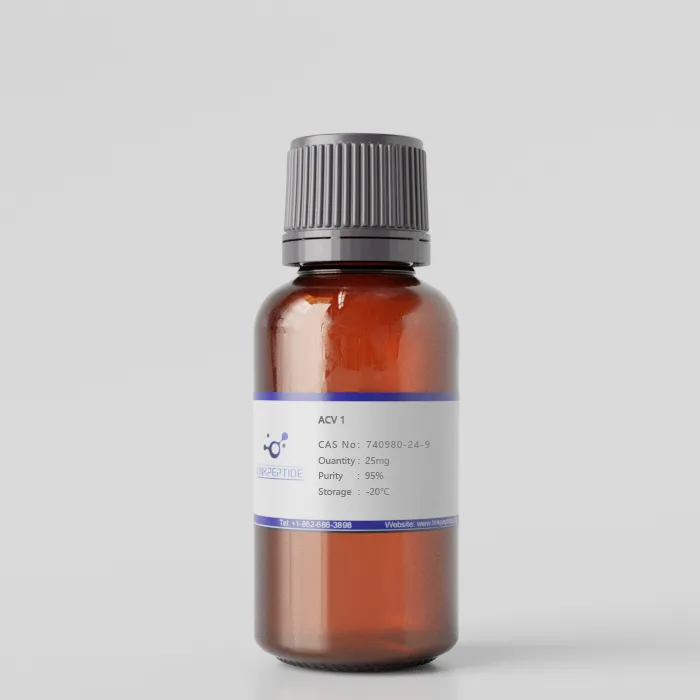
Product Name:ACV 1
CAS No:740980-24-9
Purity:95%
Molar Mass:1806.98
Chemical Formula:C71H103N23O25S4
Storage:Store at -20 degrees Celsius
Sequence:GCCSDPRCNYDHPEIC
Target:Neuronal nicotinic
Application:
ACV 1, or Acetylcholine Vasopeptidase Inhibitor 1, is a synthetic peptide that inhibits enzymes involved in the breakdown of vasopeptides, such as bradykinin and angiotensin. By preventing the degradation of these peptides, ACV 1 enhances their vasodilatory and anti-inflammatory effects, making it relevant in the study of cardiovascular diseases. ACV 1 is particularly studied for its potential to regulate blood pressure, improve vascular function, and reduce inflammation. It has applications in pharmaceutical research, especially for hypertension and heart failure treatment.
Current Research:
ACV1, also known as α-conotoxin Vc1.1, is a 16-amino-acid peptide derived from the venom of the marine cone snail Conus victoriae. It functions as a neuronal nicotinic acetylcholine receptor (nAChR) antagonist, displaying high selectivity for the α9α10 nAChR subtype. This specificity has positioned ACV1 as a promising candidate for the treatment of neuropathic pain.
Structural Characteristics
The peptide sequence of ACV1 is GCCSDPRCNYDHPEIC, with a molecular weight of 1806.98 Da. Its structure is stabilized by two disulfide bridges: one between Cys2 and Cys8, and another between Cys3 and Cys16. This disulfide-bonded framework is crucial for maintaining its bioactive conformation.
Receptor Specificity and Binding Affinity
ACV1 exhibits potent inhibition of the α9α10 nAChR subtype, with an IC₅₀ value of 19 nM. Its affinity decreases for other nAChR subtypes, with IC₅₀ values of 140 nM for α6/α3β2β3, 980 nM for α6/α3β4, 4200 nM for α3β4, and 7300 nM for α3β2. This selectivity underscores its potential for targeted therapeutic applications.
Mechanism of Action
By binding to the α9α10 nAChR subtype, ACV1 inhibits acetylcholine-induced ion flux, thereby modulating neuronal excitability. This action is particularly relevant in the context of neuropathic pain, where aberrant nAChR activity contributes to pathological pain signaling.
Pharmacological Profile
In preclinical studies, ACV1 has demonstrated efficacy in alleviating neuropathic pain across various rat models. Additionally, it has been shown to accelerate the functional recovery of injured neurons, suggesting neuroprotective properties.
Research Applications
The high selectivity of ACV1 for the α9α10 nAChR subtype makes it a valuable tool for:
Investigating the role of specific nAChR subtypes in pain pathways.
Developing targeted therapies for neuropathic pain conditions.
Exploring the neuroprotective mechanisms associated with nAChR modulation.
Clinical Implications
The promising preclinical outcomes have spurred interest in ACV1 as a novel analgesic agent. Its unique mechanism of action, distinct from traditional opioids, offers potential advantages in terms of efficacy and safety profiles.
Conclusion
ACV1 represents a significant advancement in the search for targeted neuropathic pain treatments. Its specificity for the α9α10 nAChR subtype and demonstrated efficacy in preclinical models highlight its potential as a therapeutic agent. Ongoing research aims to further elucidate its mechanisms and translate these findings into clinical applications.
Reference:
Get a Quote
 LinkPeptide

![SCYLLATOXIN [Tyr2]-](https://www.linkpeptide.com/wp-content/uploads/2024/10/SCYLLATOXIN-Tyr2-jpg-2.webp "SCYLLATOXIN [Tyr2]-")