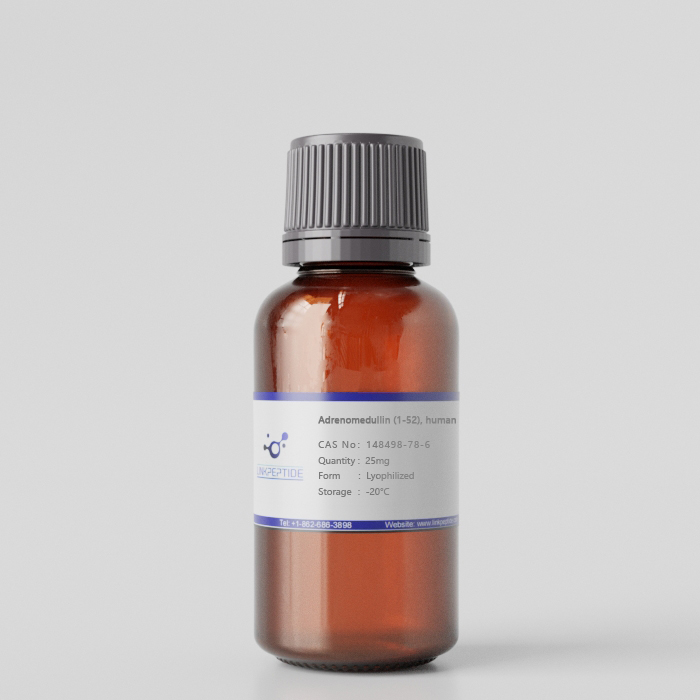
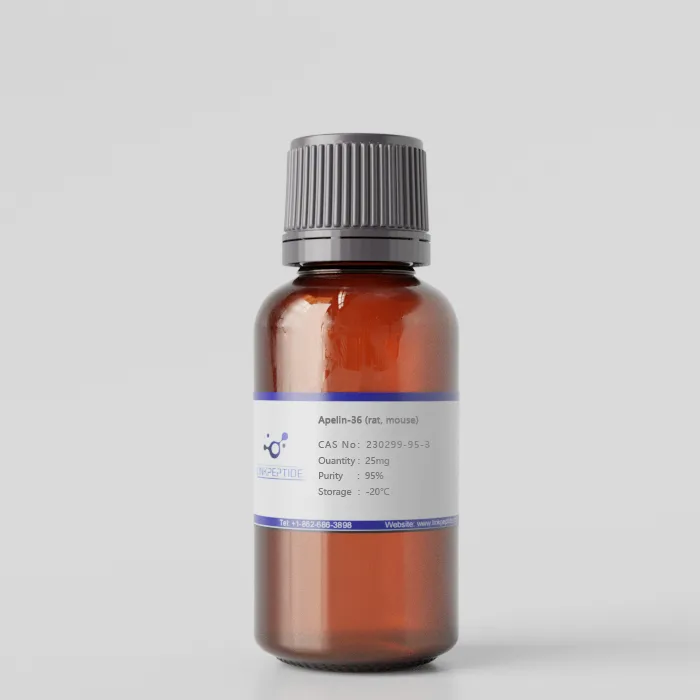
Product Name: Adrenomedullin (1-52), human
Sequence One Letter Code: YRQSMNNFQGLRSFGCRFGTCTVQKLAHQIYQFTDKDKDNVAPRSKISPQGY-NH2 (Disulfide bridge: 16-21)
Sequence Three Letter Code: H-Tyr-Arg-Gln-Ser-Met-Asn-Asn-Phe-Gln-Gly-Leu-Arg-Ser-Phe-Gly-Cys-Arg-Phe-Gly-Thr-Cys-Thr-Val-Gln-Lys-Leu-Ala-His-Gln-Ile-Tyr-Gln-Phe-Thr-Asp-Lys-Asp-Lys-Asp-Asn-Val-Ala-Pro-Arg-Ser-Lys-Ile-Ser-Pro-Gln-Gly-Tyr-NH2 (Disulfide bridge: 16-21)
Cas No: 148498-78-6
Chemical Formula:C264H406N80O77S3
Molecular Weight: 6028.8
Purity: 95%
Form: Lyophilized
Storage Conditions: - 20 °C
Research Area: Cardiovascular Disease Research
SMILES: CC[C@H](C)[C@@H](C(=O)N[C@@H](CCCNC(=N)N)C(=O)N[C@@H](CO)C(=O)N[C@@H](CC1=CC=CC=C1)C(=O)NCC(=O)N[C@H]2CSSC[C@H](NC(=O)[C@@H](NC(=O)CNC(=O)[C@@H](NC(=O)[C@@H](NC2=O)CCCNC(=N)N)CC3=CC=CC=C3)[C@@H](C)O)C(=O)N[C@@H]([C@@H](C)O)C(=O)N[C@@H](C(C)C)C(=O)N[C@@H](CCC(=O)N)C(=O)N[C@@H](CCCCN)C(=O)N[C@@H](CC(C)C)C(=O)N[C@@H](C)C(=O)N[C@@H](CC4=CN=CN4)C(=O)N[C@@H](CCC(=O)N)C(=O)N[C@@H]([C@@H](C)CC)C(=O)N[C@@H](CC5=CC=C(C=C5)O)C(=O)N[C@@H](CCC(=O)N)C(=O)N[C@@H](CC6=CC=CC=C6)C(=O)N[C@@H]([C@@H](C)O)C(=O)N[C@@H](CC(=O)O)C(=O)N[C@@H](CCCCN)C(=O)N[C@@H](CC(=O)O)C(=O)N[C@@H](CCCCN)C(=O)N[C@@H](CC(=O)O)C(=O)N[C@@H](CC(=O)N)C(=O)N[C@@H](C(C)C)C(=O)N[C@@H](C)C(=O)N7CCC[C@H]7C(=O)N[C@@H](CCCNC(=N)N)C(=O)N[C@@H](CO)C(=O)N[C@@H](CCCCN)C(=O)N[C@@H]([C@@H](C)CC)C(=O)N[C@@H](CO)C(=O)N8CCC[C@H]8C(=O)N[C@@H](CCC(=O)N)C(=O)NCC(=O)N[C@@H](CC9=CC=C(C=C9)O)C(=O)N)NC(=O)CNC(=O)[C@H](CCC(=O)N)NC(=O)[C@H](CC1=CC=CC=C1)NC(=O)[C@H](CC(=O)N)NC(=O)[C@H](CC(=O)N)NC(=O)[C@H](CCSC)NC(=O)[C@H](CO)NC(=O)[C@H](CCC(=O)N)NC(=O)[C@H](CCCNC(=N)N)NC(=O)[C@H](CC1=CC=C(C=C1)O)N
IUPAC: (3S)-3-[[(2S)-6-amino-2-[[(2S)-2-[[(2S,3R)-2-[[(2S)-2-[[(2S)-5-amino-2-[[(2S)-2-[[(2S,3S)-2-[[(2S)-5-amino-2-[[(2S)-2-[[(2S)-2-[[(2S)-2-[[(2S)-6-amino-2-[[(2S)-5-amino-2-[[(2S)-2-[[(2S,3R)-2-[[(4R,7S,13S,16S,19R)-19-[[2-[[(2S)-2-[[(2S)-2-[[(2S)-2-[[(2S,3S)-2-[[2-[[(2S)-5-amino-2-[[(2S)-2-[[(2S)-4-amino-2-[[(2S)-4-amino-2-[[(2S)-2-[[(2S)-2-[[(2S)-5-amino-2-[[(2S)-2-[[(2S)-2-amino-3-(4-hydroxyphenyl)propanoyl]amino]-5-carbamimidamidopentanoyl]amino]-5-oxopentanoyl]amino]-3-hydroxypropanoyl]amino]-4-methylsulfanylbutanoyl]amino]-4-oxobutanoyl]amino]-4-oxobutanoyl]amino]-3-phenylpropanoyl]amino]-5-oxopentanoyl]amino]acetyl]amino]-3-methylpentanoyl]amino]-5-carbamimidamidopentanoyl]amino]-3-hydroxypropanoyl]amino]-3-phenylpropanoyl]amino]acetyl]amino]-13-benzyl-16-(3-carbamimidamidopropyl)-7-[(1R)-1-hydroxyethyl]-6,9,12,15,18-pentaoxo-1,2-dithia-5,8,11,14,17-pentazacycloicosane-4-carbonyl]amino]-3-hydroxybutanoyl]amino]-3-methylbutanoyl]amino]-5-oxopentanoyl]amino]hexanoyl]amino]-4-methylpentanoyl]amino]propanoyl]amino]-3-(1H-imidazol-5-yl)propanoyl]amino]-5-oxopentanoyl]amino]-3-methylpentanoyl]amino]-3-(4-hydroxyphenyl)propanoyl]amino]-5-oxopentanoyl]amino]-3-phenylpropanoyl]amino]-3-hydroxybutanoyl]amino]-3-carboxypropanoyl]amino]hexanoyl]amino]-4-[[(2S)-6-amino-1-[[(2S)-1-[[(2S)-4-amino-1-[[(2S)-1-[[(2S)-1-[(2S)-2-[[(2S)-1-[[(2S)-1-[[(2S)-6-amino-1-[[(2S,3S)-1-[[(2S)-1-[(2S)-2-[[(2S)-5-amino-1-[[2-[[(2S)-1-amino-3-(4-hydroxyphenyl)-1-oxopropan-2-yl]amino]-2-oxoethyl]amino]-1,5-dioxopentan-2-yl]carbamoyl]pyrrolidin-1-yl]-3-hydroxy-1-oxopropan-2-yl]amino]-3-methyl-1-oxopentan-2-yl]amino]-1-oxohexan-2-yl]amino]-3-hydroxy-1-oxopropan-2-yl]amino]-5-carbamimidamido-1-oxopentan-2-yl]carbamoyl]pyrrolidin-1-yl]-1-oxopropan-2-yl]amino]-3-methyl-1-oxobutan-2-yl]amino]-1,4-dioxobutan-2-yl]amino]-3-carboxy-1-oxopropan-2-yl]amino]-1-oxohexan-2-yl]amino]-4-oxobutanoic acid
INCHIKEY: ULCUCJFASIJEOE-NPECTJMMSA-N
INCHI:
InChI=1S/C264H406N80O77S3/c1-19-132(10)207(335-200(366)120-294-216(377)160(78-84-189(270)355)308-234(395)171(107-142-52-30-24-31-53-142)322-237(398)176(112-196(277)362)324-238(399)175(111-195(276)361)323-230(391)166(90-101-422-18)312-245(406)182(123-346)332-229(390)163(81-87-192(273)358)309-220(381)156(60-42-95-289-261(280)281)302-215(376)151(269)103-144-66-72-148(352)73-67-144)253(414)315-159(63-45-98-292-264(286)287)226(387)331-183(124-347)246(407)320-170(106-141-50-28-23-29-51-141)219(380)295-119-199(365)301-185-126-423-424-127-186(334-256(417)210(137(15)349)336-201(367)121-296-218(379)169(105-140-48-26-22-27-49-140)319-224(385)157(307-247(185)408)61-43-96-290-262(282)283)248(409)342-212(139(17)351)258(419)338-206(131(8)9)252(413)316-164(82-88-193(274)359)227(388)303-152(56-34-38-91-265)221(382)318-168(102-129(4)5)233(394)298-135(13)214(375)317-174(110-147-117-288-128-297-147)236(397)311-165(83-89-194(275)360)232(393)340-208(133(11)20-2)254(415)328-172(109-146-70-76-150(354)77-71-146)235(396)310-162(80-86-191(272)357)228(389)321-173(108-143-54-32-25-33-55-143)242(403)341-211(138(16)350)257(418)329-180(116-204(372)373)240(401)305-154(58-36-40-93-267)222(383)326-178(114-202(368)369)239(400)304-153(57-35-39-92-266)223(384)327-179(115-203(370)371)241(402)325-177(113-197(278)363)243(404)337-205(130(6)7)251(412)299-136(14)259(420)343-99-46-64-187(343)249(410)313-158(62-44-97-291-263(284)285)225(386)330-181(122-345)244(405)306-155(59-37-41-94-268)231(392)339-209(134(12)21-3)255(416)333-184(125-348)260(421)344-100-47-65-188(344)250(411)314-161(79-85-190(271)356)217(378)293-118-198(364)300-167(213(279)374)104-145-68-74-149(353)75-69-145/h22-33,48-55,66-77,117,128-139,151-188,205-212,345-354H,19-21,34-47,56-65,78-116,118-127,265-269H2,1-18H3,(H2,270,355)(H2,271,356)(H2,272,357)(H2,273,358)(H2,274,359)(H2,275,360)(H2,276,361)(H2,277,362)(H2,278,363)(H2,279,374)(H,288,297)(H,293,378)(H,294,377)(H,295,380)(H,296,379)(H,298,394)(H,299,412)(H,300,364)(H,301,365)(H,302,376)(H,303,388)(H,304,400)(H,305,401)(H,306,405)(H,307,408)(H,308,395)(H,309,381)(H,310,396)(H,311,397)(H,312,406)(H,313,410)(H,314,411)(H,315,414)(H,316,413)(H,317,375)(H,318,382)(H,319,385)(H,320,407)(H,321,389)(H,322,398)(H,323,391)(H,324,399)(H,325,402)(H,326,383)(H,327,384)(H,328,415)(H,329,418)(H,330,386)(H,331,387)(H,332,390)(H,333,416)(H,334,417)(H,335,366)(H,336,367)(H,337,404)(H,338,419)(H,339,392)(H,340,393)(H,341,403)(H,342,409)(H,368,369)(H,370,371)(H,372,373)(H4,280,281,289)(H4,282,283,290)(H4,284,285,291)(H4,286,287,292)/t132-,133-,134-,135-,136-,137+,138+,139+,151-,152-,153-,154-,155-,156-,157-,158-,159-,160-,161-,162-,163-,164-,165-,166-,167-,168-,169-,170-,171-,172-,173-,174-,175-,176-,177-,178-,179-,180-,181-,182-,183-,184-,185-,186-,187-,188-,205-,206-,207-,208-,209-,210-,211-,212-/m0/s1
Source / Species: human
Conjugation: Unconjugated
Code Nacres: NA.26
Application: Adrenomedullin (1–52), human is a synthetic full-length peptide corresponding to the endogenous 52-amino acid vasoactive hormone first isolated from adrenal medullary tumors. Adrenomedullin exerts potent vasodilatory effects through receptor complexes involving calcitonin receptor-like receptor (CLR) and receptor activity–modifying proteins (RAMPs), promoting cAMP-dependent signaling. Beyond vascular tone regulation, it contributes to natriuresis, fluid homeostasis, and modulation of endocrine secretion. Emerging evidence implicates adrenomedullin in angiogenesis, cellular proliferation control, and innate immune defense, including antimicrobial functions. Due to its pleiotropic physiological roles, this peptide is widely utilized in cardiovascular research, inflammation models, and studies of endothelial function. It provides a defined tool for examining peptide–receptor interactions, downstream second messenger pathways, and disease-associated alterations in vascular and immune signaling networks.
Current Research: Adrenomedullin (1–52), Human Adrenomedullin (1–52), human is a synthetic peptide corresponding to the full-length 52–amino acid endogenous vasoactive hormone originally isolated from adrenal medullary tumors. Since its discovery, adrenomedullin (ADM) has been recognized as a multifunctional regulatory peptide with broad physiological impact across the cardiovascular, renal, endocrine, and immune systems. Its defined primary structure and preserved bioactivity make it an essential experimental tool for mechanistic studies of peptide-mediated signaling. Receptor Complexes and Signal Transduction Adrenomedullin exerts its biological effects through receptor complexes composed of the calcitonin receptor-like receptor (CLR) in association with receptor activity–modifying proteins (RAMP2 or RAMP3). These heterodimeric complexes determine ligand specificity and downstream signaling characteristics. Upon binding to CLR/RAMP2 or CLR/RAMP3, ADM primarily activates G_s proteins, stimulating adenylyl cyclase and increasing intracellular cAMP levels. Elevated cAMP triggers protein kinase A (PKA) activation and subsequent phosphorylation cascades that regulate vascular smooth muscle relaxation, endothelial nitric oxide production, and gene expression. In addition to canonical cAMP signaling, ADM has been shown to engage PI3K/Akt and MAPK pathways in a cell-type–dependent manner, expanding its functional repertoire beyond simple vasodilation. Regulation of Vascular Tone and Endothelial Function One of the most extensively studied functions of adrenomedullin is its potent vasodilatory activity. By promoting nitric oxide synthesis and reducing intracellular calcium in vascular smooth muscle cells, ADM lowers peripheral vascular resistance and contributes to systemic blood pressure regulation. Recent research highlights ADM’s role in maintaining endothelial barrier integrity. In inflammatory or septic conditions, ADM signaling stabilizes endothelial junctions, reduces vascular permeability, and mitigates edema formation. These protective properties have positioned adrenomedullin as a molecule of interest in acute cardiovascular and inflammatory disorders. Natriuresis and Fluid Homeostasis Beyond vascular tone regulation, ADM influences renal function and fluid balance. It promotes natriuresis by modulating renal tubular sodium handling and increasing renal blood flow. Through coordinated vascular and renal effects, ADM contributes to systemic volume regulation and hemodynamic stability. Investigations into ADM’s interaction with the renin–angiotensin–aldosterone system (RAAS) suggest a counter-regulatory role in hypertensive states, where it may act to buffer excessive vasoconstriction and sodium retention. Angiogenesis and Cellular Proliferation Emerging evidence links adrenomedullin to angiogenic processes. ADM stimulates endothelial cell proliferation and migration, partly through cAMP-dependent signaling and activation of pro-survival pathways such as PI3K/Akt. These properties are relevant in physiological tissue repair as well as pathological angiogenesis observed in tumor progression. In cancer biology, elevated ADM expression has been associated with tumor vascularization and hypoxia adaptation. As such, the peptide is frequently used in experimental systems to dissect angiogenic signaling networks and evaluate potential modulators of vascular growth. Immunomodulatory and Antimicrobial Functions Adrenomedullin also exhibits immunoregulatory properties. It modulates cytokine production, influences macrophage activation, and contributes to innate immune responses. Additionally, ADM possesses direct antimicrobial activity against select bacterial strains, suggesting a protective role at epithelial and vascular interfaces. Current studies examine ADM signaling in inflammatory diseases, sepsis models, and vascular immune interactions, further expanding its relevance in translational research. Applications in Research Adrenomedullin (1–52), human is widely applied in: Vascular reactivity and smooth muscle relaxation assays Endothelial permeability and barrier function studies cAMP signaling and second messenger analysis Angiogenesis and cell proliferation models Inflammation and sepsis research Peptide–CLR/RAMP interaction characterization Because it represents the full-length endogenous sequence, this peptide provides comprehensive receptor engagement consistent with physiological signaling. It enables controlled examination of receptor pharmacology, downstream signaling cascades, and disease-associated alterations in vascular and immune pathways. Overall, Adrenomedullin (1–52), human serves as a versatile and mechanistically defined tool for investigating peptide hormone signaling across cardiovascular, renal, inflammatory, and angiogenic systems.
Get a Quote
 LinkPeptide