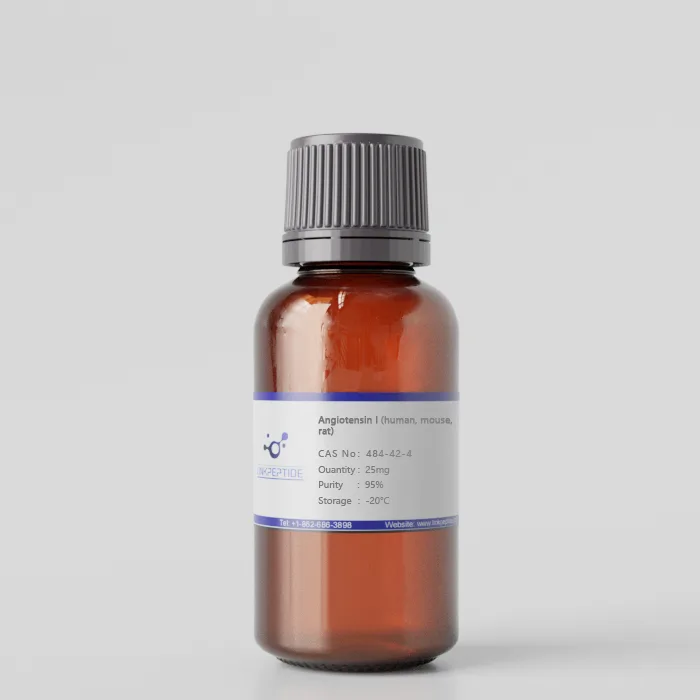
Product Name:Urotensin II-related peptide
CAS No:342878-90-4
Purity:95%
Molar Mass:1017.22
Chemical Formula:C49H64N10O10S2
Storage:Store at -20 degrees Celsius
Sequence:ACFWKYCV
Application:
Urotensin II-related peptide (URP) is a peptide that is structurally related to Urotensin II (UII), a potent vasoactive peptide involved in cardiovascular regulation. Like Urotensin II, URP binds to the G-protein-coupled receptor UT (Urotensin II receptor) and modulates various physiological processes, including vasoconstriction, cell proliferation, and fibrosis. URP is particularly significant in cardiovascular research due to its role in hypertension, heart failure, and vascular remodeling. Studies on Urotensin II-related peptide focus on understanding its mechanisms of action and exploring therapeutic opportunities for cardiovascular diseases and other conditions where Urotensin II signaling plays a crucial role.
Current Research:
Urotensin II–related peptide (URP) is an endogenous cyclic neuropeptide present across all sequenced vertebrates. It serves as a ligand for the urotensin II receptor (UT), playing roles in cardiovascular regulation and potentially in reproductive processes.
Discovery and Structure
URP was identified in rat brains during investigations aimed at locating urotensin II (UII), a potent vasoconstrictor neuropeptide. Researchers found a smaller peptide with similar characteristics to UII, leading to its designation as Urotensin II–related peptide. The human URP gene is located on chromosome 3q28. The mature URP peptide consists of eight amino acids: Alanine-Cysteine-Phenylalanine-Tryptophan-Lysine-Tyrosine-Cysteine-Valine. It features a cysteine-bridged hexapeptide ring (CFWKYC), known as the core, which is crucial for its biological activity. Modifications to the amino terminus do not significantly affect its pharmacological function, indicating that this region is less critical for receptor activation.
Receptor Interaction
URP acts as an agonist for the UT receptor, a G protein–coupled receptor that activates the Gαq11 subunit. This activation leads to increased intracellular calcium levels, influencing various physiological responses. The UT receptor is distributed in multiple peripheral tissues, blood vessels, and specific brain regions, including the brainstem cholinergic neurons of the laterodorsal tegmental and pedunculopontine tegmental nuclei.
Physiological Functions
Cardiovascular Effects: In animal studies, URP administration results in a prolonged hypotensive response, suggesting its role in blood pressure regulation. Interestingly, while UII is known for its vasoconstrictive properties, URP can induce opposite effects despite both peptides acting on the same receptor.
Central Nervous System: URP-reactive axons are primarily located in the organum vasculosum laminae terminalis and the median eminence, areas associated with reproductive hormone regulation. This distribution implies that URP may influence reproductive functions, although specific roles remain to be fully elucidated.
Tissue Distribution
The precursor to URP, prepro-URP, is expressed in various tissues, including the frontal lobe, hypothalamus, heart, kidneys, lungs, placenta, ovaries, and testes. In humans, URP and UII gene expression levels are comparable, except in the spinal cord, where UII expression predominates. In rats, UII gene expression is generally higher than that of URP throughout the body; however, within the brain, URP appears to be the primary endogenous ligand.
Clinical Implications
Given its involvement in cardiovascular regulation and potential roles in reproduction, URP represents a target of interest for therapeutic interventions aimed at conditions like hypertension and reproductive disorders. Further research is necessary to fully understand its functions and to develop targeted treatments.
In summary, Urotensin II–related peptide is a significant neuropeptide with diverse physiological roles, particularly in cardiovascular and reproductive systems. Ongoing studies continue to uncover its functions and therapeutic potential.
Reference:
Get a Quote
 LinkPeptide

![[Pyr1]-Apelin-13](https://www.linkpeptide.com/wp-content/uploads/2024/10/Pyr1-Apelin-13-jpg-3.webp "[Pyr1]-Apelin-13")