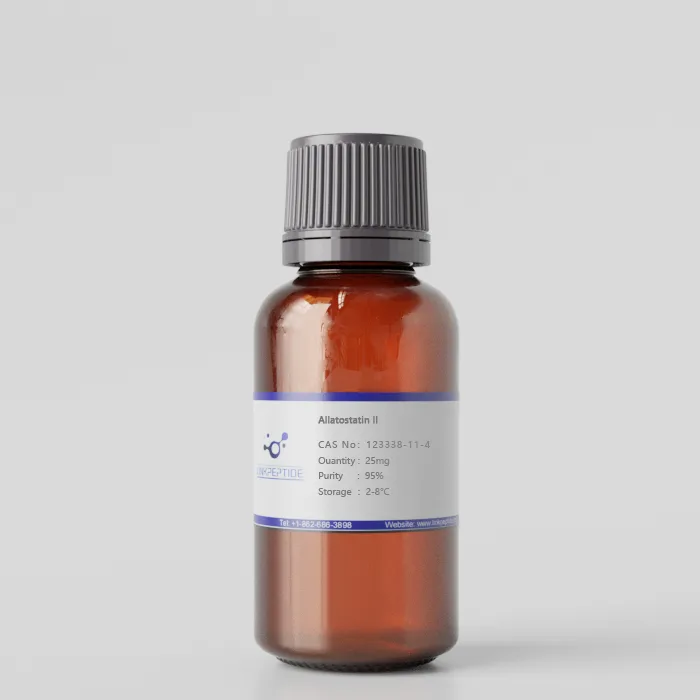
Product Name:Allatostatin II
Form:TFA salt
Purity:95%
Storage:2-8 degree Celsius
Cas No:123338-11-4
Molar Mass:1067.2
Chemical Formula:C49H74N14O13
IUPAC Name:3-[(2-aminoacetyl)amino]-4-[[2-[[1-[[1-[[1-[[1-[[1-[[2-[(1-amino-4-methyl-1-oxopentan-2-yl)amino]-2-oxoethyl]amino]-1-oxo-3-phenylpropan-2-yl]amino]-1-oxopropan-2-yl]amino]-3-(4-hydroxyphenyl)-1-oxopropan-2-yl]amino]-4-methyl-1-oxopentan-2-yl]amino]-5-(diaminomethylideneamino)-1-oxopentan-2-yl]amino]-2-oxoethyl]amino]-4-oxobutanoic acid
SMILES:CC(C)CC(C(=O)N)NC(=O)CNC(=O)C(CC1=CC=CC=C1)NC(=O)C(C)NC(=O)C(CC2=CC=C(C=C2)O)NC(=O)C(CC(C)C)NC(=O)C(CCCN=C(N)N)NC(=O)CNC(=O)C(CC(=O)O)NC(=O)CN
InChIKey:WGQGYYOXEWOITJ-UHFFFAOYSA-N
InChI:InChI=1S/C49H74N14O13/c1-26(2)18-33(42(51)70)59-40(67)25-55-44(72)35(20-29-10-7-6-8-11-29)61-43(71)28(5)57-47(75)36(21-30-13-15-31(64)16-14-30)63-48(76)34(19-27(3)4)62-46(74)32(12-9-17-54-49(52)53)58-39(66)24-56-45(73)37(22-41(68)69)60-38(65)23-50/h6-8,10-11,13-16,26-28,32-37,64H,9,12,17-25,50H2,1-5H3,(H2,51,70)(H,55,72)(H,56,73)(H,57,75)(H,58,66)(H,59,67)(H,60,65)(H,61,71)(H,62,74)(H,63,76)(H,68,69)(H4,52,53,54)
Sequence:Gly-Asp-Gly-Arg-Leu-Tyr-Ala-Phe-Gly-Leu-NH2
Application:Allatostatin II is a neuropeptide found in insects, primarily functioning as an inhibitor of juvenile hormone (JH) synthesis in the corpora allata, a key endocrine gland regulating growth, metamorphosis, and reproduction. It belongs to the allatostatin (AST) family, which also influences feeding behavior, gut motility, and metabolic regulation. By suppressing JH production, Allatostatin II plays a vital role in developmental transitions, reproductive control, and energy balance. Research on Allatostatin II focuses on insect endocrinology, neuropeptide signaling, and pest control strategies, making it a valuable tool in hormonal regulation studies and environmentally friendly insect population management.
Current Research:Allatostatin II is an essential neuropeptide in insects, regulating juvenile hormone (JH) synthesis, digestion, and feeding behavior. As part of the allatostatin family, it functions as a potent negative regulator of JH production, influencing insect development, metamorphosis, and reproduction. Research on Allatostatin II extends to pest control, metabolic signaling, and comparative endocrinology due to its role in hormonal regulation. 1. Role in Juvenile Hormone Regulation and Development Allatostatin II is secreted from neurosecretory cells in the brain and acts on the corpora allata, leading to: Inhibition of JH biosynthesis, reducing its influence on insect growth and development. Acceleration of metamorphosis, shortening larval stages and advancing pupation. Reproductive suppression, as JH is critical for ovarian development and egg production. These effects make Allatostatin II a key target in insect developmental research, with applications in population control and pest management. 2. Influence on Feeding Behavior and Digestive Processes Beyond its role in JH inhibition, Allatostatin II is also involved in digestive regulation and feeding control, affecting: Gut motility, by slowing peristalsis and modifying nutrient absorption. Digestive enzyme secretion, reducing metabolic efficiency. Foraging and food intake, linking neuroendocrine signaling to nutritional status. Studies suggest that Allatostatin II interacts with insulin-like peptides, potentially influencing energy storage and metabolic homeostasis. 3. Applications in Pest Control and Insecticide Development Due to its critical function in hormonal regulation, Allatostatin II is being explored for biological pest control applications. Potential strategies include: Allatostatin-mimicking compounds, designed to suppress insect reproduction and disrupt development. Gene-editing approaches targeting allatostatin pathways to alter growth and survival rates in pest species. These methods offer eco-friendly alternatives to conventional insecticides, aiming for species-specific hormonal disruption without harming beneficial insects. 4. Comparative Neuroendocrinology and Evolutionary Studies Allatostatins, including Allatostatin II, share similarities with vertebrate neuropeptides such as somatostatin and galanin, leading to research on: The evolutionary conservation of neuropeptide signaling. Potential links between insect and vertebrate metabolic regulation mechanisms. Conclusion Allatostatin II is a key neuropeptide involved in juvenile hormone inhibition, feeding behavior, and metabolic regulation in insects. Its significance in insect development and reproductive control makes it an important target in pest management, endocrinology, and evolutionary neuropeptide research, providing insights into hormonal regulation and potential biotechnological applications.
Get a Quote
 LinkPeptide