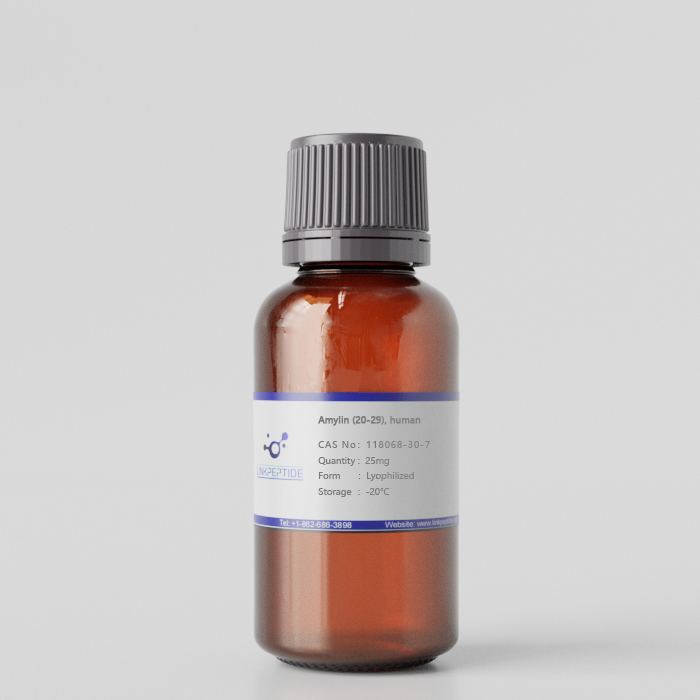
Product Name: Amylin (20-29), human
Sequence One Letter Code: SNNFGAILSS
Sequence Three Letter Code: H-Ser-Asn-Asn-Phe-Gly-Ala-Ile-Leu-Ser-Ser-OH
Cas No: 118068-30-7
Chemical Formula:C43H68N12O16
Molecular Weight: 1009.1
Purity: 95%
Form: Lyophilized
Storage Conditions: - 20 °C
Research Area: Diabetes and Metabolic Syndrome
SMILES: CC[C@H](C)[C@@H](C(=O)N[C@@H](CC(C)C)C(=O)N[C@@H](CO)C(=O)N[C@@H](CO)C(=O)O)NC(=O)[C@H](C)NC(=O)CNC(=O)[C@H](CC1=CC=CC=C1)NC(=O)[C@H](CC(=O)N)NC(=O)[C@H](CC(=O)N)NC(=O)[C@H](CO)N
IUPAC: (2S)-2-[[(2S)-2-[[(2S)-2-[[(2S,3S)-2-[[(2S)-2-[[2-[[(2S)-2-[[(2S)-4-amino-2-[[(2S)-4-amino-2-[[(2S)-2-amino-3-hydroxypropanoyl]amino]-4-oxobutanoyl]amino]-4-oxobutanoyl]amino]-3-phenylpropanoyl]amino]acetyl]amino]propanoyl]amino]-3-methylpentanoyl]amino]-4-methylpentanoyl]amino]-3-hydroxypropanoyl]amino]-3-hydroxypropanoic acid
INCHIKEY: RMSCIVKVSZSEHU-ITYUDAQQSA-N
INCHI:
InChI=1S/C43H68N12O16/c1-6-21(4)34(42(69)52-25(12-20(2)3)38(65)53-29(18-57)41(68)54-30(19-58)43(70)71)55-35(62)22(5)48-33(61)16-47-37(64)26(13-23-10-8-7-9-11-23)50-40(67)28(15-32(46)60)51-39(66)27(14-31(45)59)49-36(63)24(44)17-56/h7-11,20-22,24-30,34,56-58H,6,12-19,44H2,1-5H3,(H2,45,59)(H2,46,60)(H,47,64)(H,48,61)(H,49,63)(H,50,67)(H,51,66)(H,52,69)(H,53,65)(H,54,68)(H,55,62)(H,70,71)/t21-,22-,24-,25-,26-,27-,28-,29-,30-,34-/m0/s1
Source / Species: human
Conjugation: Unconjugated
Code Nacres: NA.26
Application: Amylin (20–29), human, is a peptide fragment corresponding to the central amyloidogenic region of islet amyloid polypeptide. This short sequence represents the core determinant of fibril formation and readily assembles into amyloid-like aggregates exhibiting diverse and polymorphic structural features. Despite its minimal length, the fragment retains strong self-association properties, making it an efficient experimental model for investigating the molecular basis of amyloid nucleation and elongation. Amylin (20–29) is widely applied in biophysical and biochemical studies examining peptide self-assembly, β-sheet formation, and fibril stabilization mechanisms. It also supports investigations into aggregation-associated cytotoxicity and membrane interactions relevant to β-cell dysfunction. As a simplified system, this fragment enables detailed structural, kinetic, and inhibitor screening analyses, facilitating mechanistic exploration of islet amyloid deposition and its contribution to the pathogenesis of type 2 diabetes and related metabolic disorders.
Current Research: Amylin (20–29), human, represents the central amyloidogenic core of islet amyloid polypeptide (IAPP) and remains one of the most intensively studied minimal sequences in protein aggregation research. Corresponding to residues 20–29 of the full-length 37-amino acid hormone, this short fragment contains the principal structural determinants responsible for fibril nucleation and propagation. Despite its reduced length, Amylin (20–29) preserves a pronounced intrinsic tendency to self-associate, forming β-sheet–rich amyloid-like aggregates with structural polymorphism similar to that observed in full-length human amylin. Current research consistently identifies this region as the primary driver of amyloid formation in type 2 diabetes. Subtle variations within the 20–29 sequence dramatically influence aggregation kinetics, species specificity, and fibril morphology. Comparative studies between human and rodent amylin highlight how key residue substitutions in this segment disrupt β-sheet stacking and prevent amyloid formation in non-human species. As a result, Amylin (20–29) serves as a powerful reductionist model for dissecting the molecular grammar of amyloidogenic sequences. Biophysical investigations frequently employ this fragment to characterize the fundamental steps of amyloid assembly. Using techniques such as circular dichroism spectroscopy, Fourier-transform infrared spectroscopy, solid-state nuclear magnetic resonance, atomic force microscopy, and cryo-electron microscopy, researchers monitor the transition from soluble monomers to oligomeric intermediates and ultimately to mature fibrils. The fragment rapidly adopts β-sheet–dominated conformations, enabling precise kinetic measurements of nucleation and elongation phases. Because of its short sequence and reproducible aggregation behavior, Amylin (20–29) allows high-resolution structural analysis that can be more challenging with full-length peptides. Recent work has emphasized the polymorphic nature of aggregates formed by this fragment. Depending on environmental conditions—such as pH, ionic strength, temperature, and peptide concentration—Amylin (20–29) can assemble into structurally distinct fibril architectures. These polymorphs differ in β-sheet packing arrangements and stability, offering insights into how subtle conformational variations may influence cytotoxicity and disease progression. Understanding this structural diversity is increasingly recognized as critical for interpreting amyloid pathology. Beyond structural studies, Amylin (20–29) is widely used to investigate membrane interactions and aggregation-associated cytotoxic mechanisms. Oligomeric species derived from this region can interact with lipid bilayers, perturb membrane integrity, and promote ion permeability changes—processes implicated in pancreatic β-cell dysfunction. By isolating the core aggregation domain, researchers can directly evaluate how β-sheet formation correlates with membrane disruption, oxidative stress induction, and downstream apoptotic signaling. The fragment also plays a central role in inhibitor discovery and mechanistic screening efforts. Because aggregation occurs rapidly and reproducibly, Amylin (20–29) is well suited for evaluating small molecules, peptides, antibodies, and chemical chaperones designed to interfere with nucleation, β-sheet stacking, or fibril elongation. High-throughput fluorescence-based assays, including thioflavin T binding measurements, are commonly employed to quantify aggregation kinetics and assess compound efficacy. Insights gained from fragment-based screening often inform strategies targeting full-length amylin and other amyloid-forming proteins. Importantly, the simplified nature of Amylin (20–29) enables systematic structure–activity relationship analyses. Researchers can introduce targeted substitutions, backbone modifications, or stereochemical changes to determine how individual residues contribute to self-assembly and fibril stability. These studies deepen understanding of sequence-dependent amyloidogenicity and help define general principles governing protein misfolding disorders. Overall, Amylin (20–29), human, functions as a highly efficient experimental platform for exploring the molecular basis of amyloid formation. Its strong self-association properties, structural versatility, and compatibility with diverse analytical techniques make it indispensable for mechanistic, structural, and therapeutic investigations. By providing a focused model of the amyloidogenic core, this fragment continues to advance understanding of islet amyloid deposition and its contribution to β-cell dysfunction in type 2 diabetes and related metabolic diseases.
Get a Quote
 LinkPeptide