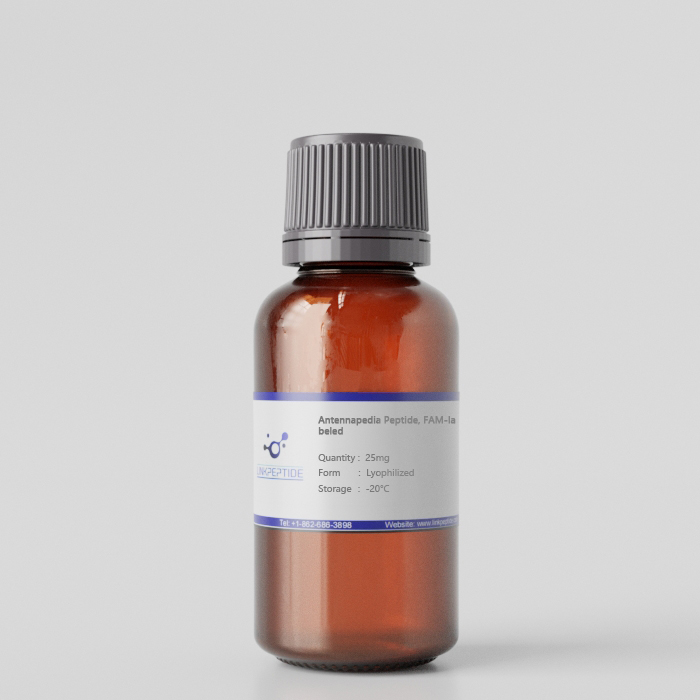
Product Name: Antennapedia Peptide, FAM-labeled
Sequence One Letter Code: 5-FAM-RQIKIWFQNRRMKWKK-NH2
Sequence Three Letter Code: 5-FAM-Arg-Gln-Ile-Lys-Ile-Trp-Phe-Gln-Asn-Arg-Arg-Met-Lys-Trp-Lys-Lys-NH2
Chemical Formula:C125H179N35O25S1
Molecular Weight: 2604.2
Purity: 95%
Form: Lyophilized
Storage Conditions: - 20 °C Protected from light
Research Area: Cell Penetrating Peptides
Source / Species: Drosophila
Conjugation: Conjugated
Conjugation Type: Fluorescent dyes
Code Nacres: NA.26
Application: This FAM-labeled Antennapedia peptide corresponds to residues 43–58 of the Drosophila Antennapedia homeodomain and is commonly known as penetratin, a well-characterized cell-penetrating peptide. The 16-amino-acid sequence can rapidly translocate across biological membranes, enabling efficient delivery into the cytosol and nucleus of living cells. Conjugation with fluorescein (FAM) provides excitation and emission maxima around 492/518 nm, allowing visualization of peptide uptake and intracellular localization by fluorescence microscopy or flow cytometry. Penetratin can enter cells at both physiological temperature and low temperatures, indicating energy-independent membrane translocation. This fluorescent peptide is widely used to study cellular uptake mechanisms, membrane permeability, and intracellular delivery of biomolecules, and it supports applications in drug delivery research and live-cell imaging.
Current Research: Introduction to Cell-Penetrating Peptides Cell-penetrating peptides (CPPs) are short peptide sequences capable of crossing biological membranes and delivering molecular cargo into living cells. These peptides have become valuable tools in cell biology and drug delivery research because they can transport biomolecules such as nucleic acids, proteins, and therapeutic agents into the cytoplasm or nucleus. One of the best-known CPPs is penetratin, a peptide derived from the Drosophila Antennapedia homeodomain. When labeled with fluorescein (FAM), the peptide enables direct visualization of cellular uptake and intracellular distribution. The FAM-labeled Antennapedia (43–58) peptide, commonly referred to as FAM-penetratin, is therefore widely used in studies of membrane translocation, intracellular delivery, and live-cell imaging. Origin and Structure of Penetratin Penetratin corresponds to residues 43–58 of the Antennapedia homeodomain, a transcription factor involved in developmental regulation in Drosophila melanogaster. The peptide consists of 16 amino acids and contains several positively charged residues that facilitate interactions with negatively charged components of cellular membranes. These electrostatic interactions contribute to the peptide’s ability to cross lipid bilayers and enter living cells. Because of its relatively small size and efficient membrane translocation properties, penetratin has become a model system for studying the mechanisms underlying CPP-mediated cellular uptake. Fluorescent Labeling with FAM In this peptide construct, penetratin is conjugated with fluorescein amidite (FAM), a commonly used fluorescent dye. FAM provides strong fluorescence signals with excitation and emission maxima of approximately 492 nm and 518 nm, respectively. The fluorescent labeling allows researchers to monitor peptide uptake and intracellular distribution in real time. Techniques such as fluorescence microscopy, confocal imaging, and flow cytometry can be used to detect the fluorescent signal and track the localization of the peptide within cells. This capability makes FAM-penetratin particularly useful for experiments investigating membrane transport and intracellular trafficking. Mechanism of Cellular Uptake Penetratin is known for its ability to rapidly translocate across biological membranes. Once in contact with the cell surface, the peptide can enter the cytosol and often accumulate in the nucleus. This property makes it an effective vehicle for delivering molecular cargo into intracellular compartments. Interestingly, penetratin can enter cells at both physiological temperatures and low temperatures, indicating that its translocation does not rely exclusively on energy-dependent processes such as endocytosis. This observation suggests that the peptide can cross membranes through energy-independent mechanisms, although multiple uptake pathways may contribute depending on experimental conditions. Studying these mechanisms provides insight into how small peptides interact with lipid membranes and penetrate cellular barriers. Applications in Cellular Uptake Studies Because of its reliable membrane-penetrating ability, FAM-penetratin is widely used in cellular uptake experiments. Researchers can use the fluorescent peptide to investigate how CPPs interact with cell membranes, how quickly they enter cells, and where they accumulate inside the cell. These experiments help clarify the factors that influence peptide internalization, including membrane composition, peptide concentration, and environmental conditions. Such studies contribute to a broader understanding of membrane permeability and intracellular transport processes. Utility in Drug Delivery Research Cell-penetrating peptides are also of significant interest in drug delivery research, where they can serve as carriers for therapeutic molecules. Penetratin has been explored as a delivery vector capable of transporting peptides, proteins, nucleic acids, and small molecules across cell membranes. By attaching therapeutic cargo to CPPs, researchers aim to improve intracellular delivery of compounds that would otherwise have difficulty crossing the plasma membrane. FAM-penetratin provides a convenient experimental tool for evaluating delivery efficiency and tracking cargo localization within cells. Applications in Live-Cell Imaging and Membrane Studies The fluorescent nature of FAM-penetratin makes it particularly useful in live-cell imaging studies. Researchers can monitor peptide entry into cells and observe intracellular distribution patterns using fluorescence microscopy. In addition, the peptide can be used to examine membrane permeability, peptide–membrane interactions, and intracellular trafficking pathways. These experiments help reveal how biological membranes respond to CPP interactions and how molecules move between cellular compartments. Conclusion The FAM-labeled Antennapedia (43–58) peptide, commonly known as FAM-penetratin, is a well-characterized cell-penetrating peptide widely used in cellular uptake and intracellular delivery studies. Derived from the Antennapedia homeodomain of Drosophila, this 16-residue peptide can efficiently translocate across biological membranes and accumulate within the cytosol and nucleus. With its fluorescent FAM label enabling detection at approximately 492/518 nm, the peptide supports visualization of membrane translocation and intracellular localization using fluorescence microscopy and flow cytometry. As a result, FAM-penetratin remains a valuable tool for studying membrane permeability, intracellular delivery mechanisms, and drug delivery strategies in living cells.
Get a Quote
 LinkPeptide