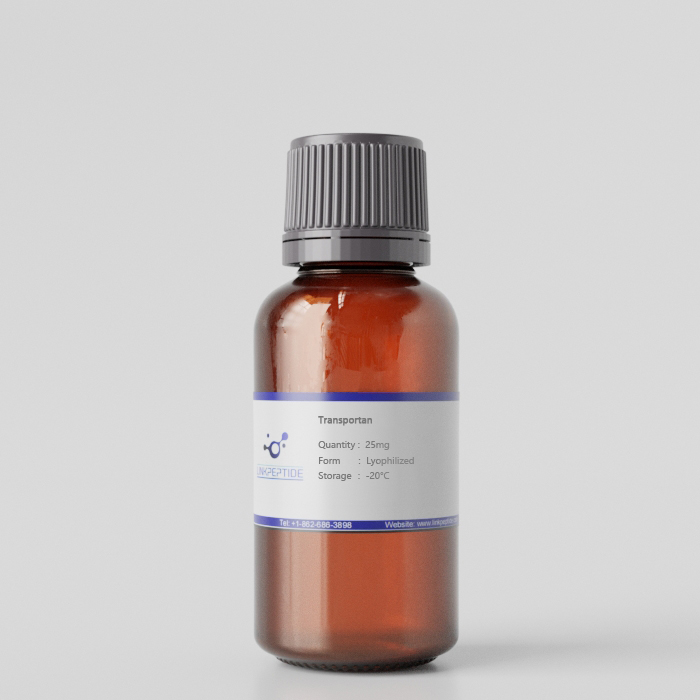
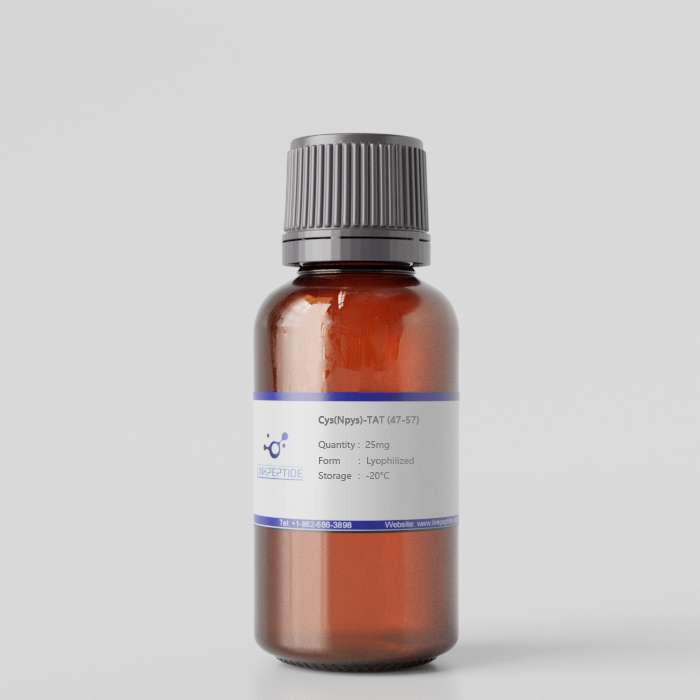
Product Name: Transportan
Sequence One Letter Code: GWTLNSAGYLLGKINLKALAALAKKIL
Sequence Three Letter Code: Gly-Trp-Thr-Leu-Asn-Ser-Ala-Gly-Tyr-Leu-Leu-Gly-Lys-Ile-Asn-Leu-Lys-Ala-Leu-Ala-Ala-Leu-Ala-Lys-Lys-Ile-Leu
Chemical Formula:C134H226N34O33
Molecular Weight: 2841.5
Purity: 95%
Form: Lyophilized
Storage Conditions: - 20 °C
Research Area: Cell Penetrating Peptides
Source / Species: Synthetic construct
Conjugation: Unconjugated
Code Nacres: NA.26
Application: Transportan (TP) is a 27-amino acid amphipathic chimeric peptide that combines cell-penetrating and antimicrobial properties. It consists of a 12-residue segment derived from the neuropeptide galanin linked to a 14-residue fragment of the wasp venom peptide mastoparan via a lysine residue. Transportan retains functional characteristics of both parent peptides, including modulation of G protein activity and inhibition of galanin binding to GALR-1 receptors. Its amphipathic structure enables efficient membrane interaction and intracellular delivery of conjugated cargos. Transportan is widely used in research on cellular uptake mechanisms, membrane translocation, intracellular delivery of biomolecules, and signal transduction pathways involving G protein regulation.
Current Research: Transportan (TP) is a 27–amino acid chimeric peptide engineered by fusing a 12-residue fragment of the neuropeptide galanin to a 14-residue segment of the wasp venom peptide mastoparan, linked via a lysine residue. This rational design combines structural and functional elements of both parent peptides, resulting in a molecule that exhibits potent cell-penetrating capability along with bioactivity related to G protein modulation and membrane interaction. Structurally, Transportan is amphipathic and adopts an α-helical conformation in membrane-mimetic environments. The segregation of hydrophobic and cationic residues along the helical axis promotes strong interaction with phospholipid bilayers. This amphipathicity underlies its ability to insert into or associate with plasma membranes, facilitating rapid cellular uptake at low micromolar concentrations. Unlike highly lytic peptides, Transportan can translocate across membranes without extensive membrane disruption when used under controlled experimental conditions. The galanin-derived N-terminal segment preserves partial affinity for galanin receptors, particularly GALR-1, and has been shown to inhibit galanin binding. The mastoparan-derived C-terminal segment contributes membrane-perturbing activity and interaction with heterotrimeric G proteins. Mastoparan is known to directly activate G_i/o proteins by mimicking receptor-mediated activation, and Transportan retains aspects of this G protein–modulating capacity. Consequently, TP serves not only as a delivery vector but also as a bioactive probe for studying GPCR-associated signaling pathways and G protein regulation. Mechanistically, Transportan-mediated cellular uptake can occur via multiple pathways, including endocytosis and direct membrane translocation. The specific route depends on concentration, cargo type, cell type, and experimental conditions. Once internalized, TP can facilitate cytosolic delivery of conjugated cargos, making it a versatile platform for intracellular transport. Covalent conjugation or noncovalent complexation strategies have been used to deliver peptides, proteins, nucleic acids, and nanoparticles into a variety of cell types. In cellular uptake research, Transportan is frequently employed to dissect membrane translocation mechanisms. Experimental approaches include fluorescence microscopy to track intracellular localization, flow cytometry to quantify uptake efficiency, and biochemical assays to assess endosomal escape and cytosolic release. Comparative studies with other cell-penetrating peptides (CPPs), such as Tat or penetratin, often highlight TP’s strong membrane interaction and delivery efficiency. Because of its mastoparan component, Transportan can influence intracellular signaling independently of its delivery function. It has been used to study G protein activation dynamics, downstream second messenger production, and cross-talk between membrane-active peptides and receptor-mediated pathways. This dual functionality makes it a useful model for investigating how membrane-active peptides modulate signal transduction while simultaneously acting as delivery vectors. In antimicrobial and membrane biology contexts, Transportan demonstrates activity consistent with amphipathic helical peptides, including interactions with bacterial membranes. Although not primarily developed as an antimicrobial agent, its membrane-perturbing characteristics provide insight into structure–activity relationships shared between antimicrobial peptides and CPPs. Overall, Transportan is a multifunctional amphipathic peptide that integrates cell-penetrating capability with G protein–modulating activity. Its chimeric design enables efficient membrane interaction and intracellular delivery of diverse cargos, while also serving as a tool for investigating membrane dynamics, GPCR signaling, and G protein regulation. These properties make it widely applicable in studies of cellular uptake mechanisms, intracellular transport strategies, and signal transduction pathways.
Get a Quote
 LinkPeptide