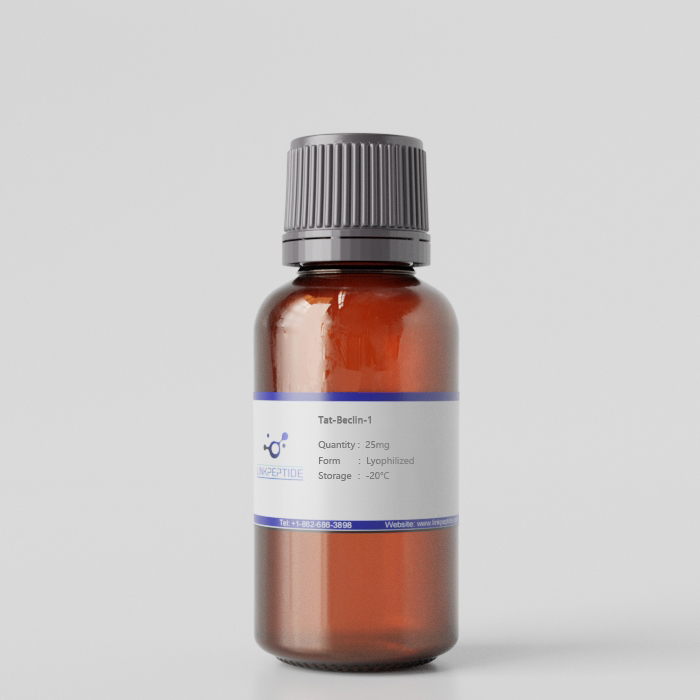
Product Name: Tat-Beclin-1
Sequence One Letter Code: YGRKKRRQRRRGGTNVFNATFEIWHDGEFGT
Sequence Three Letter Code: Tyr-Gly-Arg-Lys-Lys-Arg-Arg-Gln-Arg-Arg-Arg-Gly-Gly-Thr-Asn-Val-Phe-Asn-Ala-Thr-Phe-Glu-Ile-Trp-His-Asp-Gly-Glu-Phe-Gly-Thr-OH
Chemical Formula:C164H251N57O45
Molecular Weight: 3741.3
Purity: 95%
Form: Lyophilized
Storage Conditions: - 20 °C
Research Area: Cell Penetrating Peptides
Source / Species: human
Conjugation: Unconjugated
Code Nacres: NA.26
Application: Tat-Beclin-1 is a cell-permeable peptide composed of the HIV-1 Tat transduction domain fused to residues 267–299 of human Beclin-1, a region responsible for HIV-1 Nef interaction. Beclin-1 is a key regulator of autophagy, coordinating initiation of autophagosome formation and cellular stress responses. Fusion with the Tat sequence enables efficient intracellular delivery, allowing exogenous application to induce autophagy in cultured cells and in vivo models. Tat-Beclin-1 is widely used to study autophagic flux, lysosomal degradation pathways, and the role of autophagy in infection, neurodegeneration, and cancer. It provides a practical tool for modulating autophagy in mechanistic and therapeutic research settings.
Current Research: Tat-Beclin-1 is a synthetic, cell-permeable peptide composed of the HIV-1 Tat protein transduction domain fused to residues 267–299 of human Beclin-1. The Beclin-1 segment corresponds to a region within the coiled-coil domain that mediates interaction with HIV-1 Nef and participates in regulatory control of autophagy. By coupling this sequence to the arginine-rich Tat delivery motif, the peptide efficiently penetrates cell membranes, enabling direct pharmacologic modulation of autophagy in cultured cells and in vivo systems. Beclin-1 is a central scaffold protein in the class III phosphatidylinositol 3-kinase (PI3KC3/Vps34) complex, which governs nucleation of the autophagosomal membrane. Under basal conditions, Beclin-1 activity is tightly regulated through interactions with inhibitory partners such as Bcl-2 family proteins and other negative regulators. Tat-Beclin-1 promotes autophagy by disrupting inhibitory interactions and facilitating activation of the PI3KC3 complex. This results in increased phosphatidylinositol-3-phosphate (PI3P) production at nascent phagophore membranes, promoting autophagosome formation. Current research uses Tat-Beclin-1 as a robust experimental tool to induce autophagic flux rather than merely increasing autophagosome number. Studies typically confirm enhanced flux by monitoring LC3-II accumulation in combination with lysosomal inhibitors, assessing degradation of autophagy substrates such as p62/SQSTM1, and employing tandem fluorescent LC3 reporters to distinguish autophagosome maturation from blocked degradation. Because the peptide activates endogenous autophagy machinery without genetic manipulation, it allows rapid and reversible modulation of the pathway. In infectious disease research, Tat-Beclin-1 has been shown to enhance clearance of certain viral and bacterial pathogens by stimulating autophagic degradation pathways. Autophagy contributes to host defense by targeting intracellular pathogens and regulating inflammatory signaling. Experimental models demonstrate that pharmacologic activation with Tat-Beclin-1 can reduce pathogen burden and modulate immune responses, highlighting its relevance in studying host–pathogen interactions. In neurodegenerative disease models, Tat-Beclin-1 is used to examine the role of autophagy in clearing aggregation-prone proteins such as amyloid-β, tau, and α-synuclein. Impaired autophagic flux is a feature of several neurodegenerative disorders, and restoring autophagy may mitigate accumulation of toxic protein species. In transgenic animal models, administration of Tat-Beclin-1 has been associated with enhanced clearance of protein aggregates and improved cellular homeostasis, supporting its utility in mechanistic studies of proteostasis. Cancer research presents a more complex context, as autophagy can exert tumor-suppressive or tumor-promoting effects depending on stage and cellular environment. Tat-Beclin-1 enables controlled induction of autophagy to investigate how enhanced lysosomal degradation influences tumor cell survival, metabolic adaptation, or sensitivity to chemotherapy. Researchers frequently combine Tat-Beclin-1 treatment with metabolic stressors or cytotoxic agents to dissect context-dependent autophagy roles. Mechanistically, ongoing research examines how Tat-Beclin-1 alters interactions between Beclin-1 and its regulatory partners, including UVRAG, ATG14L, and Rubicon. Structural and biochemical analyses explore how the 267–299 region influences complex assembly and membrane recruitment. These studies contribute to broader understanding of autophagy initiation control points. Importantly, Tat-Beclin-1 provides a pharmacologic alternative to genetic overexpression or knockdown strategies, allowing temporal precision in modulating autophagy. Its cell-permeable nature supports use across diverse cell types and experimental systems without the need for transfection. Overall, Tat-Beclin-1 is a widely adopted tool for inducing autophagy through activation of Beclin-1–dependent PI3KC3 signaling. By enabling controlled enhancement of autophagic flux, it supports mechanistic investigations into lysosomal degradation, infection control, neurodegeneration, cancer biology, and therapeutic modulation of cellular stress responses.
Get a Quote
 LinkPeptide