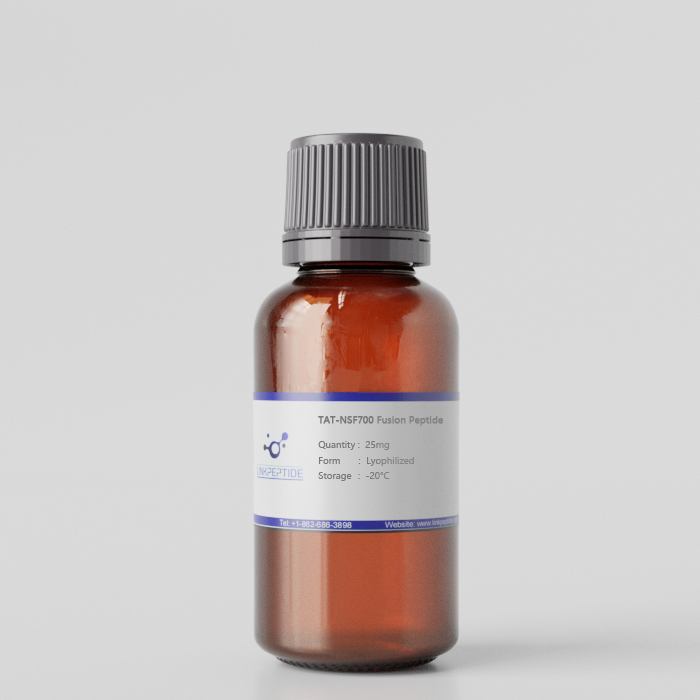
Product Name: TAT-NSF700 Fusion Peptide
Sequence One Letter Code: YGRKKRRQRRR-GGG-LLDYVPIGPRFSNLVLQALLVL
Sequence Three Letter Code: H-Tyr-Gly-Arg-Lys-Lys-Arg-Arg-Gln-Arg-Arg-Arg-Gly-Gly-Gly-Leu-Leu-Asp-Tyr-Val-Pro-Ile-Gly-Pro-Arg-Phe-Ser-Asn-Leu-Val-Leu-Gln-Ala-Leu-Leu-Val-Leu-OH
Molecular Weight: 4167.2
Purity: 95%
Form: Lyophilized
Storage Conditions: - 20 °C
Research Area: Inflammation and Immunology Research
Source / Species: HIV
Conjugation: Unconjugated
Code Nacres: NA.26
Application: TAT-NSF700 Fusion Peptide is a cell-penetrating inhibitory peptide that combines the HIV-TAT protein transduction domain with a functional sequence derived from N-ethylmaleimide-sensitive factor (NSF), a key ATPase involved in vesicle fusion and membrane trafficking. The TAT domain facilitates efficient cellular uptake, allowing the peptide to inhibit NSF-dependent exocytosis and vesicular transport processes inside cells. Studies have demonstrated that TAT-NSF700 suppresses thrombin-induced exocytosis in endothelial cells in a dose-dependent manner, highlighting its value in investigating regulated secretion pathways. This fusion peptide is widely used to study membrane trafficking, vesicle fusion, endothelial cell signaling, and vascular inflammatory responses, providing a powerful experimental tool for dissecting NSF-mediated mechanisms in cellular transport and secretion.
Current Research: Intracellular membrane trafficking and vesicle fusion are essential processes that regulate secretion, signal transduction, and membrane dynamics in eukaryotic cells. These processes rely on coordinated interactions between multiple protein complexes that control vesicle docking and fusion with target membranes. One of the key regulators of these events is N-ethylmaleimide-sensitive factor (NSF), an ATPase that participates in the disassembly and recycling of SNARE complexes required for vesicle fusion. To investigate NSF-mediated pathways in living cells, researchers often employ inhibitory peptides capable of penetrating cell membranes. Among these tools, the TAT-NSF700 fusion peptide has become a widely used reagent for studying regulated exocytosis and membrane trafficking. NSF and Its Role in Vesicle Fusion NSF is a hexameric ATPase belonging to the AAA (ATPases Associated with diverse cellular Activities) family. It plays a critical role in intracellular transport by regulating the function of SNARE proteins, which drive vesicle fusion with target membranes. During vesicle trafficking, SNARE proteins from vesicles and target membranes assemble into stable complexes that bring membranes into close proximity, allowing fusion to occur. After fusion, these SNARE complexes must be disassembled so that the individual proteins can be reused in subsequent trafficking cycles. NSF, together with accessory proteins known as α-SNAPs, uses ATP hydrolysis to separate SNARE complexes and reset the fusion machinery. Through this mechanism, NSF contributes to a wide range of cellular processes, including: Exocytosis and regulated secretion Endosomal trafficking Synaptic vesicle recycling Membrane repair and turnover Disrupting NSF activity can therefore provide valuable insights into how vesicle fusion and membrane transport are controlled. Design of the TAT-NSF700 Fusion Peptide The TAT-NSF700 peptide is engineered as a fusion construct that combines two functional components: HIV-1 TAT protein transduction domain – a well-known cell-penetrating peptide that enables efficient transport of fused molecules across cellular membranes. NSF-derived inhibitory sequence (NSF700) – a peptide fragment derived from NSF that interferes with NSF-dependent vesicle trafficking processes. The presence of the TAT domain allows the fusion peptide to enter cells rapidly and efficiently without requiring transfection reagents or specialized delivery systems. Once inside the cell, the NSF-derived segment interacts with components of the vesicle fusion machinery, thereby disrupting NSF-mediated processes. This design enables researchers to selectively inhibit NSF-dependent exocytosis and investigate the functional consequences in living cells. Inhibition of Regulated Exocytosis One of the most important applications of the TAT-NSF700 peptide is the study of regulated exocytosis, the process by which cells release signaling molecules, enzymes, or other cargo through vesicle fusion with the plasma membrane. Experimental studies have shown that TAT-NSF700 can inhibit exocytosis triggered by thrombin stimulation in endothelial cells. This inhibition occurs in a dose-dependent manner, demonstrating that the peptide effectively interferes with the vesicle fusion machinery controlled by NSF. Because endothelial cells rely on regulated secretion to release inflammatory mediators and adhesion molecules, inhibition of this process provides a valuable way to investigate mechanisms underlying vascular inflammation and endothelial activation. Applications in Membrane Trafficking Research The TAT-NSF700 fusion peptide is widely used as an experimental tool for studying cellular transport pathways. By blocking NSF-dependent processes, researchers can examine how vesicle trafficking contributes to various cellular functions. Common research applications include: Investigating SNARE-dependent membrane fusion mechanisms Studying vesicular transport pathways in endothelial and epithelial cells Examining regulated secretion of inflammatory mediators Analyzing intracellular trafficking of signaling molecules These studies help clarify how cells coordinate vesicle transport with signaling and physiological responses. Relevance to Vascular and Inflammatory Signaling Endothelial cells play a central role in maintaining vascular homeostasis and regulating inflammatory responses. When stimulated by factors such as thrombin, these cells undergo regulated exocytosis of storage granules, releasing molecules that influence coagulation, immune cell recruitment, and vascular permeability. By inhibiting NSF-dependent vesicle fusion, TAT-NSF700 allows researchers to examine how vesicular secretion contributes to endothelial signaling and vascular inflammation. This approach has helped uncover mechanisms linking membrane trafficking to inflammatory pathways. A Tool for Dissecting Vesicle Fusion Mechanisms Cell-penetrating inhibitory peptides provide a powerful strategy for manipulating intracellular processes without genetic modification. The TAT-NSF700 fusion peptide combines efficient cellular delivery with targeted inhibition of NSF-dependent vesicle fusion. Through its ability to suppress regulated exocytosis and vesicular transport, this peptide has become an important tool for studying membrane trafficking, SNARE complex regulation, and endothelial signaling pathways. By enabling controlled disruption of vesicle fusion mechanisms, TAT-NSF700 continues to support research aimed at understanding the molecular basis of cellular transport and secretion.
Get a Quote
 LinkPeptide