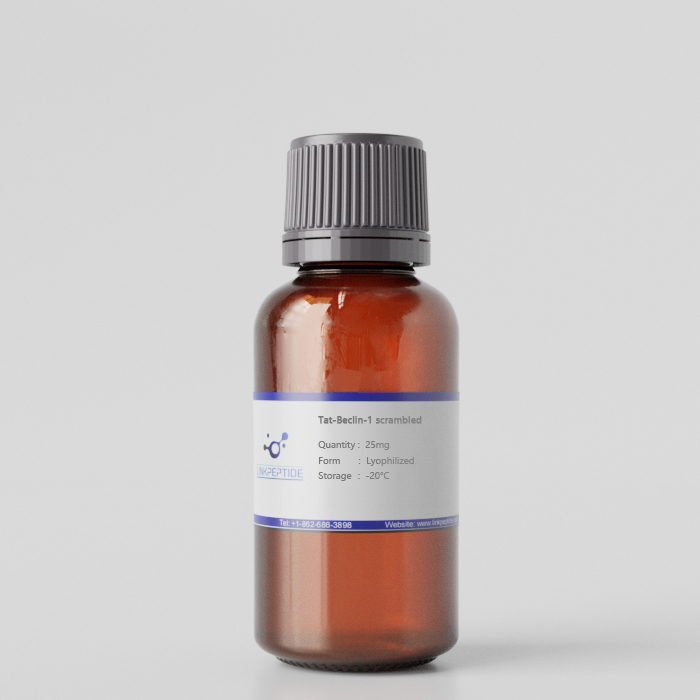
Product Name: Tat-Beclin-1 scrambled
Sequence One Letter Code: YGRKKRRQRRRGGVGNDFFINHETTGFATEW
Sequence Three Letter Code: Tyr-Gly-Arg-Lys-Lys-Arg-Arg-Gln-Arg-Arg-Arg-Gly-Gly-Val-Gly-Asn-His-Phe-Phe-Ile-Asn-His-Ser-Thr-Thr-Gly-Phe-Ala-Thr-Gln-Trp-OH
Chemical Formula:C164H251N57O45
Molecular Weight: 3741.3
Purity: 95%
Form: Lyophilized
Storage Conditions: - 20 °C
Research Area: Cancer Disease Research
Source / Species: human
Conjugation: Unconjugated
Code Nacres: NA.26
Application: Tat-Beclin-1 scrambled is a control peptide derived from the Beclin-1 region spanning residues 267–299, corresponding to the HIV-1 Nef–binding domain of human Beclin-1. Beclin-1 is a central regulator of autophagy, a lysosome-dependent degradation pathway critical for cellular adaptation and survival. In active constructs, fusion to the HIV-1 Tat sequence enables intracellular delivery and autophagy induction. The scrambled version lacks autophagy-inducing activity and does not trigger downstream signaling, making it an essential negative control for mechanistic studies. This peptide is used to validate the specificity of Tat-Beclin-1–mediated autophagy activation in cellular assays investigating intracellular signaling, stress responses, and cell fate regulation.
Current Research: Tat-Beclin-1 scrambled is a synthetic control peptide derived from the Beclin-1 region encompassing residues 267–299, which corresponds to the HIV-1 Nef–binding domain of human Beclin-1. Beclin-1 is a core component of the class III phosphatidylinositol 3-kinase (PI3KC3/Vps34) complex and serves as a central regulator of autophagy, the lysosome-dependent degradation pathway responsible for recycling cytoplasmic components, damaged organelles, and protein aggregates. Through its scaffolding and regulatory interactions, Beclin-1 coordinates autophagosome nucleation and membrane trafficking events essential for cellular stress adaptation and homeostasis. The active Tat-Beclin-1 peptide consists of the Beclin-1 267–299 sequence fused to the HIV-1 Tat cell-penetrating motif, which enables efficient intracellular delivery. This fusion peptide has been shown to induce autophagy by promoting activation of the PI3KC3 complex and enhancing autophagosome formation. Mechanistically, Tat-Beclin-1 disrupts inhibitory interactions between Beclin-1 and negative regulators, thereby facilitating autophagic flux. It increases LC3 lipidation (LC3-II formation), promotes autophagosome maturation, and enhances degradation of autophagy substrates such as p62/SQSTM1. Tat-Beclin-1 scrambled retains the Tat delivery sequence but contains a scrambled version of the Beclin-1 267–299 region. The scrambled sequence preserves amino acid composition but disrupts the native order required for functional interaction with autophagy machinery. As a result, it lacks autophagy-inducing activity and does not activate downstream signaling pathways associated with autophagic flux. This makes Tat-Beclin-1 scrambled an essential negative control in experiments designed to evaluate autophagy induction specificity. In cellular assays, Tat-Beclin-1 scrambled is used to confirm that observed increases in autophagy markers—such as LC3 puncta formation, LC3-II accumulation, autophagosome number, or enhanced lysosomal degradation—are specifically attributable to the functional Beclin-1 sequence rather than nonspecific effects of peptide delivery or Tat-mediated membrane translocation. Because Tat itself can influence membrane permeability and intracellular trafficking, inclusion of a scrambled control ensures experimental rigor when interpreting autophagy-related phenotypes. Autophagy research increasingly relies on multiparametric validation of pathway activation. Investigators typically combine fluorescence microscopy of LC3 puncta, Western blot analysis of LC3-II and p62 turnover, tandem mRFP-GFP-LC3 reporter assays to assess autophagic flux, and pharmacologic inhibition with agents such as bafilomycin A1 or chloroquine. Tat-Beclin-1 scrambled provides a critical comparator in these studies, distinguishing sequence-specific activation from background cellular responses. Beyond basic autophagy mechanisms, Tat-Beclin-1–based tools are widely used in studies of neurodegeneration, infectious disease, metabolic stress, and cancer biology. Autophagy plays complex roles in these contexts—ranging from cytoprotective clearance of toxic aggregates to modulation of inflammatory signaling and cell survival. The scrambled peptide supports mechanistic dissection of these pathways by serving as a nonfunctional control in experiments examining cell viability, stress responses, mitochondrial quality control, and apoptotic crosstalk. In models of neurodegenerative disease, for example, Tat-Beclin-1 has been investigated for its capacity to enhance clearance of pathogenic protein aggregates. Inclusion of the scrambled control peptide ensures that observed effects on aggregate reduction or neuronal survival arise from bona fide autophagy induction. Similarly, in cancer research, where autophagy may either promote tumor survival or sensitize cells to stress depending on context, the scrambled construct is essential for confirming pathway specificity. Overall, Tat-Beclin-1 scrambled is a rigorously designed negative control peptide that preserves delivery characteristics while eliminating functional autophagy-inducing activity. Its use strengthens experimental interpretation in studies of Beclin-1–dependent autophagy activation, intracellular signaling, stress adaptation, and cell fate regulation. By enabling precise validation of Tat-Beclin-1–mediated effects, this control peptide plays a critical role in maintaining mechanistic clarity in autophagy research.
Get a Quote
 LinkPeptide