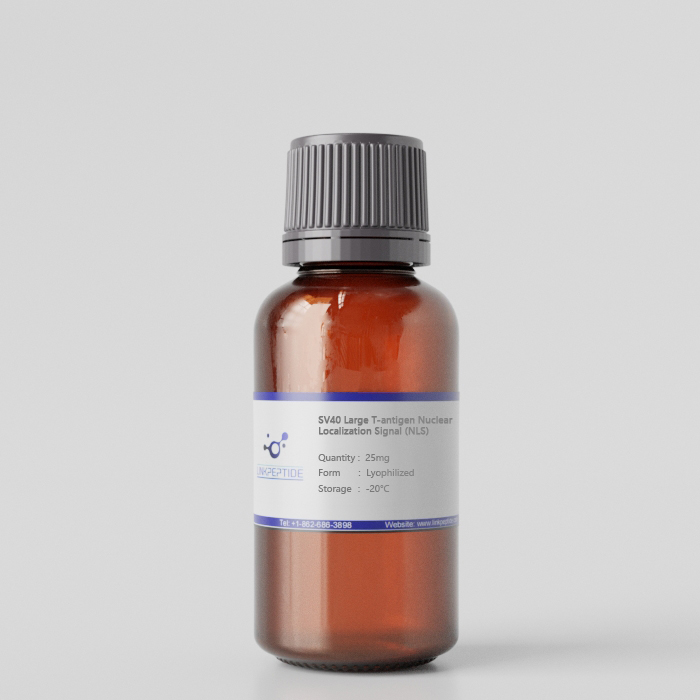
Product Name: SV40 Large T-antigen Nuclear Localization Signal (NLS)
Sequence One Letter Code: PKKKRKVEDPYC
Sequence Three Letter Code: H-Pro-Lys-Lys-Lys-Arg-Lys-Val-Glu-Asp-Pro-Tyr-Cys-OH
Chemical Formula:C66H111N19O18S1
Molecular Weight: 1490.9
Purity: 95%
Form: Lyophilized
Storage Conditions: - 20 °C
Research Area: epigenetics
Source / Species: Polyoma virus
Conjugation: Unconjugated
Code Nacres: NA.26
Application: The SV40 Large T-antigen nuclear localization signal peptide corresponds to residues 47–56 of the viral protein and contains a classical basic NLS motif. This sequence directs conjugated cargos to the nucleus by engaging the host cell nuclear import machinery. When linked to DNA, proteins, or nanoparticles, the peptide enhances nuclear accumulation and can improve gene expression efficiency. It is widely used in gene delivery research, intracellular trafficking studies, and molecular biology applications focused on nucleocytoplasmic transport and nuclear targeting mechanisms.
Current Research: The simian virus 40 (SV40) Large T-antigen nuclear localization signal (NLS) is one of the most extensively characterized nuclear targeting sequences in molecular and cell biology. Corresponding to residues 47–56 of the viral protein, this short peptide contains a classical monopartite basic NLS motif enriched in lysine and arginine residues. The sequence is sufficient to direct proteins and other conjugated cargos to the nucleus by engaging the host cell’s nuclear import machinery. Owing to its robust and well-defined activity, the SV40 NLS peptide remains a foundational tool in gene delivery research and studies of nucleocytoplasmic transport. Nuclear import of proteins larger than approximately 40–60 kDa requires active transport through the nuclear pore complex (NPC). The SV40 NLS functions by binding to importin-α, which recognizes clusters of basic residues. Importin-α subsequently associates with importin-β to form a transport complex that docks at the NPC and translocates through the pore in a Ran GTPase–dependent manner. Once inside the nucleus, dissociation of the complex releases the NLS-containing cargo into the nucleoplasm. The SV40 NLS peptide recapitulates this targeting signal, enabling exogenous molecules to exploit endogenous nuclear transport pathways. In gene delivery applications, efficient nuclear entry is a critical determinant of transgene expression, particularly in non-dividing cells where the nuclear envelope remains intact. Conjugation of the SV40 NLS peptide to plasmid DNA, DNA-binding proteins, or nonviral vectors enhances nuclear accumulation and can significantly improve gene expression efficiency. Strategies include direct covalent linkage to carrier proteins, incorporation into polymeric or lipid-based delivery systems, or fusion to DNA-binding peptides that associate with plasmid constructs. By promoting nuclear import, the NLS reduces cytoplasmic retention and degradation of genetic cargo. The SV40 NLS is also widely used in recombinant protein engineering. Fusion of the NLS to proteins of interest enables targeted localization to the nucleus, facilitating functional studies of transcription factors, DNA repair enzymes, genome-editing components, and other nuclear proteins. In fluorescence microscopy experiments, NLS-tagged reporter proteins serve as markers for nuclear compartmentalization and enable visualization of nuclear import dynamics in live cells. Beyond gene delivery, the SV40 NLS peptide supports mechanistic investigations of nucleocytoplasmic trafficking. Because its interaction with importin-α is well characterized, it is frequently employed in binding assays, structural studies, and transport kinetics analyses. Mutational modification of the basic residues allows exploration of sequence determinants required for high-affinity importin recognition. These studies have contributed significantly to understanding how nuclear localization signals are decoded and how transport specificity is regulated. In nanoparticle research, surface functionalization with the SV40 NLS enhances nuclear targeting of nanoscale carriers designed for drug or gene delivery. This approach is particularly relevant for therapies requiring nuclear access, such as genome editing with CRISPR-associated proteins or delivery of transcription-modulating agents. By combining cell-penetrating peptides with NLS motifs, researchers can design multifunctional constructs that first traverse the plasma membrane and subsequently accumulate within the nucleus. The peptide is also valuable in studying pathological alterations of nuclear transport. Dysregulation of nucleocytoplasmic trafficking has been implicated in cancer, viral infection, and neurodegenerative diseases. The SV40 NLS provides a standardized probe to assess import efficiency under conditions of cellular stress or transport inhibition. In summary, the SV40 Large T-antigen NLS peptide (residues 47–56) is a classical basic nuclear localization sequence that directs cargos to the nucleus through importin-mediated transport. Its robust and well-characterized activity makes it a versatile tool in gene delivery optimization, protein localization studies, and mechanistic analysis of nuclear import pathways. By enabling controlled nuclear targeting, the SV40 NLS continues to support advances in molecular biology and intracellular trafficking research.
Get a Quote
 LinkPeptide