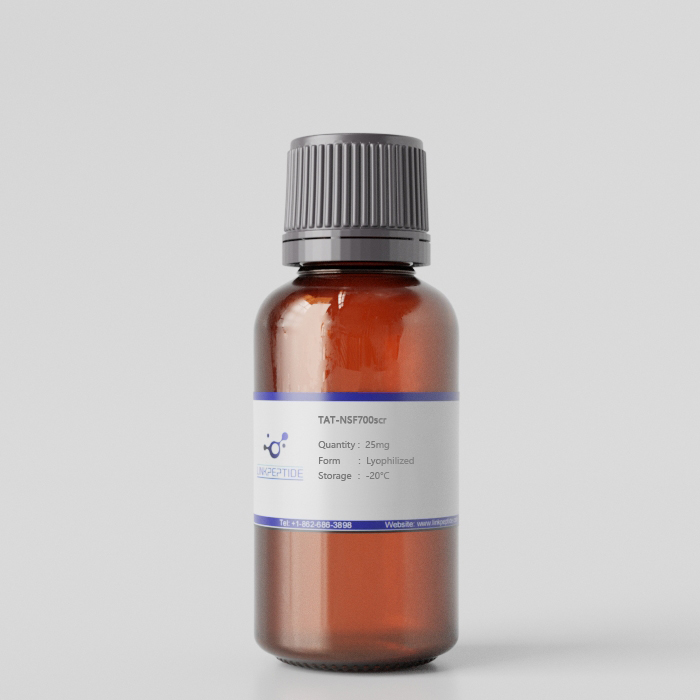
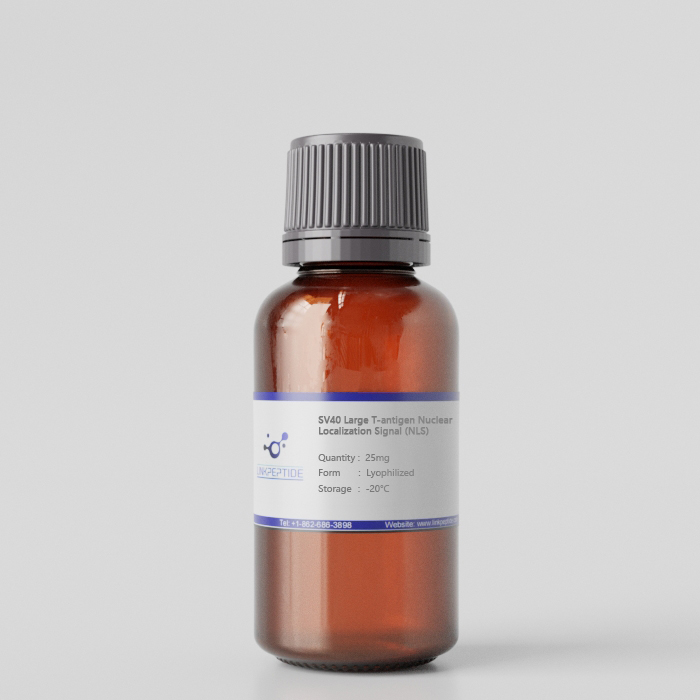
Product Name: TAT-NSF700scr
Sequence One Letter Code: YGRKKRRQRRRGGGIPPVYFSRLDLNLVVLLLAQL
Sequence Three Letter Code: H-Tyr-Gly-Arg-Lys-Lys-Arg-Arg-Gln-Arg-Arg-Arg-Gly-Gly-Gly-Ile-Pro-Pro-Val-Tyr-Phe-Ser-Arg-Leu-Asp-Leu-Asn-Leu-Val-Val-Leu-Leu-Leu-Ala-Gln-Leu-OH
Chemical Formula:C186H315N61O44
Molecular Weight: 4110.2
Purity: 95%
Form: Lyophilized
Storage Conditions: - 20 °C
Research Area: Peptide Series
Source / Species: HIV
Conjugation: Unconjugated
Code Nacres: NA.26
Application: TAT-NSF700scr is a scrambled control peptide derived from the TAT-NSF700 sequence and fused to the HIV-1 TAT cell-penetrating domain. While the active TAT-NSF700 peptide inhibits NSF-mediated SNARE complex disassembly and regulated exocytosis, the scrambled variant lacks inhibitory activity. The TAT domain enables efficient cellular uptake, allowing intracellular delivery without functional interference with NSF. This peptide is used as a negative control in studies examining vesicle trafficking, membrane fusion, and ATPase-dependent exocytotic processes, ensuring validation of sequence-specific effects.
Current Research: N-ethylmaleimide-sensitive factor (NSF) is a hexameric AAA+ ATPase that catalyzes ATP-dependent disassembly of SNARE complexes following membrane fusion. This disassembly step is essential for recycling SNARE proteins and maintaining efficient vesicle trafficking, regulated exocytosis, and membrane turnover. Experimental modulation of NSF activity has provided key insights into synaptic transmission, hormone secretion, and intracellular transport mechanisms. TAT-NSF700scr is a scrambled control peptide derived from the active TAT-NSF700 inhibitory sequence and fused to the HIV-1 TAT cell-penetrating domain. It serves as a negative control for validating sequence-specific inhibition of NSF function. The active TAT-NSF700 peptide interferes with NSF-mediated SNARE complex disassembly, thereby attenuating regulated exocytosis and vesicle recycling. Its inhibitory action is sequence-dependent, targeting functional domains within NSF required for ATPase-driven conformational cycling. In contrast, TAT-NSF700scr contains the same amino acid composition as the parent sequence but arranged in a randomized order. This scrambling disrupts structural determinants necessary for interaction with NSF, abolishing inhibitory activity while preserving general physicochemical characteristics such as length and net charge. Fusion to the HIV-1 TAT domain ensures efficient intracellular delivery. The TAT sequence, enriched in basic residues, facilitates membrane translocation through endocytic and direct uptake mechanisms. As a result, TAT-NSF700scr rapidly enters cells without the need for transfection reagents or viral vectors. Importantly, although the peptide is cell-permeable, it does not interfere with NSF ATPase activity or SNARE complex disassembly. This property makes it an essential experimental control in assays evaluating NSF-dependent processes. In vesicle trafficking studies, distinguishing between sequence-specific inhibition and nonspecific effects caused by peptide uptake, charge, or concentration is critical. TAT-NSF700scr enables direct comparison with the active inhibitory peptide under identical experimental conditions. For example, in models of regulated exocytosis—such as neurotransmitter release in neurons or insulin secretion in pancreatic β-cells—the scrambled peptide demonstrates that observed functional changes result from targeted NSF disruption rather than generalized perturbation of membrane dynamics. The control peptide is also widely used in investigations of membrane fusion. NSF, together with α-SNAP, binds assembled cis-SNARE complexes and hydrolyzes ATP to drive their dissociation. Inhibition of this process leads to accumulation of SNARE complexes and altered vesicle pool dynamics. By including TAT-NSF700scr in parallel experiments, researchers confirm that changes in SNARE complex levels or trafficking kinetics are attributable to specific blockade of NSF rather than to off-target peptide interactions. In electrophysiological and imaging-based assays, TAT-NSF700scr provides a baseline for assessing ATPase-dependent exocytotic processes. For instance, measurements of synaptic vesicle recycling using fluorescent reporters or capacitance recordings require rigorous controls to validate mechanistic interpretations. The scrambled peptide supports such validation by demonstrating that cellular uptake of a TAT-fused construct alone does not impair vesicle fusion or recycling. Beyond exocytosis, NSF participates in additional membrane-associated processes, including endosomal trafficking and receptor recycling. Studies employing TAT-NSF700scr alongside the active inhibitor allow differentiation between direct NSF inhibition and nonspecific alterations in membrane integrity or cellular stress responses. This distinction is particularly important in short-term functional assays where acute peptide treatment is used to modulate intracellular pathways. Overall, TAT-NSF700scr is a cell-permeable scrambled control peptide designed to match the composition and delivery properties of the active TAT-NSF700 inhibitor while lacking functional activity. By enabling rigorous validation of sequence-specific effects, it strengthens experimental interpretation in studies of NSF-mediated SNARE disassembly, vesicle trafficking, and ATPase-dependent membrane fusion. As such, it represents an essential control reagent in research focused on intracellular transport and regulated exocytosis mechanisms.
Get a Quote
 LinkPeptide