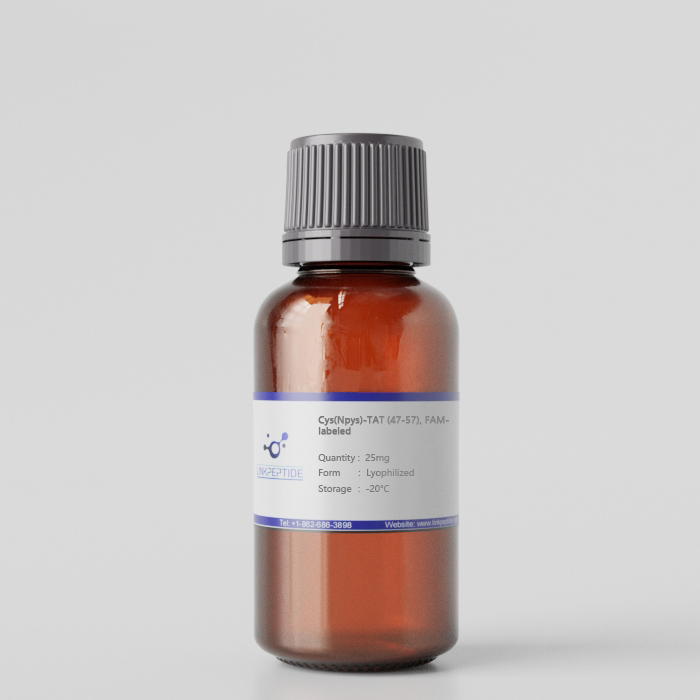
Product Name: Cys(Npys)-TAT (47-57), FAM-labeled
Sequence One Letter Code: C(Npys)YGRKKRRQRRR-K(FAM)-NH2
Sequence Three Letter Code: Cys(Npys)-Tyr-Gly-Arg-Lys-Lys-Arg-Arg-Gln-Arg-Arg-Arg-Lys(FAM)-NH2
Chemical Formula:C99H148N38O23S2
Molecular Weight: 2302.6
Purity: 95%
Form: Lyophilized
Storage Conditions: - 20 °C Protected from light
Research Area: Peptide Series
Source / Species: HIV
Conjugation: Conjugated
Conjugation Type: Fluorescent dyes
Code Nacres: NA.26
Application: Cys(Npys)-TAT (47–57), FAM-labeled, is a modified peptide derived from the protein transduction domain of the HIV-1 TAT protein and widely used for intracellular delivery applications. The sequence contains an N-terminal Cys(Npys) residue in which the 3-nitro-2-pyridinesulfenyl group activates the thiol for rapid and selective disulfide exchange with introduced thiol-containing molecules. This configuration enables efficient, site-specific conjugation of cargos while preserving the intrinsic cell-penetrating capability of the TAT domain. The peptide is labeled with carboxyfluorescein (FAM), allowing fluorescence-based monitoring of cellular uptake and intracellular distribution. Detection is achieved at excitation and emission wavelengths of 494 and 518 nm. This construct is well suited for conjugation chemistry, delivery system development, and imaging studies investigating intracellular transport mechanisms and peptide-mediated cargo translocation in cell biology research.
Current Research: Cys(Npys)-TAT (47–57), FAM-labeled, is a multifunctional peptide construct derived from the protein transduction domain (PTD) of the HIV-1 TAT protein and engineered for intracellular delivery and conjugation applications. The TAT (47–57) sequence is a well-characterized cell-penetrating peptide (CPP) known for its strong cationic character and efficient translocation across cellular membranes. This domain enables uptake into a wide range of cell types, making it a widely used vector for intracellular delivery of biomolecules. The N-terminal incorporation of Cys(Npys) introduces a strategically activated thiol functionality. In this modification, the cysteine residue is protected with a 3-nitro-2-pyridinesulfenyl (Npys) group, which facilitates rapid and selective disulfide exchange reactions with thiol-containing molecules. This chemistry enables site-specific conjugation of cargos such as peptides, proteins, small molecules, nanoparticles, or fluorescent probes. The disulfide linkage formed is stable extracellularly but can be reduced in the intracellular environment, allowing for controlled cargo release under reducing conditions. This design preserves the intrinsic cell-penetrating properties of the TAT domain while providing a versatile conjugation handle. The positively charged arginine- and lysine-rich sequence promotes interaction with negatively charged cell surface components, including glycosaminoglycans, supporting efficient cellular internalization. As a result, Cys(Npys)-TAT (47–57) serves as a modular platform for delivery system development and intracellular targeting studies. Conjugation with 5-carboxyfluorescein (FAM) enables fluorescence-based visualization and quantitative analysis of cellular uptake. FAM exhibits excitation and emission maxima at approximately 494 nm and 518 nm, respectively, making the construct compatible with standard FITC filter sets in fluorescence microscopy, flow cytometry, and plate-based detection systems. The fluorescent label allows real-time monitoring of peptide internalization, intracellular trafficking, and subcellular localization. In cell biology research, this construct is widely applied to investigate mechanisms of peptide-mediated cargo translocation. Imaging studies can assess uptake pathways, endosomal escape efficiency, and distribution within cytosolic or nuclear compartments. The presence of the Npys-activated cysteine also allows researchers to evaluate the efficiency of thiol-mediated conjugation strategies and intracellular release dynamics. Cys(Npys)-TAT (47–57), FAM-labeled, is particularly useful in studies developing delivery systems for therapeutic peptides, nucleic acids, or protein-based agents. By enabling controlled and site-specific conjugation, the peptide supports reproducible construct generation and functional analysis. The fluorescence tag enhances assay sensitivity and facilitates optimization of delivery conditions across different cell types. Overall, Cys(Npys)-TAT (47–57), FAM-labeled, provides a versatile tool for intracellular delivery and conjugation chemistry applications. Its combination of a thiol-reactive activation group, efficient cell-penetrating sequence, and fluorescence-based traceability makes it well suited for mechanistic studies of cellular uptake, cargo release, and peptide-mediated transport processes in advanced cell biology and translational research settings.
Get a Quote
 LinkPeptide