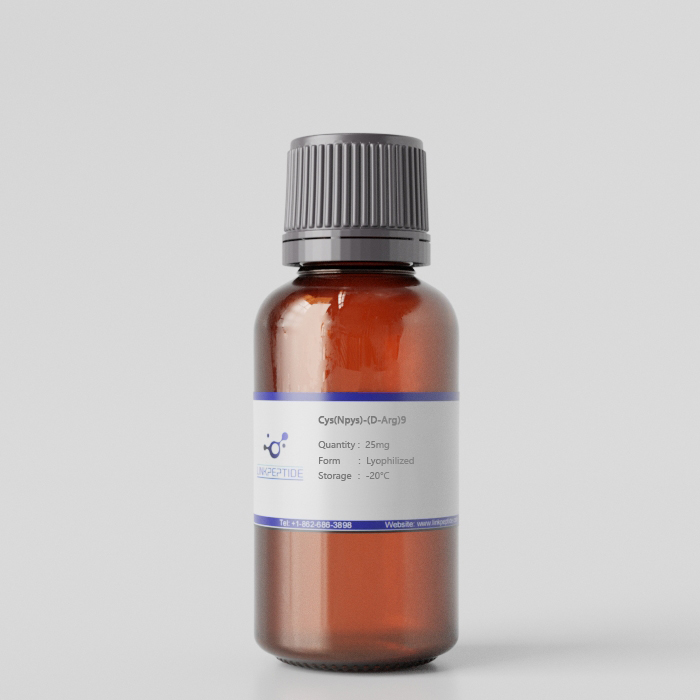
Product Name: TAT-GluR23A Fusion Peptide
Sequence One Letter Code: YGRKKRRQRRRAKEGANVAG
Sequence Three Letter Code: H-Tyr-Gly-Arg-Lys-Lys-Arg-Arg-Gln-Arg-Arg-Arg-Ala-Lys-Glu-Gly-Ala-Asn-Val-Ala-Gly-OH
Chemical Formula:C97H173N43O26
Molecular Weight: 2357.8
Purity: 95%
Form: Lyophilized
Storage Conditions: - 20 °C
Research Area: Cell Penetrating Peptides
Source / Species: HIV, Influenza
Conjugation: Unconjugated
Code Nacres: NA.26
Application: TAT-GluR23A Fusion Peptide is a cell-permeable control peptide engineered for studies of AMPA receptor trafficking and synaptic plasticity. It consists of the GluR23A sequence—an inactive mutant derived from GluR23Y residues 869–877—fused to the 11-amino-acid HIV-1 TAT protein transduction domain. Substitution of tyrosine with alanine abolishes the critical phosphorylation site required for inhibition of receptor endocytosis, rendering the peptide functionally inactive. The TAT domain enables efficient intracellular delivery into neuronal cells. TAT-GluR23A serves as an essential negative control in experiments examining AMPA receptor internalization, activity-dependent synaptic regulation, and glutamatergic signaling. It supports mechanistic studies of receptor trafficking and provides experimental validation in models of synaptic modulation and neuronal plasticity.
Current Research: Synaptic plasticity—the ability of synapses to strengthen or weaken over time—is a fundamental property of the nervous system that underlies learning, memory, and adaptive neural responses. Central to this process is the dynamic regulation of glutamate receptors, particularly α-amino-3-hydroxy-5-methyl-4-isoxazolepropionic acid (AMPA) receptors, which mediate the majority of fast excitatory neurotransmission in the brain. The trafficking of AMPA receptors between the synaptic membrane and intracellular compartments determines synaptic strength and responsiveness. To dissect the molecular mechanisms that control receptor internalization and recycling, researchers often rely on peptide-based tools that selectively modulate receptor-associated signaling pathways. One such reagent is the TAT-GluR23A fusion peptide, a cell-permeable control peptide widely used in studies of AMPA receptor trafficking and synaptic regulation. AMPA Receptor Trafficking and Synaptic Function AMPA receptors are tetrameric ion channels composed of GluA subunits that rapidly respond to glutamate release at excitatory synapses. Their number at the postsynaptic membrane is tightly regulated through processes such as endocytosis, recycling, and insertion, allowing neurons to dynamically adjust synaptic strength. Activity-dependent internalization of AMPA receptors plays a central role in long-term depression (LTD), a form of synaptic plasticity associated with reduced synaptic efficacy. One key regulatory mechanism governing AMPA receptor internalization involves phosphorylation events within the receptor’s intracellular C-terminal region. Specific tyrosine residues act as signaling nodes that control interactions with adaptor proteins and endocytic machinery. When these residues are phosphorylated, receptor internalization can be inhibited, stabilizing AMPA receptors at the synaptic membrane and influencing synaptic transmission. Because these signaling events occur within complex intracellular environments, researchers frequently employ synthetic peptides derived from receptor sequences to probe the molecular interactions that regulate receptor trafficking. Design of the TAT-GluR23A Fusion Peptide The TAT-GluR23A fusion peptide was engineered as a functionally inactive control for experiments investigating AMPA receptor trafficking mechanisms. The peptide contains two key components: GluR23A sequence – This segment corresponds to residues 869–877 of the AMPA receptor subunit region used in the GluR23Y peptide, which normally interferes with receptor endocytosis. In the GluR23A variant, the critical tyrosine residue is replaced by alanine, eliminating the phosphorylation site required for regulatory activity. As a result, the peptide cannot inhibit receptor internalization and does not alter receptor trafficking pathways. HIV-1 TAT protein transduction domain – The peptide is fused to the well-known 11-amino-acid TAT cell-penetrating sequence, derived from the HIV-1 transactivator of transcription protein. This short domain enables efficient translocation of the peptide across cellular membranes, allowing it to enter neurons and other cell types without requiring additional delivery systems. The fusion of these two elements produces a peptide that is structurally similar to active receptor-modulating peptides but lacks functional activity, making it ideal for use as a negative control in mechanistic studies. Importance of Negative Controls in Synaptic Research In experiments examining synaptic signaling pathways, proper controls are essential to distinguish genuine biological effects from nonspecific experimental artifacts. Active peptides such as GluR23Y can inhibit AMPA receptor endocytosis by interfering with phosphorylation-dependent signaling. However, without an appropriate control peptide, it would be difficult to determine whether observed effects result from the specific receptor sequence or from unrelated properties such as peptide delivery, stability, or cellular stress responses. TAT-GluR23A addresses this need by providing a structurally matched but inactive comparator. Because the peptide retains the same delivery system and similar sequence composition while lacking the critical phosphorylation site, researchers can confidently attribute experimental outcomes to the functional tyrosine-dependent mechanism present in active peptides. Applications in Neuroscience and Synaptic Plasticity Studies The TAT-GluR23A peptide is widely used in neuronal culture experiments, brain slice studies, and in vivo models investigating glutamatergic signaling. One common application is the study of activity-dependent AMPA receptor internalization, where researchers compare the effects of active inhibitory peptides with those observed using the inactive control. In electrophysiological experiments, for example, scientists may apply a TAT-fused active peptide to block receptor endocytosis and observe changes in synaptic strength or plasticity. Parallel experiments using TAT-GluR23A confirm that any observed synaptic alterations are due to the specific inhibitory mechanism rather than the presence of a cell-permeable peptide itself. The peptide is also useful in studies of long-term depression, synaptic scaling, and neuronal signaling pathways that regulate receptor trafficking. By serving as a baseline control, it helps validate experimental conclusions regarding the molecular determinants of AMPA receptor regulation. Advancing Mechanistic Understanding of Synaptic Regulation Research into synaptic plasticity has revealed that precise control of receptor trafficking is fundamental to neural circuit function and cognitive processes. Disruptions in these regulatory pathways are implicated in numerous neurological conditions, including neurodegenerative diseases, psychiatric disorders, and cognitive impairment. Tools such as TAT-GluR23A fusion peptide provide researchers with reliable experimental controls that support accurate interpretation of receptor trafficking studies. By enabling clear differentiation between functional and nonfunctional peptide effects, this reagent contributes to rigorous investigation of the molecular mechanisms that govern glutamatergic signaling. As neuroscience continues to explore the intricate processes underlying synaptic modulation and neuronal communication, well-designed peptide tools remain invaluable for unraveling the dynamic regulation of neurotransmitter receptors and the cellular basis of learning and memory.
Get a Quote
 LinkPeptide