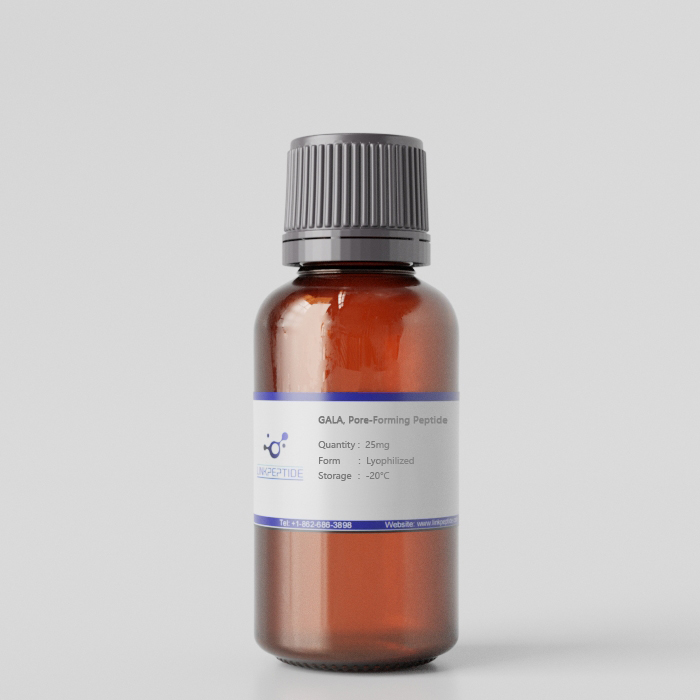
Product Name: GALA, Pore-Forming Peptide
Sequence One Letter Code: WEAALAEALAEALAEHLAEALAEALEALAA
Sequence Three Letter Code: H-Trp-Glu-Ala-Ala-Leu-Ala-Glu-Ala-Leu-Ala-Glu-Ala-Leu-Ala-Glu-His-Leu-Ala-Glu-Ala-Leu-Ala-Glu-Ala-Leu-Glu-Ala-Leu-Ala-Ala-OH
Chemical Formula:C136H215N33O45
Molecular Weight: 3032.7
Purity: 95%
Form: Lyophilized
Storage Conditions: - 20 °C
Research Area: Antiviral
Source / Species: Synthetic construct
Conjugation: Unconjugated
Code Nacres: NA.26
Application: GALA is a 30-amino acid synthetic peptide composed of repeating glutamic acid–alanine–leucine–alanine (EALA) motifs, specifically engineered to investigate membrane fusion and pore formation. Under acidic conditions, GALA adopts an amphipathic α-helical conformation that enables insertion into lipid bilayers and formation of ion-conducting pores. Its pH-dependent structural transition makes it a powerful model for studying how peptide charge, hydrophobicity, and helix stability influence membrane binding and disruption. GALA has been extensively used to mimic viral fusion peptides and to explore mechanisms of endosomal escape in drug delivery systems. It provides a controlled system for analyzing peptide-induced membrane destabilization, lipid mixing, and pore formation kinetics. This peptide supports research in membrane biophysics, intracellular delivery technologies, toxin mechanisms, and the development of pH-responsive therapeutic carriers.
Current Research: GALA is a 30-amino acid synthetic peptide composed of repeating glutamic acid–alanine–leucine–alanine (EALA) motifs, rationally designed to investigate membrane fusion, pore formation, and pH-dependent peptide–lipid interactions. Its modular sequence encodes a conditional amphipathic α-helical structure that forms under acidic conditions, enabling insertion into lipid bilayers and disruption of membrane integrity. Because its behavior is predictable and tunable, GALA has become a widely used model system in membrane biophysics and intracellular delivery research. The defining feature of GALA is its pH-dependent conformational transition. At neutral pH, the glutamic acid residues are deprotonated and negatively charged, generating electrostatic repulsion that disfavors helix formation. Under acidic conditions—such as those encountered in endosomes—the glutamate side chains become protonated, reducing charge repulsion and promoting α-helical folding. In this helical state, hydrophobic leucine residues align along one face of the helix, while remaining residues contribute to amphipathicity. This structural transition enables membrane binding and insertion. Upon insertion into lipid bilayers, GALA can induce membrane destabilization and form ion-conducting pores. Electrophysiological and dye-leakage assays have demonstrated that GALA generates transient or stable pores in model membranes under acidic conditions. The peptide’s controlled activation by pH provides a powerful system for dissecting how helix stability, hydrophobic moment, and charge distribution influence pore formation kinetics and membrane permeability. GALA has been extensively used to mimic viral fusion peptides. Many enveloped viruses exploit acidic endosomal environments to trigger conformational changes in fusion proteins, facilitating membrane fusion and genome release. By modeling a pH-triggered helical insertion mechanism, GALA serves as a simplified analogue for studying fusion intermediates and lipid mixing events. Liposome fusion assays and fluorescence resonance energy transfer (FRET)-based lipid mixing experiments frequently employ GALA to quantify membrane merger and destabilization. The peptide is also central to research on endosomal escape mechanisms in drug delivery systems. A major challenge in nonviral intracellular delivery is the sequestration of therapeutic cargos within endosomes. GALA’s ability to disrupt membranes selectively under acidic conditions has been harnessed to enhance cytosolic release of nucleic acids, proteins, and nanoparticles. Conjugation of GALA to liposomes, polymeric carriers, or peptide-based transport systems improves intracellular bioavailability by facilitating pH-triggered membrane permeabilization. In membrane biophysics, GALA provides a controlled framework for analyzing peptide-induced lipid reorganization. Studies using circular dichroism spectroscopy confirm pH-dependent helix formation, while fluorescence and calorimetric techniques measure bilayer perturbation. By systematically modifying sequence composition—altering glutamate density or substituting hydrophobic residues—researchers can investigate how specific physicochemical parameters influence membrane interaction strength and pore stability. The peptide also contributes to understanding toxin-like membrane activity. Because GALA forms pores without requiring complex receptor engagement, it offers insight into general principles of amphipathic helix–mediated membrane disruption. These principles inform broader research into antimicrobial peptides, viral entry mechanisms, and engineered membrane-active therapeutics. From a translational perspective, GALA’s predictable pH responsiveness supports development of targeted delivery platforms. Its activation within acidic tumor microenvironments or intracellular compartments provides a strategy for selective therapeutic release. Incorporation into multifunctional carriers allows spatial and temporal control over membrane disruption. In summary, GALA is a synthetic, pH-responsive amphipathic peptide engineered to model membrane fusion and pore formation. Its acid-triggered α-helical transition and membrane insertion properties make it an invaluable tool for studying lipid mixing, bilayer destabilization, and endosomal escape. By offering a controllable system for probing peptide–membrane interactions, GALA advances research in membrane biophysics, intracellular delivery technologies, and the design of pH-sensitive therapeutic strategies.
Get a Quote
 LinkPeptide