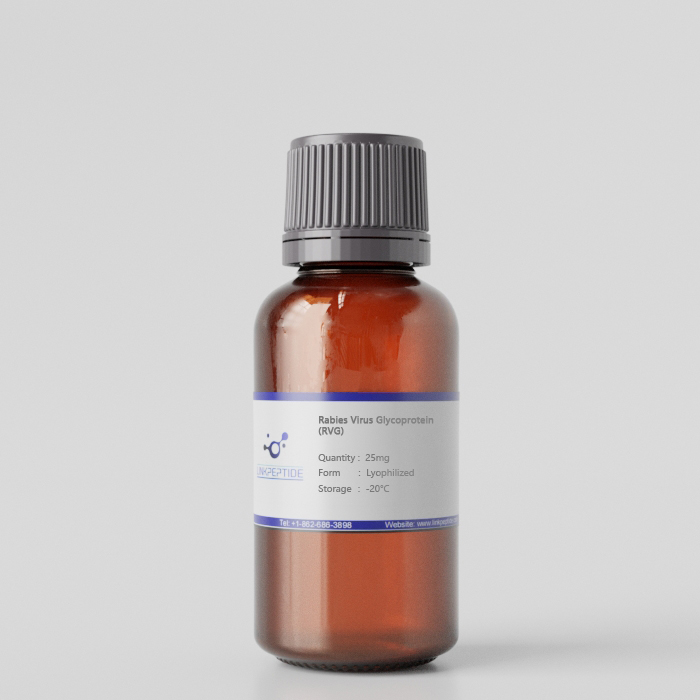
Product Name: Rabies Virus Glycoprotein (RVG)
Sequence One Letter Code: YTIWMPENPRPGTPCDIFTNSRGKRASNG
Sequence Three Letter Code: H-Tyr-Thr-Ile-Trp-Met-Pro-Glu-Asn-Pro-Arg-Pro-Gly-Thr-Pro-Cys-Asp-Ile-Phe-Thr-Asn-Ser-Arg-Gly-Lys-Arg-Ala-Ser-Asn-Gly-OH
Chemical Formula:C141H217N43O43S2
Molecular Weight: 3266.8
Purity: 95%
Form: Lyophilized
Storage Conditions: - 20 °C
Research Area: Neurological Disease Research
Source / Species: Rabies virus
Conjugation: Unconjugated
Code Nacres: NA.26
Application: Rabies Virus Glycoprotein (RVG) peptide is a 29-amino acid fragment derived from the rabies virus surface glycoprotein. RVG binds specifically to nicotinic acetylcholine receptors expressed on neuronal cells, a mechanism utilized by the virus to access the central nervous system. This targeting property has been adapted for research applications involving brain delivery. RVG is commonly conjugated to siRNA, nanoparticles, or other cargos to facilitate receptor-mediated transport across the blood–brain barrier. The peptide is widely used in neuroscience and drug delivery research to study neuronal targeting, central nervous system uptake, and noninvasive delivery strategies for therapeutic agents.
Current Research: Rabies virus glycoprotein (RVG) is a surface-exposed viral protein responsible for host cell recognition and neurotropism. A defined 29-amino acid fragment derived from RVG retains the receptor-binding capacity of the full-length glycoprotein and has become an established targeting ligand in neuroscience and central nervous system (CNS) drug delivery research. This RVG peptide binds selectively to nicotinic acetylcholine receptors (nAChRs), which are highly expressed on neuronal cells and present at the neuromuscular junction and within the CNS. The rabies virus exploits this interaction to enter peripheral neurons and undergo retrograde transport into the brain. The receptor specificity of RVG has been repurposed as a molecular targeting strategy to overcome one of the most significant challenges in neurotherapeutics: delivery across the blood–brain barrier (BBB). The BBB is a highly selective endothelial interface that restricts passage of most macromolecules and nanoparticles. By conjugating therapeutic cargos to RVG, researchers can harness receptor-mediated transport pathways to enhance neuronal uptake and CNS accumulation following systemic administration. Mechanistically, RVG-mediated targeting relies on binding to neuronal nAChRs, triggering endocytosis and facilitating internalization of the peptide–cargo complex. When linked to small interfering RNA (siRNA), for example, RVG enables selective delivery to neuronal populations, supporting gene silencing within the brain without direct intracranial injection. This approach has been used extensively in proof-of-concept studies evaluating RNA interference–based modulation of viral infections, neurodegenerative disease targets, and inflammatory mediators in the CNS. RVG is also widely incorporated into nanoparticle and liposome-based delivery platforms. Surface functionalization of polymeric nanoparticles, lipid nanoparticles, or exosomes with RVG enhances their tropism toward neuronal tissues. Such systems are evaluated for transport efficiency, biodistribution, and target gene knockdown in vivo. By comparing RVG-modified carriers with non-targeted controls, investigators can quantify receptor-dependent uptake and assess improvements in therapeutic index. The modular nature of RVG conjugation allows flexibility in cargo design, including nucleic acids, peptides, proteins, and small molecules. In addition to BBB translocation studies, RVG peptide is employed in models investigating neuronal specificity and cellular internalization pathways. Fluorescently labeled RVG conjugates facilitate imaging-based assessment of receptor binding, uptake kinetics, and intracellular trafficking in neuronal cultures and brain tissue. These experiments contribute to understanding how ligand density, linker chemistry, and nanoparticle size influence targeting efficiency. Such structure–function analyses are critical for optimizing delivery vectors intended for clinical translation. RVG-based delivery strategies are particularly relevant in research on neurodegenerative disorders such as Alzheimer’s disease, Parkinson’s disease, and amyotrophic lateral sclerosis, where therapeutic targets reside within the CNS. Gene modulation, RNA interference, and protein replacement strategies all face substantial delivery barriers. RVG-functionalized systems provide a noninvasive alternative to intracerebral administration, supporting systemic dosing paradigms while maintaining neuronal specificity. Safety and immunogenicity considerations are also investigated using the RVG peptide. Because it represents a defined fragment rather than the full viral glycoprotein, it reduces the complexity associated with viral vectors while preserving targeting functionality. Researchers evaluate dose-dependent toxicity, off-target distribution, and immune activation to refine delivery constructs for translational applications. Overall, the 29-amino acid RVG peptide represents a compact and versatile neuron-targeting ligand derived from a naturally neurotropic virus. By exploiting its affinity for nicotinic acetylcholine receptors, investigators have developed receptor-mediated delivery platforms capable of enhancing CNS uptake of diverse therapeutic cargos. As neuroscience research continues to prioritize noninvasive and targeted brain delivery approaches, RVG remains a foundational tool for studying neuronal targeting, blood–brain barrier transport mechanisms, and next-generation neurotherapeutic strategies.
Get a Quote
 LinkPeptide